
Why Contract Disputes Matter to Your Business and Peace of Mind
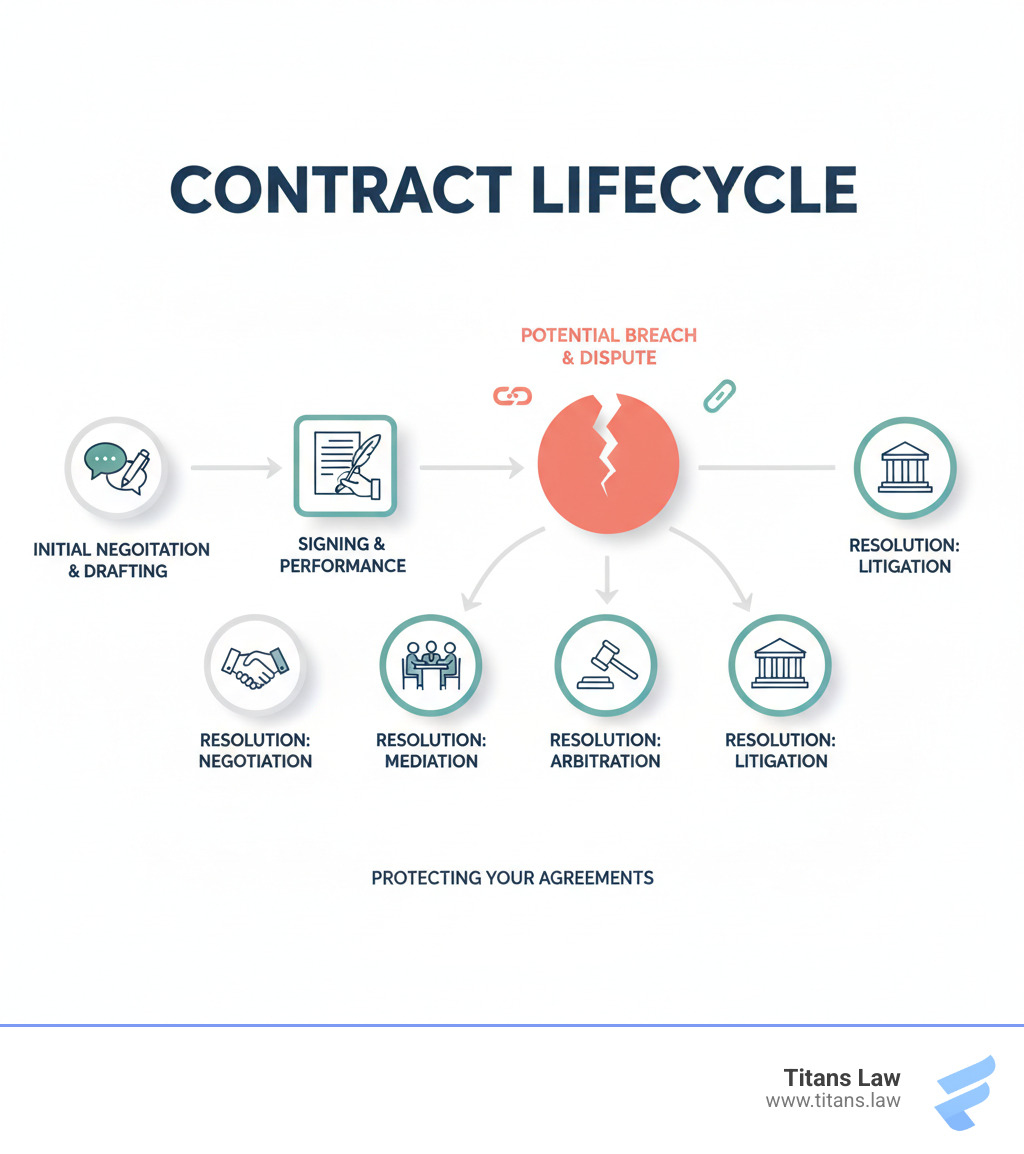
A contract dispute attorney is a legal professional who represents individuals and businesses when disagreements arise over a contract’s terms, performance, or enforcement. They help clients resolve disputes through negotiation, mediation, arbitration, or litigation.
When you need a contract dispute attorney:
- You’ve suffered financial loss due to someone failing to honor a contract
- The other party refuses to perform services or deliver goods as agreed
- There’s disagreement over payment terms, deadlines, or contract interpretation
- You’ve been served with a breach of contract lawsuit
- Negotiations have failed and you need legal representation
- The contract involves significant money or complex business relationships
Contract disputes cost businesses billions annually, according to the U.S. Chamber of Commerce Institute for Legal Reform. These conflicts can derail business plans, strain professional relationships, and create financial uncertainty.
Whether you’re facing a partnership disagreement, a vendor who won’t deliver, or a real estate transaction gone wrong, you don’t have to steer this alone. The good news is that most disputes can be resolved without lengthy court battles with the right legal guidance. An experienced contract dispute attorney can evaluate your situation, explain your options in plain language, and develop a strategy that aligns with your goals—whether that means negotiating a settlement or taking your case to court.
The Anatomy of a Contract Dispute
A contract dispute is a disagreement over what a contract says, what it means, or whether someone followed through on their promises. These conflicts can threaten your business, damage relationships, and cause significant stress. At Titans Law, we understand that these aren’t just legal headaches; they’re business-critical problems. Understanding the basics can help you protect yourself.
What Makes a Contract Legally Binding?
For an agreement to be a legally enforceable contract, it must contain several key elements. There must be a clear offer and a direct acceptance of that same offer (the “mirror image” rule). Both parties must exchange something of value, known as consideration—this can be money, goods, services, or a promise. The parties must have mutual assent, or a “meeting of the minds,” on the essential terms. They also need the legal capacity to enter the contract (being of sound mind and legal age) and the contract’s purpose must be lawful. If any of these elements are missing, the contract may be unenforceable.
Common Types of Contract Disputes
Disputes can arise in any industry. Some of the most common types include:
- Business-to-business disagreements: These involve issues like supplier agreements gone wrong, partnership disputes, or unfair competition claims. Late deliveries, quality issues, and nonpayment are frequent triggers.
- Employment contract disputes: These often concern wrongful termination, unpaid commissions, or contentious non-compete agreements.
- Real estate transactions: Conflicts can arise from purchase agreements, lease disputes, or property management contracts.
- Construction project issues: Often complex and involving multiple parties, these disputes stem from project delays, cost overruns, quality concerns, or payment disagreements.
- Vendor and supplier conflicts: These typically arise when one party fails to deliver goods or services as promised, or when payment is not made on time.
Are Oral and Implied Contracts Enforceable?
Yes, contracts don’t always need to be in writing to be legally binding. Verbal agreements can be enforceable if you can prove the terms, often through witness testimony, emails, or patterns of behavior. Implied contracts are formed through actions and conduct rather than words, such as a long-standing, consistent payment practice.
However, a legal principle called the Statute of Frauds requires certain contracts to be in writing. This typically includes contracts for the sale of land, agreements that cannot be completed within one year, and contracts for the sale of goods over a certain value (often $500). While there are exceptions, relying on an oral agreement in these situations is risky. If you’re in a dispute over a non-written contract, a skilled contract dispute attorney can help you gather evidence and assess your options.
Identifying a Breach and Understanding Your Options
When one party doesn’t hold up their end of a deal, it’s known as a breach of contract. Understanding what constitutes a breach, what defenses you might face, and what your options are is the first step toward resolution.
What Is a Breach of Contract?
A breach occurs when a party fails to perform their contractual obligations. Not all breaches are equal, and the type of breach determines your legal options.
- A material breach is a serious failure that defeats the essential purpose of the contract. For example, if a web developer delivers a non-functional website. This type of breach allows the non-breaching party to sue for damages and may excuse them from their own obligations.
- A minor breach (or partial breach) is less severe and doesn’t undermine the entire agreement. For instance, a delivery that is one day late. You can sue for any damages the delay caused, but you generally cannot cancel the contract.
- An anticipatory breach happens when one party makes it clear they will not perform their duties before the performance is due. This allows you to take legal action immediately rather than waiting for the failure to occur.
Evidence Needed to Prove a Breach of Contract
To win a breach of contract claim, you must prove a valid contract existed, you fulfilled your part, the other party failed to fulfill theirs, and you suffered damages as a result. Key evidence includes:
- The written contract: The foundational document outlining the agreement.
- Emails and correspondence: Communications that clarify terms, expectations, and what went wrong.
- Invoices and payment records: Proof of financial obligations and transactions.
- Witness statements: Testimony from individuals who have knowledge of the agreement or the breach.
- Performance records: Documents like delivery receipts or project reports showing you met your obligations.
- Expert opinions: Testimony from specialists may be needed for complex issues, like calculating lost profits or assessing construction defects.
Potential Remedies for a Breach
The law provides several remedies to make the injured party whole.
- Compensatory damages: Money awarded to compensate for your actual losses, including direct costs and foreseeable consequential damages (like lost profits).
- Liquidated damages: A pre-agreed amount of money specified in the contract to be paid in the event of a breach.
- Specific performance: A court order requiring the breaching party to perform their contractual obligation. This is reserved for unique cases, such as real estate or one-of-a-kind goods.
- Rescission and Restitution: Rescission cancels the contract, and restitution requires the breaching party to return any benefit they received from you.
Common Defenses Against a Breach Claim
A party accused of a breach may raise several defenses, including:
- Impossibility of performance: An unforeseen event made performance genuinely impossible.
- Mutual mistake: Both parties were mistaken about a critical fact when the contract was made.
- Fraud or duress: One party was tricked or forced into the agreement.
- Unconscionable terms: The contract is so one-sided and unfair that it’s unenforceable.
- Statute of limitations: The deadline for filing a lawsuit has passed.
- Ambiguous terms: The contract language is unclear, meaning there was no “meeting of the minds.”
An experienced contract dispute attorney from Titans Law can help you steer these complexities, whether you are pursuing a claim or defending against one.
Why You Need an Expert Contract Dispute Attorney

Contract disputes are stressful, with significant financial and professional stakes. The uncertainty and disruption can be overwhelming. This is when a seasoned contract dispute attorney becomes your most valuable asset. At Titans Law, we act as your guide, strategist, and advocate, focusing on your real-world concerns and goals.
When Should You Consider Hiring a Contract Dispute Attorney?
While some minor issues can be resolved directly, certain red flags indicate it’s time for professional legal help:
- Significant financial stakes are involved: If the dispute could cost your business dearly or threaten your financial security, the risk of going it alone is too high.
- The contract language is complex: If you need a law degree to understand your agreement, you need an expert who can interpret the legalese and identify risks.
- You’re facing bad faith negotiations: When the other party is being deceptive, uncooperative, or ignoring you, legal intervention forces them to take the matter seriously.
- A lawsuit is imminent or has been filed: The legal system has complex rules and deadlines. Navigating it without an attorney is a serious risk to your case.
- Before signing a high-value contract: Proactive legal review is the best defense. An attorney can spot ambiguous clauses and unfavorable terms before they become a problem.
How a Skilled Contract Dispute Attorney Can Help
A contract dispute attorney does more than just argue in court. We manage your case from start to finish to achieve your desired outcome.
- Contract Review and Analysis: We dissect your contract to clarify obligations, identify key provisions, and determine the strengths and weaknesses of your position.
- Strategic Legal Advice: We provide an honest assessment of your case and explain your options in plain English. We then develop a strategy aligned with your goals, whether that’s recovering money or preserving a business relationship.
- Evidence Gathering: We help you collect and organize the crucial documentation needed to build a compelling case, including emails, invoices, and witness statements.
- Negotiation with the Opposing Party: As experienced negotiators, we can often achieve a favorable settlement without going to court, saving you time, money, and stress.
- Drafting Legal Documents: We prepare precise, professional demand letters, complaints, and other legal filings required to advance your case.
- Representation in Dispute Resolution: We advocate for you in mediation, arbitration, or litigation, handling all procedural complexities and fighting for the best possible outcome.
At Titans Law, our goal is to protect your rights and assets while minimizing disruption to your life and business. We treat your dispute as if it were our own.
Navigating the Legal Process: Timelines, Costs, and Methods
When you’re caught in a contract dispute, understanding the legal process can feel overwhelming. The good news? You have several paths to resolution, and not all of them involve a courtroom showdown. Let’s walk through your options, talk about timing (including those pesky deadlines), and get real about what this might cost you.
Negotiation, Mediation, and Litigation: What to Expect
Most contract disputes are resolved before ever reaching a trial. There are several methods of resolution, each with distinct advantages.
Negotiation is the most direct and informal approach, involving discussions between the parties (or their attorneys) to reach a private settlement. It is the fastest, least expensive option and offers the best chance of preserving the business relationship.
Mediation involves a neutral third-party mediator who facilitates conversation and helps both sides find common ground. The process is confidential and non-binding unless a settlement is reached. Many contracts require mediation before a lawsuit can be filed because it is highly effective.
Arbitration is a more formal process where a neutral arbitrator acts like a private judge, hearing evidence and making a binding decision. It is generally faster and more private than litigation, and its use is often mandated by a clause in the contract.
Litigation is the traditional courtroom process, where a judge or jury decides the outcome. It is the most formal, expensive, and time-consuming option. Proceedings are public, and the adversarial nature can permanently damage relationships. However, it is sometimes necessary when other methods fail.
| Feature | Negotiation | Mediation | Litigation |
|---|---|---|---|
| Description | Direct discussions between parties or their lawyers to reach settlement | Neutral mediator facilitates communication to help find compromise | Judge or jury decides the case in public court |
| Control | You retain full control over outcome | You control outcome with mediator’s guidance | Judge/jury decides; you lose control |
| Formality | Informal | Semi-formal, structured discussions | Highly formal with strict legal rules |
| Cost | Generally lowest (lawyer fees only) | Moderate (mediator and lawyer fees) | Highest (court fees, extensive lawyer time, expert costs) |
| Time | Quickest if successful | Relatively quick (weeks to months) | Longest (months to years) |
| Binding? | Only if settlement agreement signed | Only if settlement agreement signed | Binding court judgment |
| Privacy | Private | Private and confidential | Public record |
| Relationships | Preserves relationships best | Helps preserve or repair relationships | Often damages relationships |
What Is the Statute of Limitations for a Contract Dispute?
The statute of limitations is a critical deadline for filing a lawsuit. If you miss it, you lose your right to sue, regardless of the merits of your case. These timeframes vary significantly by state and by the type of contract. For example, the limit for a written contract is often different from that for an oral one. Most states set deadlines for written contracts somewhere between three to six years from the date of the breach.
Calculating when the clock starts ticking can be complex, especially with ongoing or anticipatory breaches. It is crucial to consult a contract dispute attorney as soon as you suspect a problem to ensure your rights are protected before they expire. For more detailed insights, visit our litigation services page.
Understanding the Potential Costs
Legal fees should be viewed as an investment to protect your assets and enforce your rights. We believe in transparency regarding costs.
- Attorney fees can be structured as hourly rates, a flat fee for a specific service, or on a contingency basis, where we are paid a percentage of the recovery only if you win.
- Other costs can include court filing fees, fees for expert witnesses, findy costs (like depositions), and mediator or arbitrator fees.
During your initial consultation, we will discuss all potential costs and fee structures openly so you can make an informed decision.
Frequently Asked Questions about Contract Disputes
We know you have questions—we hear them every day from clients just like you. Here are some of the most common inquiries we receive about contract disputes, answered in plain language.
Can I recover lost profits from a breach of business contract?
Yes, it is often possible to recover lost profits, but you must prove three things. First, the losses must have been a foreseeable result of the breach at the time the contract was signed. Second, you must show direct causation—that the breach itself is the reason you lost profits. Finally, you must prove the amount of lost profits with reasonable certainty, which typically requires detailed financial records, historical data, and often the testimony of a financial expert. Speculative claims are not enough, but with solid evidence, recovery is achievable.
What happens if the contract is silent on remedies for a breach?
If your contract doesn’t specify remedies for a breach, you are not out of luck. Courts apply default legal remedies to make the injured party whole. The most common is compensatory damages, where the court orders the breaching party to pay for your actual financial losses. Another option is restitution, which forces the breaching party to return any money or benefit they unfairly received from you. In rare cases involving unique items (like real estate), a court may order specific performance, compelling the party to fulfill their promise. Additionally, nearly every contract includes an implied covenant of good faith and fair dealing, meaning both parties must act honestly. A breach of this covenant can also lead to a remedy.
Where can I find resources for a smaller dispute?
Not every dispute requires a full-scale lawsuit. For smaller matters, several excellent resources are available:
- Small claims court is designed for disputes under a certain monetary threshold (which varies by state). The process is simpler and less expensive, and many people represent themselves.
- Your local bar association often provides attorney referral services, sometimes with free or low-cost initial consultations.
- Law school pro bono programs offer free legal help from law students supervised by professors. You can find a Directory of law school pro bono programs online.
- Legal aid organizations like those found through the Legal Services Corporation (LSC) or LawHelp.org provide free or low-cost assistance to eligible individuals.
- Online resources like Law Help Interactive and the American Bar Association free legal answers site can also provide guidance and help with forms.
Even for smaller disputes, understanding your rights is crucial. At Titans Law, we can help you determine the most cost-effective path forward for your situation.
Protect Your Business and Secure Your Agreements

Contracts are the foundation of business relationships and personal agreements. They are the promises we rely on. But with billions of dollars flowing through contractual agreements in the U.S. economy, disputes are an inevitable part of the landscape.
The good news? You don’t have to face these challenges alone.
At Titans Law, we understand that behind every dispute is a person or business owner worried about their finances, reputation, and future. We believe the best legal battle is the one you never have to fight. Having a skilled contract dispute attorney review your agreements before you sign can prevent years of future headaches by ensuring your contracts are clear, enforceable, and protective of your interests.
When disputes do occur, you need an advocate who knows how to negotiate effectively and is prepared to go to court if necessary. Our team has deep experience in negotiation, mediation, arbitration, and litigation, allowing us to tailor a strategy to your specific needs.
Whether you’re dealing with a partnership disagreement, a non-performing vendor, or a complex business-to-business conflict, we are here to guide you. We will explain your options in plain English and work tirelessly to achieve the best possible result. Your peace of mind and your business’s future are our priority.
Contact our expert attorneys for a consultation today, and let’s turn your contract concerns into confidence.