
Why Contract Disputes Demand Strategic Action in Florida
Contract disputes in Florida can determine the trajectory of your business. When a contract breaks down, you need decisive action, not delays or passive legal counsel.
If you’re facing a contract dispute in Florida, here’s what you need to know:
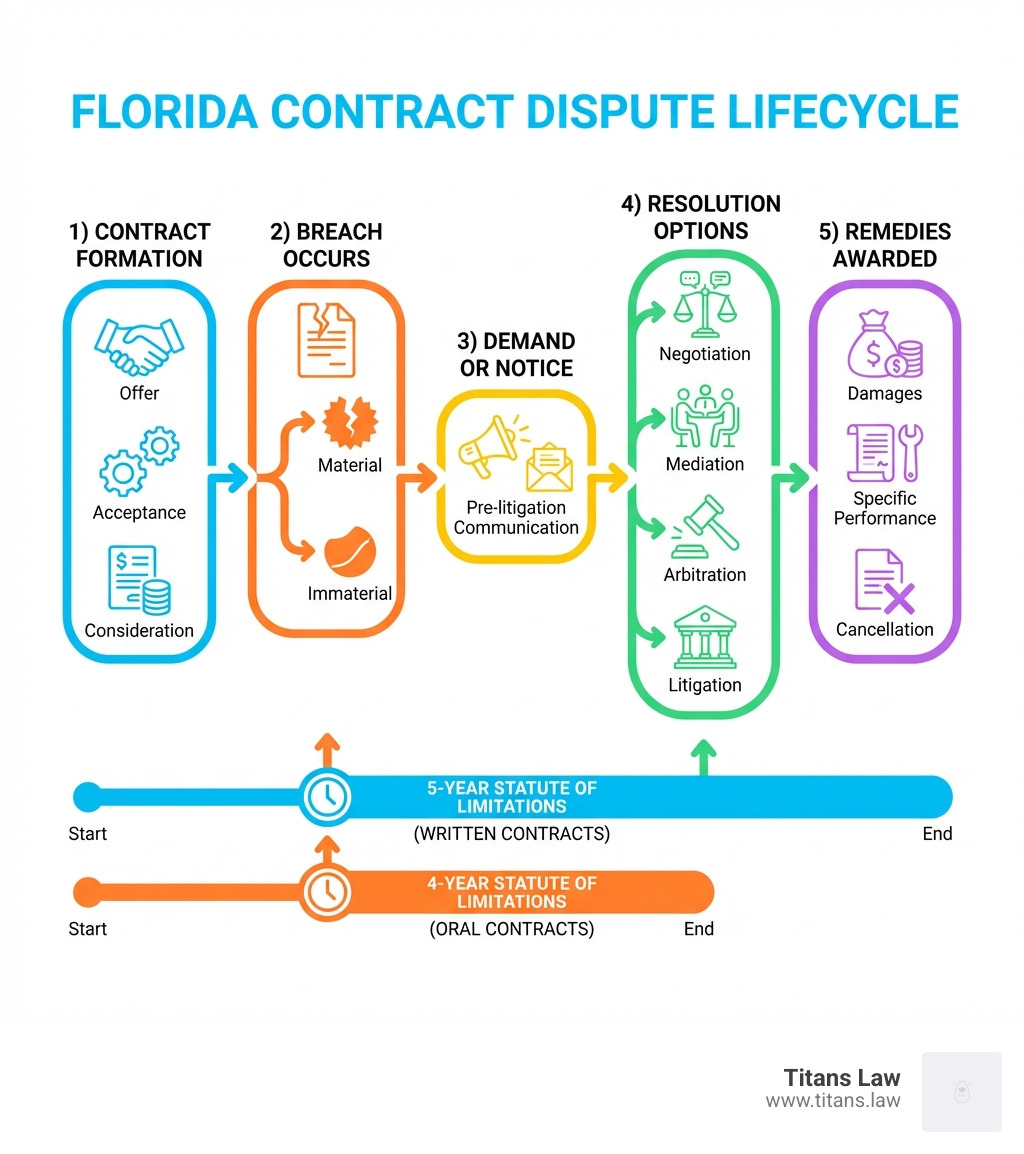
- Essential elements of a valid contract: Offer, acceptance, consideration, mutual assent, legal capacity, and lawful purpose
- Proving a breach: You must establish a valid contract existed, a material breach occurred, and measurable damages resulted
- Resolution options: Negotiation, mediation, arbitration, or litigation—each with distinct strategic implications
- Available remedies: Compensatory damages, specific performance, liquidated damages, or contract cancellation
- Critical deadlines: Five years for written contracts, four years for oral contracts
- Key defenses: Impossibility, force majeure, fraud, duress, mutual mistake, or unconscionable terms
Contracts are the lifeblood of business, outlining rights and responsibilities. When one party fails to uphold their end, disputes ensue.
Florida’s business landscape generates thousands of contract disputes annually. Cases with claims under $15,000 are usually in County Courts, while higher claims are in Circuit Courts. These disputes range from partnership disagreements to unpaid invoices.
A contract dispute threatens your financial stability, business relationships, and resources. Navigating Florida’s legal framework requires strategic precision.
This guide breaks down Florida’s contract dispute landscape. You’ll learn what constitutes a valid contract, how to prove a breach, available defenses, and strategic resolution methods. Whether enforcing rights or defending against allegations, you must understand the battlefield.
The Anatomy of a Florida Contract: Building a Foundation for Enforcement
In Florida, the enforceability of a contract dispute Florida claim hinges on the agreement meeting specific legal requirements. Without these elements, a contract may be unenforceable, leaving your business vulnerable.
For a contract to be valid and legally binding in Florida, it must contain several essential elements:
- Offer and Acceptance: One party must make a clear offer, and the other must unequivocally accept it.
- Consideration: This is the “bargained-for exchange.” Each party must give and receive something of value. This can be a promise to act or refrain from acting. A “gratuitous promise” is generally unenforceable unless one party acts to their detriment in reliance on it.
- Mutuality of Assent (Meeting of the Minds): Both parties must genuinely agree on the same essential terms and conditions.
- Legal Capacity: All parties must have the legal ability to enter the contract, meaning they are of legal age and mentally competent.
- Legal Purpose: The contract’s objective must be lawful.
The absence of these core elements can render a contract void or voidable. We examine these foundations to establish the strength of your position.
Written vs. Oral Contracts in Florida
While written contracts are preferable, Florida law recognizes oral contracts in many circumstances.
- Enforceability of Oral Agreements: Oral contracts are generally enforceable, especially with partial performance. However, proving their terms is challenging, relying on testimony and evidence. This difficulty makes written contracts superior.
- When Written Contracts are Required (Statute of Frauds): Florida’s Statute of Frauds mandates that certain contracts must be in writing to be enforceable. These include:
- Contracts for the sale of real estate.
- Agreements that cannot be performed within one year.
- Promises to pay the debt of another.
- Contracts for the sale of goods worth $500 or more (governed by the UCC).
- Superiority of Written Contracts: Written contracts eliminate ambiguity, providing a clear record that simplifies proving a breach. Our approach prioritizes written agreements to fortify your legal standing.
What Constitutes a Contract Dispute in Florida?
A contract dispute Florida arises from disagreements over a contract’s terms or performance, leading to business disruption.
Common disputes include:
- Disagreements over Terms: Parties interpret contract clauses differently.
- Conflicts over Performance: One party alleges the other failed to perform their duties as specified or performed them inadequately.
- Failure to Uphold Obligations: This can manifest as:
- Non-payment or late payment
- Non-delivery or late delivery
- Subpar quality of work
- Breaches of confidentiality
- Disagreements over scope of work
- Unjustified termination
Common Florida disputes we handle include partnership agreements, commercial leases, B2B contracts, severance agreements, and more. Each demands a strategic, decisive response.
Proving a Breach: The Core of a Contract Dispute Florida Case
In a contract dispute Florida, the central task is proving one party failed to uphold the agreement. This requires demonstrating a legal breach and its direct financial impact.

A material breach is a substantial failure that defeats the contract’s purpose, allowing termination and damages. An immaterial breach is a minor deviation that may allow for damages but not termination.
Success requires proving the breach and the resulting damages. This involves gathering evidence to show causation and quantify financial harm. We handle high-stakes disputes across various sectors, including partnership disputes, breaches of commercial leases, and complex B2B contracts, focusing on decisive outcomes for our clients.
Key Elements of a Breach of Contract Claim
To successfully pursue a breach of contract claim in Florida, we must establish three core elements:
- An Existing, Valid, and Enforceable Contract: The foundation is a valid, enforceable contract. We analyze its formation to ensure it meets all Florida legal requirements. For oral contracts, we work to prove its terms through other evidence.
- A Breach of a Contractual Duty: We must prove the other party failed to perform a specific contractual obligation, such as non-payment or failure to deliver. We pinpoint the exact deviation from their duties.
- Measurable Harm or Loss to the Non-Breaching Party Caused by the Breach: The breach must have caused quantifiable damages. We prove the causal link between the breach and the financial harm, quantifying the loss to restore our client’s position.
Our approach to civil litigation emphasizes strategic advocacy and thorough preparation. For more information on how we approach complex legal battles, explore our dedicated litigation services: More info about our litigation services
Common Defenses Against Breach Allegations
We aggressively pursue and defend against breach of contract claims. A strong defense can mitigate or invalidate a claim. Common defenses in a contract dispute Florida include:
- Mistake or Misunderstanding: A bilateral mistake regarding a material fact may render the contract unenforceable.
- Impossibility of Performance: If unforeseen circumstances make performance objectively impossible, it may be excused. This high bar requires showing no one could perform the contract.
- Force Majeure: Contract clauses that excuse performance for extraordinary events (natural disasters, wars) beyond the parties’ control.
- Fraud or Misrepresentation: If one party was induced into the contract by fraud, the contract may be voidable.
- Duress: A contract signed under threat or coercion may be invalid.
- Unconscionable Contract: A contract with terms so unfair they shock the conscience may be unenforceable.
- Illegality: A contract with an illegal purpose is unenforceable.
- Statute of Frauds: If a contract required to be in writing was only made orally, it cannot be enforced.
- Statute of Limitations Expiration: Lawsuits filed after the statute of limitations has expired are barred.
We analyze every defense, whether asserting it for our client or dissecting an opponent’s, to ensure the strongest possible legal position.
Strategic Resolution: Your Options for Resolving Contract Disputes
Navigating a contract dispute Florida requires a calculated approach. While litigation is a powerful tool, it is not always the first path. Strategic resolution means evaluating options to determine the most advantageous course for your business.
ADR methods like negotiation, mediation, and arbitration can offer quicker, more confidential, and less expensive resolutions. However, our firm prepares every case for trial, ready to litigate if ADR fails or the stakes demand court action. We conduct a cost-benefit analysis with clients to align our strategy with their business objectives.
Negotiation, Mediation, and Arbitration
Understanding each resolution method is crucial for strategic decision-making in a contract dispute Florida:
- Negotiation: Direct discussions between parties, often with attorneys, to reach an agreement. It is the least formal and most cost-effective method.
- Mediation: A neutral mediator facilitates communication to help parties find their own resolution. It is confidential and non-binding. In some Florida homeowners’ association (HOA) disputes, presuit mediation is mandatory (Florida Statutes 720.311). However, certain claims, like breaches of fiduciary duty by condo directors, are excluded from mandatory presuit arbitration under Florida Statute 718.1255.
- Arbitration: A neutral arbitrator hears evidence and issues a decision, which can be binding. Agreeing to binding arbitration means giving up the right to a jury trial and appeal. These clauses are generally binding in Florida. Be aware that arbitrator fees can exceed court costs, and you forfeit your right to a judge or jury.
| Feature | Negotiation | Mediation | Arbitration | Litigation |
|---|---|---|---|---|
| Cost | Lowest (attorney fees only) | Moderate (mediator + attorney fees) | Higher (arbitrator + attorney fees) | Highest (court fees + extensive attorney fees) |
| Speed | Fastest | Faster than litigation | Faster than litigation | Slowest |
| Confidentiality | High | High (proceedings are confidential) | Often confidential | Public Record |
| Outcome Control | High (parties decide) | High (parties decide) | Moderate (arbitrator decides) | Low (judge/jury decides) |
| Binding? | Yes (if agreement reached) | No (unless settlement reached) | Yes (if binding arbitration agreed) | Yes (court judgment) |
Handling Specific Disputes: Non-Compete Agreements
Non-compete agreements are a frequent source of high-stakes contract dispute Florida litigation. Found in employment or business sale contracts, they prevent competition for a specific time and geographic area.
Florida law, specifically Florida Statute 542.335, permits non-competes but requires they be:
- In Writing and Signed: The agreement must be documented and signed.
- Justified by Legitimate Business Interests: The employer must show a legitimate interest to protect, such as:
- Trade secrets
- Confidential or proprietary business information
- Substantial customer relationships
- Goodwill
- Extraordinary or specialized training
- Reasonable in Time and Scope: Restrictions must be reasonable and necessary. Overly broad restrictions are often unenforceable by Florida courts.
We aggressively enforce non-competes to protect businesses and defend individuals against invalid restrictions. Our strategic analysis of the agreement’s terms, business interests, and reasonableness aims for a decisive outcome.
Remedies and Ramifications: The Stakes of a Breach of Contract Claim
In a contract dispute Florida, remedies are the legal means to compensate the non-breaching party. The goal is to place them in the position they would have been in without the breach, using monetary or equitable relief.
We strategize the most effective remedies to protect our clients’ interests and enforce their rights. This involves calculating financial loss and taking aggressive action to enforce court orders or settlements. For a deeper dive into the foundational principles of agreements, we recommend reviewing this resource: Legal and Binding Contracts in Florida
Available Remedies for a Florida Contract Dispute
Florida law provides several remedies for a breach of contract:
- Damages: The most common remedy, compensating for financial losses.
- Compensatory Damages: Cover direct losses and costs from the breach.
- Consequential (Special) Damages: Indirect but foreseeable losses, like lost profits.
- Liquidated Damages Clauses: A contract-specified damage amount. Enforceable in Florida if it’s a reasonable estimate of hard-to-ascertain damages, not a penalty.
- Specific Performance: A court order to perform contractual duties. This remedy is granted when money is inadequate, such as in contracts for unique real estate or goods.
- Cancellation and Restitution: This annuls the contract and returns exchanged benefits, restoring parties to their pre-contract positions.
- Rescission: Nullifies the contract, often used when a party wishes to unwind the agreement without seeking significant monetary damages.
Our firm evaluates each contract dispute Florida to determine the most effective remedy to secure our client’s position and recover their losses.
Critical Deadlines and Contractual Rights
Timeliness is paramount in a contract dispute Florida. Missing legal deadlines can bar your claim, regardless of its merits.
- Statute of Limitations: Florida sets strict deadlines for filing a lawsuit:
- Written Contracts: Five years from the date of the breach.
- Oral Contracts: Four years from the date of the breach.
- Real Property Improvement Claims: Typically a four-year statute of limitations.
Consult with legal counsel to determine the precise deadline for your case.
- ‘Cooling-Off’ Periods: Florida law provides a three-day right to cancel specific contracts, such as:
- Home Solicitation Sales: Sales over $25 made at your home.
- Contracts for Future Services: Like gym memberships.
These are exceptions requiring specific, timely notice of cancellation.
- Attorney’s Fees Clauses: Many business contracts include clauses allocating attorney’s fees in a dispute, often to the prevailing party. We analyze these provisions as they significantly impact litigation strategy.
The Role of a High-Stakes Litigator in Florida Contract Disputes
When facing a contract dispute Florida, your choice of legal representation can dictate the outcome. Our firm specializes in high-stakes civil litigation, bringing aggressive, results-driven representation to complex disputes where the financial and strategic consequences are significant. We are strategic advocates committed to protecting your business interests.
Our role extends far beyond merely filing paperwork. We provide:
- Strategic Advocacy: We develop custom legal strategies designed to achieve decisive outcomes.
- Protecting Business Interests: We focus on safeguarding your assets, reputation, and operational continuity.
- Enforcing Contractual Rights: We aggressively pursue all available remedies to ensure your rights are upheld.
- Defending Against Allegations: We mount a formidable defense to protect you from unwarranted liability.
We combine hard-hitting advocacy with a deep understanding of Florida contract law. When the stakes are high, our firm fights to win.
How a Contract Dispute Attorney Builds Your Case
Building a winning case in a contract dispute Florida is a rigorous process demanding a proactive, aggressive stance. Our approach leaves no stone unturned:
- Comprehensive Case Assessment: We begin with an in-depth evaluation of your situation to understand the strengths and weaknesses of your position.
- Aggressive Evidence Gathering: We systematically collect all necessary documentation, data, and witness statements, using subpoenas and other legal tools.
- Deposing Witnesses: We conduct rigorous depositions to lock in testimony and expose inconsistencies.
- Drafting Strategic Motions: We prepare powerful legal motions to advance your position or seek early resolution.
- Developing a Trial Strategy: We prepare every contract dispute Florida for trial. This readiness strengthens our negotiating position.
- Aggressive Negotiation: We engage in assertive negotiations, leveraging the strength of our prepared case to secure the best possible outcome.
Our firm handles tough cases with experienced representation prepared for every phase of a dispute. To discuss your situation and our strategic approach, connect with us: Contact us for a strategic consultation
Conclusion
Navigating a contract dispute Florida demands strategic foresight and aggressive advocacy. From the foundational elements of a valid contract to proving a breach, every step carries significant implications for your business.
A well-drafted contract is your first line of defense, but when disputes arise, decisive action is paramount. The stakes are invariably high. We provide the hard-hitting, results-driven representation necessary to protect your interests and secure a favorable resolution. When the future of your business hangs in the balance, expert representation is not just an advantage—it is a necessity.
Let us be your strategic partner in complex civil litigation. Navigate your complex civil litigation matter with a strategic partner