
Understanding Residential Lease Termination: The Legal Stakes
Residential lease termination is a legally regulated process governed by strict statutory requirements and notice periods under Florida law. Whether you’re a landlord seeking to regain possession of your property or a tenant facing eviction, understanding the legal framework is critical to protecting your financial interests and avoiding costly litigation.
Key Facts About Residential Lease Termination in Florida:
- Tenants on a month-to-month tenancy must typically provide at least 15 days’ written notice before the end of the monthly period.
- Landlords can only terminate tenancies for specific reasons defined by law—either “for cause” (e.g., non-payment of rent, lease violations) or, for periodic tenancies, by providing proper notice without cause.
- Improper termination exposes parties to significant liability, including claims for unpaid rent, damages, and potential legal costs.
- Eviction requires court approval—landlords cannot use self-help measures like changing locks or shutting off utilities without facing serious legal consequences, including liability for damages and attorney’s fees.
- Both parties must follow precise procedural requirements including proper notice forms, service methods, and timelines to avoid having their termination declared invalid.
The Florida Residential Landlord and Tenant Act establishes a rigid legal structure. A landlord cannot force a tenant to vacate without following proper notice procedures and, if necessary, obtaining an order from the appropriate Florida court. Similarly, a tenant who abandons a lease without proper notice remains liable for rent until the landlord re-rents the unit or the lease term ends—whichever comes first.
Disputes over lease termination frequently escalate into litigation when one party fails to comply with statutory requirements or when the legitimacy of the termination grounds is contested. High-stakes cases involving commercial property owners, investment landlords, or substantial financial exposure require aggressive legal representation to protect your position and enforce your rights.
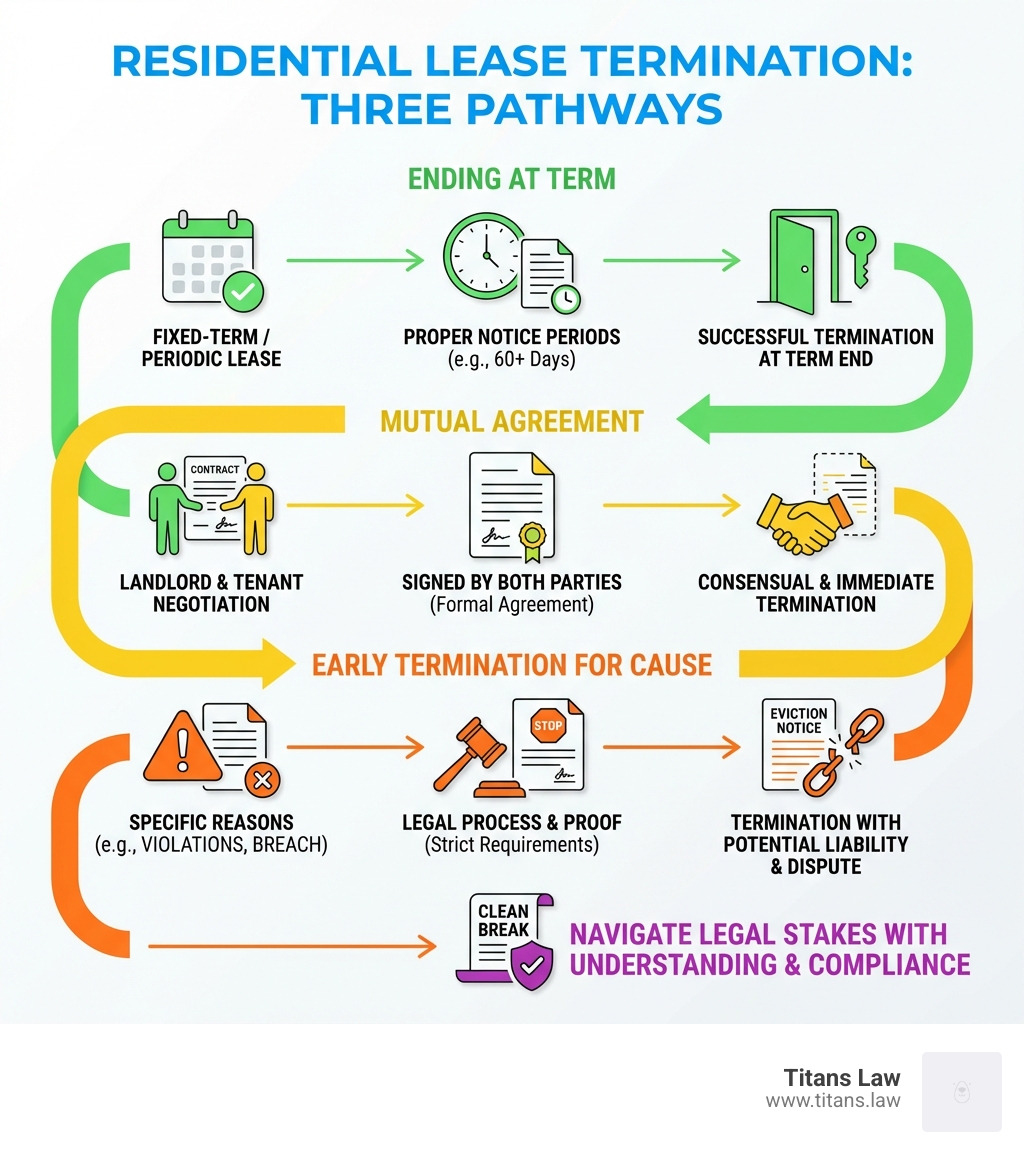
Tenant-Initiated Termination: Executing Your Exit Strategy
For tenants, ending a residential lease often feels like navigating a minefield. The general rule is simple: a lease is a binding contract. However, life happens, and sometimes an early exit becomes necessary. Understanding the proper legal channels is crucial to avoid significant financial penalties and legal disputes.
In Florida, a tenant’s ability to end a lease, particularly a fixed-term lease, is primarily dictated by the lease agreement itself and Florida Statute 83.57. Generally, a tenant is responsible for the entire term of the lease. If you move out without proper notice or justification, you may be on the hook for rent until the lease expires or until the landlord re-rents the property.

Standard Lease Termination
For most tenancies, particularly those on a month-to-month basis, Florida law requires specific notice periods for tenants wishing to terminate.
- Month-to-Month Tenancy: If you pay rent monthly and are not in a fixed-term tenancy, you must give at least 15 days’ notice before the end of any monthly period. The termination date must be the last day of the rental period. For example, if your rent is due on the first of the month, and you wish to vacate by the end of June, you must provide written notice by June 15th.
- Week-to-Week Tenancy: If you pay rent weekly, you must give at least 7 days’ notice before the end of any weekly period.
It’s vital that this notice is in writing and clearly states your intent to vacate and the specific termination date. Without proper written notice, your tenancy may automatically renew, and you could be held responsible for additional rent.
For fixed-term leases, the situation is more rigid. If your lease has a specific end date, you are generally expected to fulfill the entire term. If you plan to vacate at the end of your fixed-term lease, you are typically not required to give notice unless your lease agreement specifically states otherwise. However, it’s always a best practice to communicate your intentions to your landlord in writing.
Justified Early Residential Lease Termination for Tenants
While a fixed-term lease is binding, there are specific circumstances under Florida law where a tenant may be able to terminate a residential lease termination early without incurring full liability for the remaining rent. These exceptions are critical for tenants to understand and for landlords to recognize to avoid costly legal battles.
- Mutual Agreement with the Landlord: The cleanest way to end a lease early is by mutual written agreement with your landlord. This often involves negotiating terms, such as a lease break fee, forfeiture of a security deposit, or assisting the landlord in finding a new tenant. Any agreement reached should be explicitly documented in writing to prevent future disputes.
- Lease Clause for Early Termination: Some leases include a specific clause outlining conditions for early termination. This might involve a notice period and a termination fee, often equivalent to one or two months’ rent. If such a clause exists, adhering to its terms allows for a lawful early exit.
- Active Military Duty: Under federal law (Servicemembers Civil Relief Act) and Florida law, military personnel who receive permanent change of station orders or are deployed for 90 days or more can terminate their lease early. Proper written notice and a copy of the orders are required.
- Uninhabitable Living Conditions (Landlord’s Breach): If your landlord fails to maintain the rental unit in a habitable condition, and fails to make necessary repairs after receiving proper written notice from you, you may have grounds to terminate the lease. This involves specific steps:
- Provide written notice to the landlord, detailing the non-compliance and stating your intention to terminate if the issue is not remedied within 7 days.
- If the landlord does not fix the issue, you may then terminate the lease.
- This is a serious step and requires careful documentation and adherence to statutory requirements.
- Landlord Harassment or Privacy Violation: While less common as a direct ground for early termination, a landlord’s repeated and severe violations of your right to privacy or other forms of harassment could potentially be grounds to terminate a lease, especially if it constitutes a material breach of the lease agreement. This typically requires legal counsel to steer effectively.
It is crucial to understand that simply moving out does not absolve a tenant of their obligations. If you move out without a legally justified reason or mutual agreement, the landlord is generally obligated to make a reasonable effort to re-rent the property. However, you remain liable for the rent until a new tenant is found or the lease term ends, whichever comes first. This is where the aggressive pursuit of a tenant’s obligations becomes a critical aspect of civil litigation for landlords.
Landlord-Initiated Termination: The Grounds for Eviction
From a landlord’s perspective, terminating a tenancy is often a last resort, but a necessary one to protect property interests and ensure compliance with lease agreements. Florida law provides specific, rigid grounds and procedures that landlords must follow to terminate a tenancy and, if necessary, evict a tenant. Deviating from these procedures can lead to significant legal setbacks and financial penalties.
Florida law generally categorizes landlord-initiated terminations into “for cause” and “no-fault” scenarios, though the nuances differ from some other jurisdictions.
“For Cause” Evictions
“For cause” evictions arise when a tenant breaches the terms of the lease agreement or violates Florida landlord-tenant law. These are the most common grounds for landlords to initiate residential lease termination.
- Non-Payment of Rent: This is the most frequent cause for eviction. If a tenant fails to pay rent when due, Florida Statute 83.56 allows a landlord to issue a 3-day notice to pay rent or quit. This notice must inform the tenant that they have three business days (excluding weekends and legal holidays) to either pay the overdue rent or vacate the premises. If the tenant fails to comply, the landlord can then file an eviction lawsuit (unlawful detainer action) in court.
- Persistent Late Payment or Other Material Non-Compliance: Beyond simple non-payment, Florida law addresses other breaches. If a tenant materially violates the lease agreement or Florida Statute 83.52 (tenant obligations), the landlord can issue a 7-day notice to cure or quit. This notice must specify the non-compliance and give the tenant seven days to remedy the issue. Examples include:
- Unauthorized pets
- Excessive noise or disturbances
- Unsanitary conditions
- Unauthorized occupants
If the tenant remedies the non-compliance within seven days, the tenancy continues. However, if the tenant commits the same material non-compliance within 12 months, the landlord can issue a 7-day notice to quit without an opportunity to cure, meaning the tenant must vacate.
- Illegal Acts or Willful Destruction of Property: For certain severe breaches, Florida law permits a landlord to issue a 7-day notice to quit without an opportunity to cure. This is typically reserved for extreme violations where the tenant’s actions are beyond repair, such as:
- Willful destruction, damage, or misuse of the landlord’s or other tenants’ property.
- Conduct that constitutes a criminal act.
In these high-stakes situations, landlords must be prepared to present compelling evidence in court.
“No-Fault” Evictions
Unlike some states or provinces with extensive “no-fault” eviction rules, Florida law is more straightforward for periodic tenancies. For fixed-term leases, landlords generally cannot terminate without cause unless the lease explicitly allows it. However, for month-to-month or week-to-week tenancies, a landlord can terminate the tenancy without needing to provide a specific “cause” related to tenant behavior, simply by providing appropriate notice.
- Month-to-Month Tenancy: A landlord can terminate a month-to-month tenancy by giving at least 15 days’ written notice prior to the end of any monthly period.
- Week-to-Week Tenancy: A landlord can terminate a week-to-week tenancy by giving at least 7 days’ written notice prior to the end of any weekly period.
It’s important to note that, in Florida, landlords are generally not required to provide compensation to tenants for these “no-fault” terminations of periodic tenancies, which is a significant difference from some other jurisdictions. This means reasons like “landlord’s own use,” “purchaser’s own use,” “demolition,” or “major repairs” are not specific legal grounds for early termination of a fixed-term lease in Florida unless explicitly stated in the lease or if the property falls under specific condemnation rules. For periodic tenancies, these reasons might motivate a landlord to issue a no-cause notice, but the notice itself doesn’t need to state these reasons.

The Legal Framework of Residential Lease Termination
When a tenancy ends, whether by mutual agreement or due to a dispute, the legal implications can be substantial. This section digs into the critical legal mechanisms and potential liabilities involved in ending a tenancy, areas where disputes frequently escalate into litigation.
Assignment vs. Subletting: Understanding Your Obligations
Tenants sometimes seek to transfer their rental obligations to another party to avoid breaking a lease. Florida law generally allows assignment and subletting unless the lease specifically prohibits it. However, landlord consent is almost always required and cannot be unreasonably withheld. Understanding the difference between these two actions is critical:
| Feature | Lease Assignment | Subletting |
|---|---|---|
| Transfer of Obligations | Original tenant (assignor) transfers all rights and obligations to a new tenant (assignee). | Original tenant (sublessor) rents out the unit to a subtenant, but remains primarily responsible to the landlord. |
| Relationship to Landlord | New tenant (assignee) typically establishes a direct relationship with the landlord. | Subtenant has a relationship with the original tenant, not directly with the landlord. |
| Original Tenant’s Liability | Usually released from liability if the landlord accepts the assignment and the lease or agreement specifies release. | Remains fully liable to the landlord for rent and damages, even if the subtenant fails to pay or causes damage. |
| Landlord Consent | Required, and often subject to landlord’s approval of the new tenant’s qualifications. | Required, and the landlord may set conditions or charge a fee. |
| Control Over Property | Assignee takes over full control. | Original tenant retains some control, often planning to return. |
| Duration | Typically for the remainder of the original lease term. | Can be for a portion of the original lease term, or the entire remainder. |
For landlords, understanding the distinction is vital. An improper assignment or sublet can lead to complex eviction proceedings and potential financial losses. For tenants, failing to secure proper consent or understanding your continued liability can lead to significant financial exposure. We are adept at dissecting these agreements and aggressively pursuing claims when these distinctions are blurred or violated.
Consequences of Improper Residential Lease Termination
Walking away from a lease without proper justification or notice in Florida can trigger severe financial and legal repercussions for a tenant. Conversely, landlords who fail to follow proper legal procedures when terminating a tenancy can face substantial penalties.
For Tenants:
- Liability for Remaining Rent: If a tenant abandons the premises, they may be responsible for paying rent until the earlier of the date the unit is rented to another tenant or the earliest termination date that could have been given with proper notice. Florida law requires landlords to make a “good faith” effort to re-rent the property, but the tenant remains liable for lost rent during any vacancy.
- Small Claims Court Action: Landlords can sue tenants in Small Claims Court for unpaid rent, damages beyond normal wear and tear, and any other financial losses incurred due to the improper termination. This can include costs for advertising, re-renting the unit, and legal fees if provided for in the lease.
- Damage to Credit: A judgment against a tenant for unpaid rent or damages can severely impact their credit score, making it difficult to rent future properties, secure loans, or even obtain employment.
- Forfeiture of Personal Property: If a tenant abandons the rental unit and leaves personal belongings behind, Florida law has specific procedures. After proper notice, the landlord may be able to dispose of the property. Tenants risk losing valuable possessions if they do not properly remove them upon vacating.
For Landlords:
- Illegal Lockouts and Penalties: A landlord cannot use self-help measures to evict a tenant in Florida, such as changing locks, turning off utilities, or removing the tenant’s property. Such actions are illegal and can result in the landlord being liable for actual damages, three months’ rent, and attorney’s fees.
- Invalid Termination Notices: Using incorrect notice forms, improper service, or insufficient notice periods can invalidate a landlord’s termination attempt, forcing them to restart the process and potentially incurring further financial losses.
- Retaliation Claims: Florida law protects tenants from landlord retaliation if they exercise their legal rights (e.g., complaining about conditions, organizing with other tenants). If a landlord attempts to terminate a tenancy in retaliation, the tenant can sue for damages and attorney’s fees.
When the stakes are high, understanding these consequences is paramount. Our firm excels in navigating these complex scenarios, whether aggressively pursuing a tenant’s financial obligations or defending landlords against unwarranted claims.
Tenant Rights and Defenses Against Termination
Receiving a notice of residential lease termination or an eviction lawsuit can be daunting for any tenant. However, Florida law provides tenants with specific rights and defenses that, when properly asserted, can prevent wrongful eviction or mitigate financial liabilities.
- Right to Dispute: Tenants have the right to dispute the landlord’s claims. If you believe the termination notice is incorrect, retaliatory, or based on false pretenses, you have the right to present your case in court.
- Voiding a Notice: For certain “for cause” notices, such as a 3-day notice for non-payment of rent or a 7-day notice to cure a lease violation, the tenant has the opportunity to “void” the notice by taking corrective action (e.g., paying the rent, fixing the violation) within the specified timeframe. If the tenant complies, the landlord cannot proceed with eviction based on that notice.
- Protection from Retaliation: Florida Statute 83.64 prohibits landlords from retaliating against tenants for exercising their legal rights, such as:
- Complaining to a governmental agency about building or health code violations.
- Organizing or joining a tenant union.
- Complaining to the landlord about lease violations.
If a landlord attempts to terminate a tenancy within one year of a tenant engaging in a protected activity, it may be presumed to be retaliatory. This is a powerful defense that can invalidate an eviction.
- Right to a Hearing: In Florida, a landlord cannot unilaterally evict a tenant. If a tenant does not vacate after receiving a proper termination notice, the landlord must file an eviction lawsuit in court. The tenant then has the right to file an answer, present defenses, and have a hearing before a judge. This ensures due process and prevents landlords from taking the law into their own hands.
Navigating these defenses requires a keen understanding of Florida landlord-tenant law. Our firm is prepared to engage in aggressive civil litigation to protect the interests of our clients, whether that means defending against an improper termination or prosecuting claims of wrongful eviction. More info about civil litigation services.
The Eviction Process: From Notice to Enforcement
When a landlord initiates residential lease termination and a tenant fails to vacate, the situation escalates to a formal eviction process. In Florida, this is known as an unlawful detainer action, and it strictly adheres to court procedures. Landlords cannot use self-help measures; they must obtain a court order to legally remove a tenant.
The Formal Eviction Path
The eviction process in Florida is a multi-step legal procedure designed to ensure due process for both landlords and tenants.
- Proper Notice: The first step, as discussed, is for the landlord to serve the tenant with a legally compliant termination notice (e.g., 3-day notice for non-payment, 7-day notice for lease violation, or 15-day notice for month-to-month termination).
- Filing an Unlawful Detainer Lawsuit: If the tenant does not comply with the termination notice (e.g., fails to pay rent, cure the violation, or vacate), the landlord must file a Complaint for Eviction (also known as an unlawful detainer complaint) in the appropriate Florida County Court. This formally initiates the legal process.
- Service of Summons and Complaint: After filing, the tenant is formally “served” with a summons and a copy of the complaint. This legal document notifies the tenant of the lawsuit and the deadline to respond.
- Tenant’s Response: The tenant typically has five business days (excluding weekends and legal holidays) from the date of service to file a written answer with the court. In their answer, the tenant can admit or deny the landlord’s allegations and raise any legal defenses they may have. Failure to file an answer within this strict timeframe can result in a default judgment against the tenant, leading directly to eviction.
- Hearing and Judgment: If the tenant files an answer, a court hearing will be scheduled. Both parties present their case, evidence, and arguments to a judge. If the judge rules in favor of the landlord, a Final Judgment of Eviction is issued.
Throughout this process, attention to detail is paramount. Any procedural misstep by the landlord can delay or derail the eviction, incurring additional costs and prolonged disputes. For tenants, a timely and well-articulated defense can be the difference between retaining possession and immediate displacement.
Enforcing an Eviction Order
A Final Judgment of Eviction does not automatically remove the tenant. It simply grants the landlord the legal right to possession. The next, and final, step involves the enforcement of this order.
- Writ of Possession: Once a Final Judgment of Eviction is issued, the landlord must obtain a “Writ of Possession” from the court clerk. This is the official court order directing the Sheriff to remove the tenant.
- Role of the Court Enforcement Office (Sheriff): The landlord delivers the Writ of Possession to the local Sheriff’s Office. A Sheriff’s deputy will then post a 24-hour notice on the tenant’s door, informing them that they must vacate the premises within 24 hours.
- Physical Removal: If the tenant has not moved out after the 24-hour period, the Sheriff’s deputy will return to physically remove the tenant and any remaining belongings. The landlord must coordinate with the Sheriff and often arrange for a locksmith to change the locks immediately after the tenant’s removal.
- Illegal Lockouts and Penalties for Landlords: It is critical to reiterate: landlords cannot take matters into their own hands. Any attempt by a landlord to forcibly remove a tenant, change locks, or cut off utilities without a Writ of Possession enforced by the Sheriff is an “illegal lockout” and carries severe penalties under Florida law. Landlords found guilty of an illegal lockout can be liable for the tenant’s actual damages, three months’ rent, and attorney’s fees. Such actions are not merely civil violations but can also lead to criminal charges.
The eviction process is designed to be formal and deliberate, reflecting the significant impact it has on individuals. For landlords, understanding and strictly adhering to these procedures is not merely a suggestion but a legal imperative to avoid costly counterclaims and ensure a successful outcome.
Conclusion: Protecting Your Interests in Tenancy Disputes
Navigating residential lease termination in Florida is rarely simple. Whether you are a landlord seeking to protect your investment or a tenant asserting your rights, the legal landscape is fraught with potential pitfalls. From carefully drafting notice periods to understanding the nuances of “for cause” versus “no-fault” terminations, every step carries significant legal weight.
The general rules, such as a tenant’s 15-day notice for month-to-month tenancies or a landlord’s 3-day notice for non-payment, seem straightforward. However, the exceptions, the requirements for proper service, the implications of an abandoned premise, or the complexities of an unlawful detainer action can quickly escalate into high-stakes disputes.
At Titans Law, we understand that these are more than just agreements; they are often critical components of your financial well-being. We combine strategic, hard-hitting advocacy with a deep understanding of Florida landlord-tenant law. When faced with improper termination, significant financial liability, or the need for aggressive enforcement, our attorneys develop custom legal strategies designed to protect our clients’ interests and achieve decisive outcomes. We are prepared to fight to win, whether at the negotiating table or in the courtroom.
When the stakes are high in your residential lease disputes, do not steer these complex waters alone.