
Understanding Corporate Legal Counsel: Your Business’s Strategic Legal Backbone
Corporate legal counsel refers to attorneys who specialize in advising businesses on legal matters, ensuring compliance, and managing risk. Here’s what you need to know:
Key Functions of Corporate Legal Counsel:
- Legal Advisory – Providing guidance on commercial transactions, contracts, and corporate structure
- Risk Management – Identifying and mitigating legal exposure across all business operations
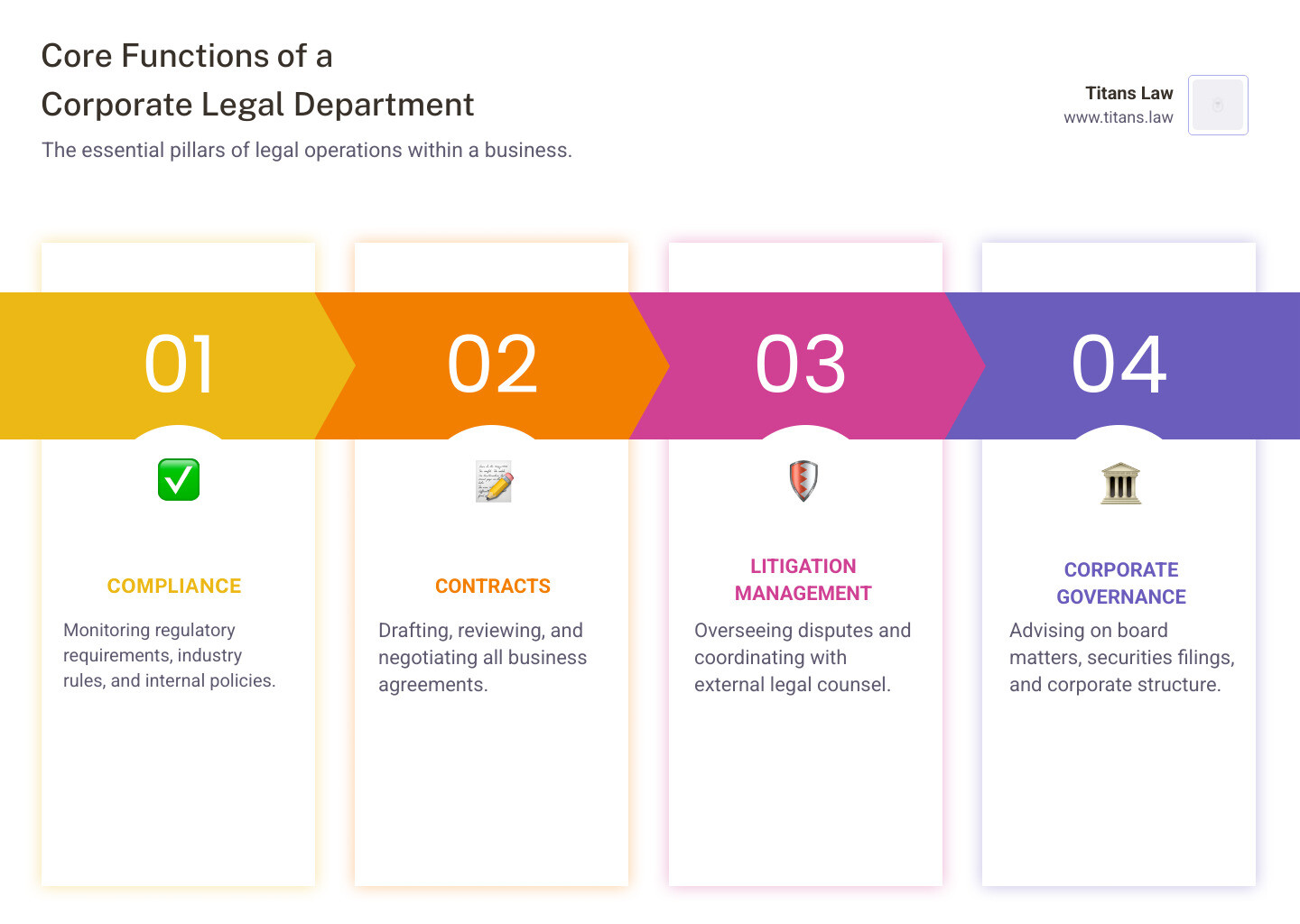
- Compliance – Ensuring adherence to regulations, securities laws, and industry-specific requirements
- Transaction Support – Structuring deals, negotiating agreements, and reviewing business arrangements
- Litigation Management – Overseeing disputes and coordinating with external litigation counsel when needed
Corporate legal counsel serves as more than just a legal advisor. They are the strategic legal backbone of modern business operations. While in-house attorneys handle day-to-day legal affairs, steer complex regulations, and enable growth through sound legal guidance, they also face a critical reality: when high-stakes disputes emerge, even the most capable in-house teams need specialized external partners.
One lawyer aptly characterized corporate lawyers as “the handmaidens of the deal”—but that description only captures part of the role. Today’s corporate counsel must be business advisors first and lawyers second. They sit at the intersection of legal compliance and business strategy, balancing risk mitigation with opportunity creation.
The challenge? Many in-house legal departments excel at transactional work and regulatory compliance but lack the resources or litigation firepower for aggressive, high-exposure disputes. That’s where the strategic alliance between corporate counsel and specialized external litigation firms becomes essential—particularly when the stakes involve significant financial exposure or reputational damage.
The Core Mandate: Roles and Responsibilities
At its heart, the primary role of a corporate legal counsel is to ensure the legality of commercial transactions and to advise corporations on their legal rights and duties. We see them not just as legal guardians, but as integral business partners, deeply embedded in the company’s operations. Their work is less about adversarial courtroom battles (though they manage those, too) and more about proactive problem-solving, strategic planning, and risk mitigation.

A corporate legal counsel is the company’s internal legal expert, providing guidance across a vast spectrum of business activities. Their responsibilities are diverse and critical to a company’s success and longevity:
- Legal Advisor: They are the first point of contact for all legal inquiries within the corporation, offering advice on everything from daily operations to complex strategic initiatives.
- Risk Management: A key function involves identifying, assessing, and mitigating legal risks across all departments. This proactive approach helps prevent costly disputes and regulatory penalties down the line. We often say an ounce of prevention is worth a pound of cure, and this is especially true in corporate law.
- Corporate Governance: They advise the board of directors and executive leadership on best practices for corporate governance, ensuring the company operates ethically and in compliance with its own bylaws and external regulations.
- Compliance Officer: Corporate legal counsel ensures adherence to a labyrinth of federal, state, and local laws and industry-specific regulations. This is a continuous process of monitoring, updating, and educating the organization.
- Contract Drafting and Negotiation: From vendor agreements to complex multi-million dollar mergers and acquisitions, they draft, review, and negotiate a wide array of contracts to protect the company’s interests.
- Transaction Structuring: They play a crucial role in structuring commercial transactions, ensuring they are legally sound, strategically beneficial, and minimize potential liabilities.
- Internal Investigations: When issues arise, whether they relate to regulatory concerns, employee conduct, or potential fraud, corporate legal counsel leads or oversees internal investigations to uncover facts and recommend appropriate actions. Cases involving major corporations like Walmart and General Motors have highlighted the complex role of corporate lawyers in these internal investigations.
The key legal areas a corporate legal counsel must be proficient in are broad, reflecting the multifaceted nature of business. These include:
- Contract Law: The foundation of all commercial dealings.
- Tax Law: Understanding the tax implications of business decisions.
- Accounting: A grasp of financial statements and practices is often necessary.
- Securities Law: Especially for public companies, advising on stock offerings, disclosures, and regulatory compliance.
- Bankruptcy: Understanding the legal framework for financial distress.
- Intellectual Property: Protecting patents, trademarks, and copyrights.
- Licensing: Negotiating agreements for the use of intellectual property or services.
- Zoning Laws: For businesses with physical locations, understanding local land use regulations.
- Industry-Specific Laws: Beyond general law, counsel must master the unique regulatory landscape of their particular industry.
For more information about our services and how we can support your legal needs, please visit More info about our services.
In-House Counsel and External Legal Partners: A Strategic Alliance
The legal landscape for businesses is complex, requiring a nuanced approach that often involves both internal and external legal expertise. Let’s clarify the distinction: in-house counsel (also known as house counsel, inside counsel, or corporate counsel) is an attorney directly employed by a company to handle its legal affairs. They receive a full-time salary and represent the entity in legal matters. This deep immersion in the business allows them to develop an unparalleled understanding of the company’s operations, culture, and strategic objectives. What is in-house counsel?
However, even the most robust in-house teams recognize the invaluable role of external legal partners. We view external counsel as the “special forces” that in-house general counsel call upon for overflow work or highly specialized needs. This strategic alliance leverages the strengths of both:
- Business Immersion vs. Broad Perspective: In-house counsel offers intimate knowledge of the company. External counsel, particularly firms like ours, brings a broader perspective gleaned from diverse client experiences and an objective viewpoint, which can be crucial in high-stakes disputes.
- Cost-Effectiveness: For many businesses, especially smaller ones, hiring a full-time corporate legal counsel can be a significant expense. In these cases, engaging outside counsel on an as-needed basis can be a more cost-effective solution for specialized tasks or complex litigation.
- Specialized Expertise: While in-house counsel are often generalists covering a wide array of legal issues, external firms provide deep specialization. For instance, our firm offers aggressive, results-driven representation specifically in high-stakes civil litigation, an area where many in-house departments may not have the dedicated resources or daily practice.
- Objective Perspective: An external legal partner can offer an unbiased assessment of legal challenges, free from internal corporate politics or pressures. This objectivity is vital when evaluating risks and strategizing for complex cases.
The collaboration between external attorneys and internal business teams (such as sales, operations, or HR) is a hallmark of an effective legal strategy. We integrate seamlessly with in-house teams, providing the focused firepower needed to achieve decisive outcomes.
Here’s a quick comparison of the key differences:
| Feature | In-House Counsel | External Legal Partners (e.g., Titans Law) |
|---|---|---|
| Business Knowledge | Deep, intimate understanding of company operations, culture, and strategic goals. | Broader industry experience, objective viewpoint, quickly adapts to client’s business context. |
| Cost Structure | Fixed salary, benefits; part of the company’s overhead. | Project-based or hourly fees; brought in for specific needs or overflow. |
| Scope of Work | Broad, day-to-day legal affairs, compliance, transactional work, internal advisory. | Specialized expertise (e.g., high-stakes litigation), overflow support, unique legal challenges. |
| Objectivity | May be influenced by internal company dynamics and relationships. | Independent, unbiased assessment of legal issues and strategic recommendations. |
| Litigation Focus | Manages disputes, coordinates with outside counsel; rarely handles aggressive litigation personally. | Provides aggressive, results-driven representation in complex disputes and high-exposure matters. |
The Corporate Legal Counsel Career: Path, Pay, and Progression
The career path for a corporate legal counsel is dynamic and offers diverse opportunities. Many attorneys transition from private practice at law firms—sometimes even “BigLaw” firms—to in-house roles, seeking a deeper immersion in a single company’s business and a different work-life balance. Others begin their careers directly within corporate legal departments.

For those pursuing a career as a corporate legal counsel, the progression can lead to senior roles such as Senior Counsel, Chief Counsel, and ultimately, General Counsel. Some may even transition into business roles, investment banking, or legal education. The journey is often marked by continuous learning and adapting to the evolving legal and business landscapes.
While we don’t discuss specific pricing, it’s worth noting that salaries for corporate legal counsel are competitive and vary significantly based on several factors. According to industry benchmarks:
- Starting salaries for corporate lawyers in major international law firms (“BigLaw” firms) can be around US$225,000 per year, excluding bonuses.
- In secondary markets like Florida, starting salaries for corporate lawyers may be closer to US$160,000 per year.
- Attorneys employed at smaller firms tend to earn smaller salaries.
- The annual salary for a Senior Manager, Corporate Counsel in some industries can range from $156,000 to $170,000 per year, with additional incentive opportunities and comprehensive benefits.
Several factors influence a corporate legal counsel’s salary range:
- Experience: More years of practice and specialized expertise command higher compensation. For instance, a Senior Manager, Corporate Counsel, often requires at least 5 years of legal experience.
- Location: Geographic markets, even within Florida, can impact salary levels. Major metropolitan areas typically offer higher compensation.
- Industry Specialization: Highly regulated industries, such as pharmaceuticals, often offer competitive salaries due to the specialized knowledge required.
- Company Size and Revenue: Larger corporations with higher revenues generally have the capacity to offer more attractive compensation packages.
- Economic Conditions: Broader economic trends and legal regulations can also influence salary trends across the legal industry.
For more detailed information on industry salary scales, you can refer to resources like Industry Salary Scale Resource.
The Role of a General Counsel vs. Other Corporate Legal Counsel
Within a corporate legal department, the General Counsel (GC) holds a distinct and liftd position. The General Counsel is the senior attorney that represents a business, often referred to as the Chief Legal Officer or legal director. This individual is not just another lawyer on the team; they are a member of the executive leadership, reporting directly to the CEO or board of directors. General Counsel Overview.
While other corporate legal counsel (such as Senior Counsel, Staff Attorneys, or Legal Managers) focus on specific legal areas or departmental needs, the General Counsel is responsible for the overall strategic direction of the company’s legal affairs. Their responsibilities include:
- Senior Leadership: Providing high-level legal and strategic advice to the executive team and board.
- Managing Legal Departments: Overseeing the entire legal department, including budgeting, staffing, and external counsel relationships.
- Risk Oversight: Monitoring potential risks across all departments, from sales contracts to mergers and acquisitions. For example, a sales department will send its transaction contracts to the General Counsel for compliance review, and the Mergers & Acquisitions department will build its M&A model with the General Counsel’s input.
- Policy and Compliance: Setting the company’s legal policies and ensuring enterprise-wide compliance.
- External Representation: Often serving as the primary legal spokesperson for the company in major external matters.
While all corporate legal counsel are vital to a company’s legal health, the General Counsel acts as the ultimate legal authority and strategic partner at the highest levels of the organization, typically requiring 5-10 years of experience in relevant fields to reach this pinnacle.
The Impact of Company Size on a Corporate Legal Counsel’s Role
The day-to-day life and responsibilities of a corporate legal counsel can differ dramatically depending on the size and structure of the company they serve.
- Small Firms or Corporations: In smaller organizations, a corporate legal counsel often wears many hats, acting as a legal generalist. They might handle a wide range of business matters, from contract review and employment issues to intellectual property protection and regulatory compliance. Resources may be more limited, requiring them to be highly adaptable and resourceful. While they handle a broad spectrum of legal issues, for complex, high-stakes civil litigation, these smaller in-house teams often rely heavily on external legal partners like us, who can provide aggressive, specialized representation.
- Large Firms or Corporations: In contrast, large corporations typically have extensive legal departments with specialized teams. A corporate legal counsel in such an environment might focus exclusively on a narrow area, such as securities law, intellectual property, or international compliance. They may spend months on a single, intricate business transaction. These larger departments often have more robust internal resources, but they, too, engage external counsel for highly specialized litigation, particularly when facing high-exposure matters that demand specific courtroom expertise and significant resources.
Regardless of company size, the goal remains the same: to protect the company’s interests, ensure compliance, and facilitate business objectives. The difference lies in the breadth versus depth of daily responsibilities and the extent to which external legal partners are integrated into the overall legal strategy.
A Specialized Focus: The Pharmaceutical Industry Counsel
The pharmaceutical industry presents a unique and regulated environment for corporate legal counsel. Operating in this sector requires not just general legal acumen but a deep understanding of highly specific laws, regulations, and industry practices.
A corporate legal counsel in the pharmaceutical industry serves as a crucial legal advisor for all commercial activities involving products, from development through marketing and sales. Their daily work is often defined by:
- Regulatory Compliance: This is paramount. Counsel must steer complex federal and state laws and regulations, including the Federal Food, Drug, and Cosmetic Act (FDCA), federal and state anti-kickback statutes, the Foreign Corrupt Practices Act (FCPA), FDA regulations, OIG guidance, PhRMA Code, Federal health care programs, state drug transparency laws, and HIPAA/privacy regulations. A minimum of 4 years of pharmaceutical experience is often required to master this intricate landscape.
- Promotional Material Review: A significant responsibility involves active participation in a Promotional Assets Review Committee (PARC). Here, counsel reviews all promotional and non-promotional materials and strategies to ensure compliance with legal and regulatory requirements and internal company policies. This is a delicate balance of enabling effective marketing while strictly adhering to legal boundaries.
- Market Access and Customer-Facing Contracts: This involves drafting, reviewing, and negotiating a wide array of contracts critical for bringing pharmaceutical products to market. These can include product purchase, supply, distribution, Pharmacy Benefit Manager (PBM), Group Purchasing Organization (GPO), rebate/discount, and specialty pharmacy agreements.
- General Commercial Contracts: Beyond market access, they handle various commercial agreements, such as Healthcare Professional (HCP) agreements, vendor Master Service Agreements (MSAs) and Statements of Work (SOWs), licensing agreements, software agreements, Non-Disclosure Agreements (NDAs), and even R&D and clinical trial agreements.
These roles demand attorneys with at least 5 years of legal experience, demonstrating a proven ability to work independently or with minimal supervision, often in a environment.
Essential Skills for a Pharmaceutical Corporate Legal Counsel
To excel as a corporate legal counsel in the pharmaceutical industry, a unique blend of legal expertise and business acumen is required. We look for individuals who possess:
- Regulatory Expertise: An unparalleled mastery of the specific laws and regulations governing the pharmaceutical sector is non-negotiable. This includes staying abreast of evolving guidance and enforcement trends.
- Contract Negotiation and Drafting: The ability to skillfully negotiate, draft, and review complex commercial and market access contracts is fundamental. This requires precision, foresight, and a keen eye for detail to protect the company’s interests.
- Project Management: Given the complexity of product launches, regulatory submissions, and promotional campaigns, strong project management skills are essential to oversee legal aspects and ensure timely execution.
- Attention to Detail: The pharmaceutical industry leaves no room for error. Counsel must be highly detail-oriented, capable of identifying subtle gaps or risk areas in complex projects and documentation.
- Problem-Solving: The capacity to analyze intricate legal and business challenges, think critically, and develop practical, compliant solutions is paramount.
- Cross-Functional Collaboration: Success in this role often hinges on the ability to work effectively and collaboratively with diverse internal teams—from R&D and marketing to sales and finance—as well as external partners, fostering strong relationships and clear communication.
These skills ensure that a pharmaceutical corporate legal counsel can effectively advise on compliance, mitigate risks, and contribute strategically to the company’s objectives in a highly scrutinized industry.
Beyond the Bottom Line: Corporate Counsel and Pro Bono Initiatives
While the primary focus of corporate legal counsel is the company’s business interests, many legal departments extend their impact beyond the balance sheet through robust pro bono initiatives. This commitment to corporate social responsibility not only assists those in need but also offers significant benefits to the corporation, its legal department, and its employees.
The benefits of a strong corporate pro bono program are manifold:
- Strengthening the Community: By providing legal services to underserved populations or non-profit organizations, corporations contribute directly to promoting equal justice and strengthening the communities in which they operate.
- Enhancing Reputation: Pro bono work improves the corporation’s public image and can foster stronger relationships with external stakeholders and even outside law firms.
- Employee Engagement and Morale: Participating in pro bono work provides attorneys and legal staff with personal satisfaction, a sense of purpose, and opportunities to develop new skills. It can be a strong factor in employee recruiting and retention, as many attorneys consider a company’s pro bono commitment when evaluating new employers.
- Professional Development: For in-house lawyers, pro bono can offer opportunities to develop legal skills, including litigation experience they might not typically gain in their daily corporate roles, and may even satisfy continuing legal education (CLE) requirements.
Establishing a successful pro bono program requires careful planning and commitment. Essential elements include:
- Leadership Commitment: Top-to-bottom support, especially from the General Counsel, is crucial.
- Formal Structure: A clear pro bono policy, a dedicated coordinator or committee, and readily available opportunities increase participation.
- Training and Support: Providing substantive training and back-up support helps in-house counsel confidently take on new pro bono matters.
- Addressing Barriers: Many in-house attorneys perceive barriers to pro bono work, such as a traditional business/transactional skill set not always applicable to individual client needs, hesitation with litigation, geographic isolation from courts, or concerns about malpractice insurance and the unauthorized practice of law (UPL). Successful programs proactively address these by offering diverse pro bono activities, ensuring adequate malpractice insurance, and partnering with legal aid organizations.
Here are some examples of pro bono activities suitable for corporate legal counsel, focusing on areas relevant to their expertise and avoiding personal or family law matters:
- Nonprofit Advisory: Providing business-related legal services to nonprofit organizations, such as drafting bylaws, assisting with tax-exempt status applications, or advising on real estate transactions for community development projects.
- Legal Clinics and Hotlines: Participating in brief advice clinics or legal hotlines focused on business or consumer issues, offering guidance to small businesses or entrepreneurs.
- Policy Advocacy: Engaging in public policy advocacy through research, drafting legislation, or lobbying on issues that align with corporate values and public interest, particularly in areas of corporate governance or economic development.
- Legal Research and Writing: Assisting pro bono organizations with complex legal research and writing projects that support broader legal initiatives.
- Partnering with Outside Counsel: Collaborating with external law firms on pro bono cases, leveraging combined expertise and resources.
Various models exist for corporate pro bono programs, including partnering with legal services organizations, creating signature stand-alone projects, or adopting a “Small Firm Model” where legal staff work in teams on cases. The Pro Bono Institute champions these efforts, showcasing how corporations are coming to the forefront of pro bono. You can learn more at The Pro Bono Institute.
Frequently Asked Questions about Corporate Legal Counsel
What is the main difference between in-house counsel and an external legal partner?
The main difference lies in their employment structure, scope of work, and perspective. In-house counsel is an employee of the company, deeply embedded in its daily operations, providing broad legal guidance, ensuring compliance, and managing day-to-day legal risks. They act as generalists, intimately familiar with the company’s specific business.
An external legal partner, like Titans Law, is an independent law firm hired for specific needs. They bring specialized expertise (e.g., high-stakes civil litigation), an objective viewpoint, and are typically engaged for complex, high-exposure matters, overflow work, or when aggressive representation is required. While in-house counsel focuses on prevention and internal advisory, external partners often step in for battle, providing the focused firepower needed for decisive outcomes.
What does a corporate lawyer do on a day-to-day basis?
A corporate legal counsel’s day-to-day can be incredibly varied, but generally involves a mix of:
- Contract Management: Drafting, reviewing, and negotiating various agreements (e.g., vendor contracts, sales agreements, licensing deals).
- Business Advisory: Providing legal advice to different departments (e.g., HR on employment law, marketing on advertising claims, sales on contract terms).
- Compliance Monitoring: Ensuring the company adheres to all relevant laws and regulations, updating policies, and training employees.
- Risk Assessment: Identifying potential legal pitfalls in new projects, business strategies, or operational changes.
- Internal Investigations: Addressing internal issues like misconduct or regulatory inquiries.
- Litigation Management: Overseeing ongoing disputes, coordinating with external litigation counsel, and preparing internal teams for potential legal challenges.
Their work is proactive, aiming to prevent legal problems before they arise, and reactive, managing issues that do emerge.
Is becoming a corporate counsel a good career path?
Absolutely! Becoming a corporate legal counsel is an excellent career path for many attorneys. It offers a unique opportunity to be deeply integrated into a business, influencing strategic decisions and directly contributing to a company’s success. This role provides diverse legal challenges, often a more predictable work-life balance compared to the demanding hours of some law firm environments, and competitive salaries, especially in industries like pharmaceuticals or large corporations. It allows lawyers to apply their legal skills in a practical, business-focused context, fostering a strong sense of purpose and professional growth.
Conclusion: Your Strategic Partner in Business and Battle
The corporate legal counsel is an indispensable asset, serving as a strategic partner and legal guardian for any business. They are the frontline defense, managing risk, ensuring compliance, and enabling growth through sound legal guidance. Their proactive role in navigating complex regulations and structuring transactions is fundamental to a company’s operational integrity and future success.
However, even the most formidable in-house legal departments understand their limitations. When the stakes are high, and the battleground shifts to complex, high-exposure civil litigation, in-house teams need more than just general legal advice; they need aggressive, results-driven representation. That’s where external legal partners, specializing in high-stakes disputes, become not just useful, but essential.
At Titans Law, we understand that every case carries significant personal and financial consequences. We combine strategic, hard-hitting advocacy with genuine empathy, developing custom legal strategies designed to protect our clients’ interests and achieve decisive outcomes—whether at the negotiating table or, when necessary, in the courtroom. When the stakes are high, Titans Law fights to win.