
Understanding the Financial Stakes When a Business Partnership Ends
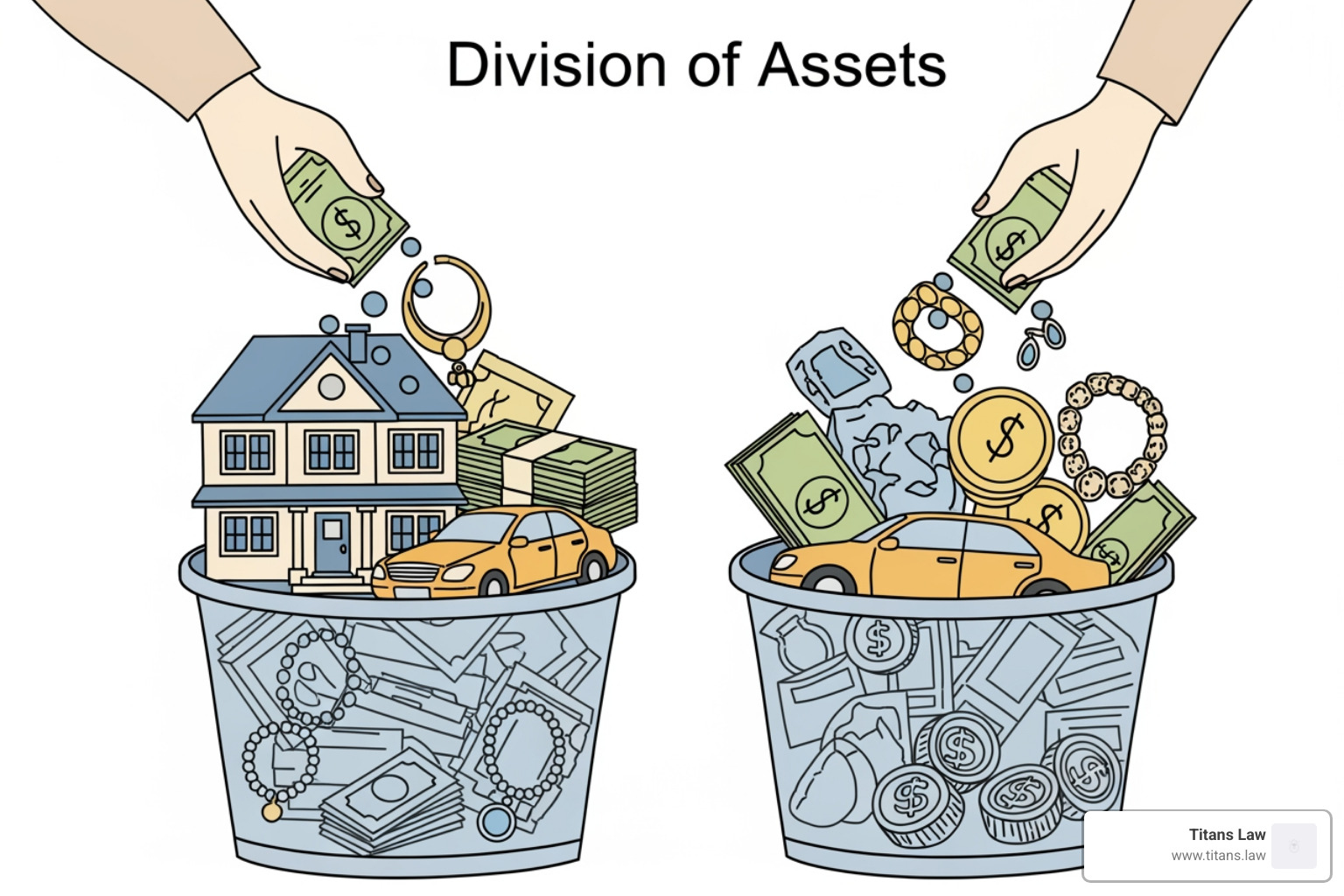
The division of assets is a financially consequential aspect of dissolving a business partnership. When a relationship fractures, every asset and debt accumulated by the enterprise becomes subject to division—from real estate and capital accounts to intellectual property and commercial loans.
Key factors in asset division:
- Governing documents: A well-drafted partnership, shareholder, or operating agreement will dictate the terms of division. Without one, state business statutes apply.
- Asset classification: A clear distinction must be made between assets owned by the business entity and those owned personally by the principals.
- Valuation: Determining the true fair market value of tangible and intangible assets often requires forensic accountants and industry-specific appraisers.
- Complex assets: Business goodwill, intellectual property, and complex investment vehicles demand sophisticated valuation and strategic allocation.
- Debts: Liabilities, including loans, lines of credit, and accounts payable, are allocated according to legal liability and any personal guarantees.
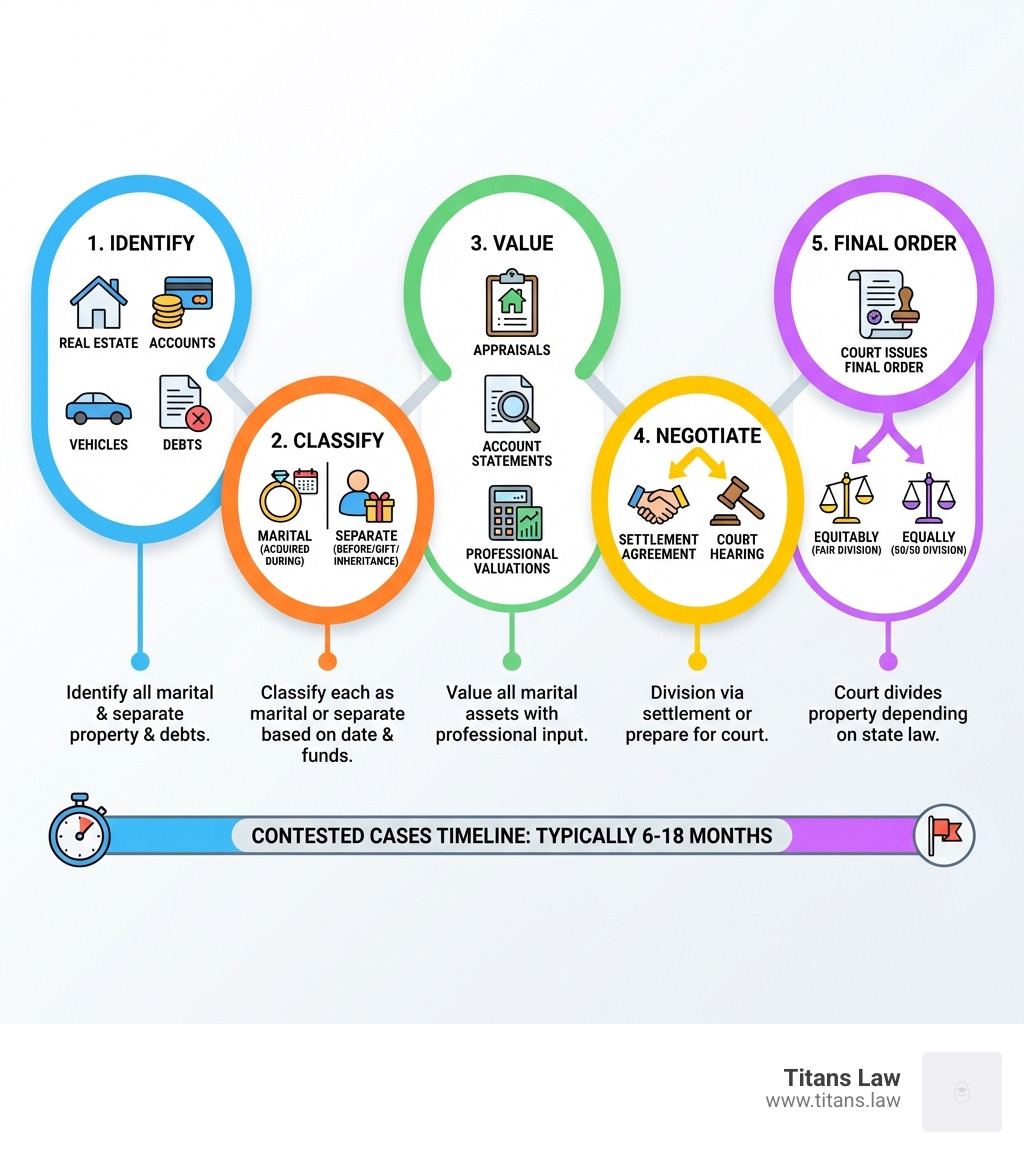
This process begins with asset identification (a complete inventory), followed by valuation (forensic analysis for intricate holdings), and finally allocation (determining distribution based on governing agreements or court proceedings).
The division is not final until a court approves a settlement or issues a judgment. Once finalized, these orders are typically permanent and can be modified only under extraordinary circumstances, such as proof of fraud.
The Financial Battlefield: Partnership vs. Separate Assets
In business dissolution, the most contentious battle revolves around classifying property as either a “partnership asset” or a “separate asset.” This distinction is paramount, as only partnership assets are subject to division. For business owners facing significant financial consequences, strategically litigating these classifications is critical.
In any business dispute, the lines between company property and personal property can become blurred, especially in closely-held companies where formalities may not have been strictly observed.
Commingling and Transmutation
Capital contributions can be jeopardized through commingling—mixing personal funds with business funds. For instance, equipment purchased with personal funds but maintained with company money may be deemed a business asset. This requires meticulous tracing of funds, often involving forensic accounting.
Transmutation occurs when a separate asset is treated in such a way that it legally becomes a business asset. This could happen if a personally-owned building is used as the primary place of business without a formal lease. Proving or disproving transmutation demands a robust legal strategy and compelling evidence.
What is the difference between partnership property and personal assets?
The core difference lies in ownership, intent, and use. Partnership property generally encompasses assets acquired by and for the business, including:
- Real estate and bank accounts held in the business name.
- Equipment, inventory, and vehicles used for operations.
- Intellectual property, client lists, and goodwill developed by the business.
Separate assets typically include:
- Assets owned by a partner before the business was formed.
- Property acquired individually with personal funds for personal use.
- Assets explicitly designated as separate in a partnership or shareholder agreement.
The burden of proof to demonstrate that an asset is separate rests on the partner making that claim. Using personal bank accounts for business transactions can quickly lead to the commingling of funds.
Can personal assets be seized in a business dissolution?
While personal assets are generally protected, exceptions exist. A partner’s personal guarantee on a business loan allows creditors to pursue personal assets. Another risk is commingling, where the failure to maintain a strict separation between finances can lead a court to “pierce the corporate veil,” making personal assets vulnerable to business creditors.
Furthermore, if a partner has used personal assets in a way that they have effectively become business property through transmutation, those assets may be included in the pool of divisible property. Litigating these claims requires a deep understanding of financial records and aggressive advocacy.
More info about civil litigation services
Governing Documents vs. Statutory Defaults: Two Frameworks for Division
The approach to the division of assets in a business breakup follows either a pre-existing agreement or statutory default rules. Understanding which framework applies is fundamental to developing a winning litigation strategy.

Default rules for partnership dissolution vary by state, making expert legal counsel essential. A strong partnership, shareholder, or operating agreement acts as a private set of laws for the business. In its absence, the dispute is governed by state statutes, which may produce unintended outcomes.
| Feature | Division by Agreement | Division by Statutory Default |
|---|---|---|
| Division Principle | Determined by contract terms (e.g., buyout formulas). | Governed by state law (e.g., equal division). |
| Factors Considered | Only factors specified in the agreement. | Statutory factors (may ignore “sweat equity”). |
| Judicial Discretion | Limited; courts enforce the contract. | High; courts interpret and apply the statute. |
| Process | Follows the agreed-upon process. | Follows court-supervised winding up. |
How do operating agreements dictate asset division?
A comprehensive operating agreement is the most important document for controlling the division of assets. It allows owners to proactively define rules, providing certainty and minimizing disputes. Key provisions include:
- Capital Accounts: Rules on how contributions are tracked and returned.
- Distribution Waterfall: A clear order of priority for asset distribution.
- Valuation Methods: A pre-agreed formula, such as a multiple of EBITDA.
- Buy-Sell Provisions: Terms for buying out a departing member’s interest.
- Dispute Resolution: Clauses requiring mediation or arbitration before litigation.
What happens without a clear partnership agreement?
Operating without a written agreement is a high-risk gamble. Partners become subject to the default rules of their state’s partnership or LLC acts. These statutory provisions are one-size-fits-all solutions that may be at odds with the partners’ intentions. For example, some state laws mandate equal profit sharing regardless of initial capital contributions.
In the absence of an agreement, dissolution becomes a formal, court-supervised “winding up.” This involves liquidating assets—often at lower prices—to pay creditors before distributing remaining funds. This public process can destroy business value, making aggressive litigation essential to advocate for a fair accounting.
Strategic Litigation for the Division of Business Assets
When financial stakes are high, effective litigation demands strategic acumen, meticulous investigation, and aggressive advocacy. This is particularly true when dealing with complex assets, hidden wealth, or a partner’s attempts to undermine the enterprise.
Asset valuation is a cornerstone of high-stakes division. Determining the true worth of real estate portfolios, intellectual property, or investment schemes requires specialized expertise. This often necessitates retaining forensic accountants to examine financial records and trace funds. Business valuation involves assessing market conditions, future projections, and personal goodwill.
Hidden assets and dissipation are serious risks. Partners may attempt to conceal funds or engage in unauthorized spending to devalue the business. Our firm is adept at initiating aggressive findy, including subpoenas and depositions, to ensure full financial disclosure and hold malfeasant partners accountable.
How are complex assets divided?
Dividing intellectual property (IP) and business interests presents unique challenges. These assets often represent the core value of an enterprise.
- Business Interests: Valuation can be highly contentious, requiring expert appraisers. Division can take the form of buyouts, in-kind distributions, or the sale of the business as a going concern.
- Intellectual Property: Patents, trademarks, and trade secrets require experts to assess market potential. Division may involve licensing agreements, royalty streams, or an outright sale.
The Role of Agreements and Misconduct
Partnership and shareholder agreements are powerful instruments for controlling asset division. However, an agreement’s enforceability can be challenged if terms are ambiguous or illegal. Litigating these interpretations requires meticulous attention to detail.
Financial misconduct, or the intentional depletion of assets (dissipation), is a breach of fiduciary duty. If a partner is found to have hidden or wasted company assets, the court has the power to:
- Award a disproportionate share of remaining assets to the non-breaching partners.
- Order the guilty partner to reimburse the business.
- Award punitive damages in cases of fraud or malice.
Proving these claims requires a hard-hitting approach, compelling evidence, and expert testimony.
Resolving Disputes: From Negotiation to Courtroom Battle
While some owners prefer negotiated resolutions, high-stakes division of assets often involves significant conflict. The path to resolution ranges from structured negotiation to intensive courtroom battles.
Methods like mediation and arbitration offer avenues to reach agreements outside of traditional litigation. However, these are only viable when all parties engage in good faith. When a party conceals assets or makes untenable demands, the matter shifts to a contested dissolution, necessitating aggressive litigation to protect our clients’ interests.
How can business partners reach a settlement?
Principals can reach a settlement through negotiation, resulting in a Settlement Agreement. This process typically involves:
- Full Financial Disclosure: All parties must provide accurate information regarding all business assets and liabilities.
- Settlement Proposals: Each side presents proposals for asset and debt division until a resolution is reached.
- Mediation: A neutral third party can help facilitate discussions and narrow disputes.
- Judicial Approval: Even if a settlement is reached, it is often incorporated into a final court order to ensure it is legally binding and enforceable.
Any settlement must be evaluated for its strategic impact on long-term financial exposure and control. We scrutinize all proposed agreements to identify vulnerabilities.
What is the role of a mediator or financial advisor?
In complex dissolutions, mediators and financial professionals are important technical resources, but they do not replace legal representation.
- A mediator facilitates communication and helps owners explore solutions but does not provide legal advice or make rulings.
- Financial experts, such as forensic accountants, provide objective analysis of the company’s worth, trace misappropriated funds, and calculate damages from misconduct.
Neither can act as your legal advocate in court or conduct aggressive findy to uncover hidden assets. In high-stakes disputes, their roles complement the need for a litigation firm prepared to drive the matter to a decisive outcome.
Frequently Asked Questions about Business Asset Division
Can a business dissolution judgment be modified?
In most jurisdictions, a final judgment ordering the division of business assets is final and not subject to modification. This underscores the importance of a robust initial litigation strategy.
However, a court might reopen a judgment under limited circumstances:
- Fraud on the Court: If one party committed fraud, such as hiding substantial assets or falsifying documents.
- Undisclosed Assets: If significant assets were entirely undisclosed during findy.
- Clerical Errors: Minor mistakes or miscalculations in the original order.
Successfully reopening a final judgment is a complex matter that demands a high burden of proof to show fundamental deception.
How are business debts allocated?
Business debts, including bank loans, lines of credit, and lease obligations, are also allocated during dissolution.
- Entity vs. Personal Liability: The first step is determining which debts involve personal guarantees.
- Allocation in Agreement: A settlement will specify responsibility for debts, but this agreement does not bind creditors.
- Creditor Rights: If a former partner fails to pay a joint debt, the creditor can still pursue you if you are on the loan.
A key strategic priority is to have the responsible party refinance debts into their own name, releasing the other party from liability.
What is the process for dividing real estate and physical property?
Real estate owned by the business must be addressed through:
- Selling the Property: Selling on the open market and dividing net proceeds.
- Buyouts: One partner buys out the other’s interest based on an appraisal. This requires securing financing to remove the other partner’s name from mortgages.
- In-Kind Distribution: Distributing specific properties directly to partners.
For physical property (equipment, inventory, vehicles):
- Inventory and Valuation: Creating a detailed list and determining fair market value through appraisals.
- Allocation or Sale: Partners may agree to divide items directly or sell them at auction.
Ensuring all legal formalities, such as recording new deeds, are correctly executed is critical to preventing future title disputes.
Conclusion: Protecting Your Financial Future
The division of assets in a business dissolution is a pivotal event that shapes your financial position and leverage. The complexities of classifying assets, navigating valuation disputes, and addressing fiduciary misconduct demand a strategic, hard-hitting approach.
At Titans Law, we recognize that complex commercial disputes require more than routine representation. We focus on high-stakes civil litigation, bringing disciplined strategy, detailed financial analysis, and assertive courtroom advocacy to every matter. Our attorneys work to uncover every asset and position our clients for a strong financial outcome.
When the exposure is significant and your business interests are on the line, you need a firm that is prepared to litigate aggressively and pursue results.
Florida, United States