
Why Business Litigation Florida Demands Hard-Hitting Advocacy
Business litigation Florida is a high-stakes legal battleground where companies and executives face disputes that can threaten their financial survival, reputation, and market position. When informal negotiations fail and significant assets hang in the balance, strategic litigation becomes the only path forward.
What is Business Litigation in Florida?
Business litigation encompasses the full spectrum of commercial legal disputes resolved through Florida’s court system:
- Contract Disputes – Breach of contract claims, non-performance issues, and enforcement actions
- Shareholder & Partnership Conflicts – Derivative actions, fiduciary duty breaches, and corporate governance battles
- Business Torts – Fraud, interference with contracts, defamation, and unfair competition
- Intellectual Property – Trade secret theft, non-compete violations, and trademark disputes
- Corporate Governance – Dissolution proceedings, minority shareholder oppression, and management disputes
Florida’s legal landscape adds complexity to these disputes. The state has specialized Business Courts in multiple judicial circuits—including the Eleventh Judicial Circuit’s Complex Business Litigation Division created in 2006—designed to handle intricate commercial matters efficiently. These specialized dockets feature judges with deep business law expertise and streamlined procedures for high-exposure cases.
The stakes are real. Whether you’re defending against a shareholder lawsuit, pursuing a claim for stolen intellectual property, or locked in a “bet-the-company” contract dispute, the outcome will have lasting financial and operational consequences. Florida’s Business Court system processes disputes ranging from multi-million dollar commercial contract breaches to complex corporate governance challenges, all governed by the Florida Rules of Civil Procedure.
Success in this arena requires more than competent legal representation. It demands aggressive advocacy, strategic precision, and attorneys who understand how to leverage Florida’s procedural rules and specialized court systems to achieve decisive outcomes.
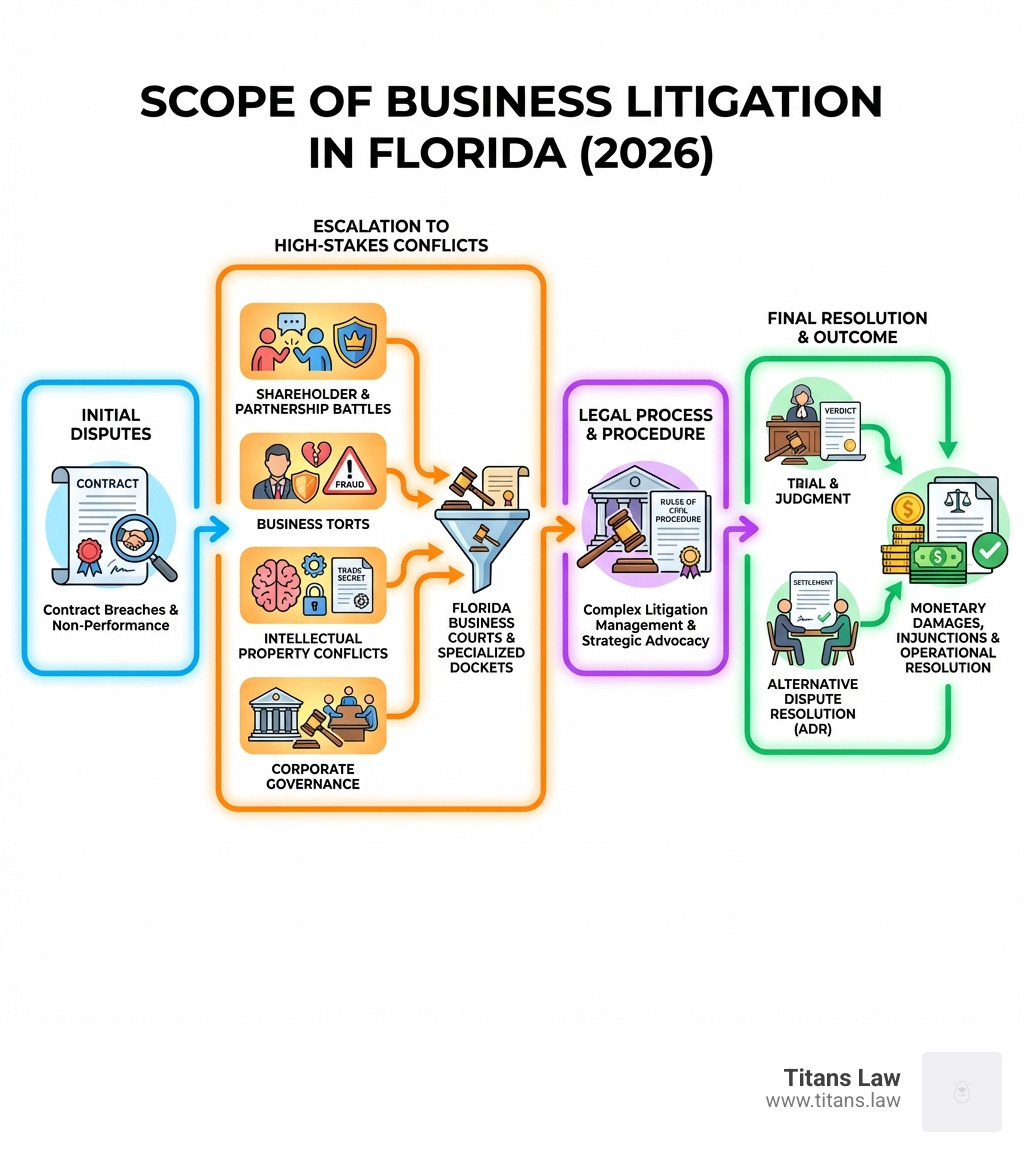
Navigating the Battlefield: Common Types of High-Stakes Business Disputes
In the competitive landscape of Business litigation Florida, disputes are an inevitable reality. For businesses operating in Florida, understanding the common types of high-stakes conflicts that often lead to litigation is crucial. We specialize in representing clients in a broad range of these complex disputes, from those that threaten the very existence of a company to contentious disagreements among partners.

The issues we encounter frequently include:
- Breach of Contract: This is perhaps the most common source of business litigation, involving disputes over the terms, performance, or interpretation of agreements.
- Shareholder and Partnership Disputes: Conflicts arising among owners, partners, or corporate shareholders, often concerning control, financial distributions, or strategic direction.
- Business Torts: These involve wrongful acts committed by one business entity against another, such as fraud, tortious interference with contracts, unfair competition, or defamation.
- Breach of Fiduciary Duty: Claims against individuals (like officers, directors, or partners) who have failed to act in the best interests of the business or its stakeholders.
- Trade Secret Theft: Protecting proprietary information, client lists, and innovative processes from misappropriation by competitors or former employees.
- Non-Compete Agreement Enforcement: Litigating the validity and enforceability of restrictive covenants designed to protect business interests after an employee’s departure.
- Intellectual Property Conflicts: Disputes over trademarks, copyrights, and other intellectual property rights, including infringement claims.
- Commercial Lease Disagreements: Conflicts arising from the terms, renewal, or termination of commercial property leases, which in Florida are not subject to rent control laws, making negotiation critical.
- Regulatory Compliance Issues: Navigating legal challenges stemming from non-compliance with federal, state, and local regulations across various sectors, including health and safety, environmental, data protection, and financial laws.
Each of these dispute types carries significant financial and operational risks, demanding a strategic and aggressive legal approach.
Understanding Contractual Warfare
At the heart of many business relationships are contracts. When these agreements are broken, or their terms are disputed, the consequences can be severe, often leading to what we refer to as “bet-the-company” litigation.
Breach of contract claims arise when one party fails to fulfill its obligations under an agreement. This can involve non-performance issues, where a party simply doesn’t do what they promised, or disputes over material breaches – failures so significant they undermine the entire contract. Our firm focuses on strategically navigating these complex claims, whether pursuing enforcement or defending against allegations.
Remedies sought in contractual disputes can vary widely. We aggressively pursue our clients’ interests, whether that means demanding liquidated damages as specified in the contract, seeking specific performance to compel the breaching party to fulfill their obligations, or arguing for other forms of compensation to cover losses. The key is to develop a litigation strategy that aligns with our client’s business goals and needs, understanding the complexities of trial to position cases for success.
Corporate & Shareholder Power Struggles
Internal conflicts within companies, especially closely held businesses, can be incredibly destructive. These corporate and shareholder power struggles often involve high stakes, impacting control, profitability, and the long-term viability of the enterprise.
We represent clients in a range of these intricate disputes, including:
- Derivative Actions: Lawsuits brought by shareholders on behalf of the corporation against its directors or officers for breaches of fiduciary duty.
- Disputes among Closely Held Companies: Conflicts between founders, partners, or members of LLCs over management decisions, profit distribution, or valuation.
- Minority Shareholder Oppression: Cases where majority shareholders or management exploit their control to disadvantage minority owners, often involving breaches of fiduciary duties.
- Corporate Governance Challenges: Litigation concerning the proper functioning of a company’s board, bylaws, or operational structure, including issues of dissolution or liquidation rights.
These cases require not only deep legal expertise but also a nuanced understanding of corporate dynamics and aggressive advocacy to protect our clients’ interests. We are adept at representing minority shareholders against majority shareholders in cases involving breaches of fiduciary duties, ensuring their rights are vigorously defended.
The Anatomy of a Lawsuit: Key Stages of Business Litigation in Florida
Navigating a business dispute through the Florida court system is a structured process governed by specific procedural rules. Understanding these stages is essential for any business contemplating or facing litigation. The Florida Rules of Civil Procedure dictate the framework for civil actions in both circuit and county courts, ensuring a systematic approach to resolving disputes.

A typical Business litigation Florida case unfolds through several critical phases:
- Pleadings Stage: This initial phase involves the formal exchange of documents that set out the parties’ claims and defenses. It begins with the filing of a Complaint, outlining the plaintiff’s allegations and requested relief. The defendant then responds with an Answer, admitting or denying allegations and raising any affirmative defenses or counterclaims.
- Findy Phase: This is an extensive information-gathering period where parties exchange relevant evidence and facts. It involves various tools to uncover information.
- Motion Practice: Throughout the litigation, parties file motions with the court to request specific actions or rulings. These can range from motions to compel findy to motions for summary judgment, which ask the court to rule on a case or specific issues without a trial.
- Trial: If the case doesn’t settle or isn’t resolved by motions, it proceeds to trial, where evidence is presented, and arguments are made before a judge or jury.
- Post-Trial Motions and Appeals: After a verdict, parties may file motions for a new trial or other relief. Unfavorable judgments can also be challenged through an appeal to a higher court.
Our firm is committed to guiding our clients through every step of this rigorous process, leveraging our experience to develop custom legal strategies. For more detailed information on our comprehensive litigation services, we invite you to explore our offerings: More info about our litigation services.
The Findy Gauntlet
The findy phase is often the most time-consuming and resource-intensive part of Business litigation Florida. It is a strategic gauntlet designed to uncover all relevant facts and evidence, and our approach is to leave no stone unturned. This phase is crucial for building a robust case or defense, allowing us to understand the strengths and weaknesses of both sides.
Key components of the findy gauntlet include:
- Strategic Information Gathering: We carefully identify and pursue all avenues for obtaining information pertinent to the dispute. This includes gathering documents, electronic data, and identifying potential witnesses.
- E-Findy Complexities: Electronic findy (e-findy) is paramount. We steer the complexities of collecting, processing, and reviewing vast amounts of electronic data, ensuring compliance with data privacy and security regulations.
- Depositions: We conduct and defend depositions of key witnesses, including corporate officers, employees, and experts. This involves sworn oral testimony taken outside of court, providing crucial insights into the other side’s case and preserving testimony for trial.
- Interrogatories: These are written questions posed to the opposing party, requiring sworn written answers. We craft precise interrogatories to elicit critical information and narrow down disputed facts.
- Document Production: We request and review all relevant documents from the opposing party, ranging from contracts and financial records to internal communications and business plans. Similarly, we assist our clients in fulfilling their own document production obligations.
- Expert Witness Engagement: For complex business matters, we identify and engage leading industry experts whose testimony can be pivotal in explaining technical concepts, assessing damages, or providing opinions on specialized issues.
- Building Leverage for Negotiation or Trial: The information uncovered during findy is instrumental in building leverage. It informs settlement negotiations and shapes our trial strategy, allowing us to present the most compelling case possible.
The thoroughness and strategic execution of findy can often dictate the trajectory of a lawsuit, making it a phase where aggressive and meticulous legal representation is indispensable.
The Path to a Verdict
When a Business litigation Florida case cannot be resolved through negotiation or pre-trial motions, it moves to trial – the ultimate test of our strategic advocacy. The path to a verdict is a dynamic and challenging process, demanding not only a deep understanding of the law but also exceptional courtroom skills.
The trial process typically involves:
- Jury Selection (Voir Dire): If a jury trial has been demanded, we strategically select jurors who are fair, impartial, and receptive to our client’s narrative. This involves careful questioning to identify potential biases.
- Opening Statements: We deliver a compelling opening statement that outlines our client’s case, presenting a clear and persuasive roadmap of the evidence the jury will hear. This is our first opportunity to make a strong impression and frame the narrative.
- Presentation of Evidence: This is the core of the trial, where we present witnesses and introduce documents to support our client’s claims or defenses. Our attorneys are skilled at direct examination, carefully eliciting testimony and introducing exhibits to build a cohesive and convincing story.
- Cross-Examination: We vigorously cross-examine opposing witnesses to challenge their credibility, expose inconsistencies, and undermine the opposing party’s case. This requires sharp legal acumen and strategic thinking.
- Closing Arguments: At the conclusion of evidence, we deliver a powerful closing argument, synthesizing the evidence and legal principles to persuade the judge or jury to rule in our client’s favor.
- Jury Deliberation and Verdict: Following closing arguments, the jury retires to deliberate and reach a verdict. In a bench trial, the judge renders the decision.
Our trial attorneys are prepared to fight tirelessly in the courtroom, combining strategic, hard-hitting advocacy with a meticulous presentation of facts. We understand the nuances of trial and how to position cases for success, ensuring our clients receive the most robust representation possible.
The Strategic Advantage: Specialized Courts and Elite Legal Counsel
In the field of Business litigation Florida, the structure of the judicial system itself offers strategic advantages for complex cases. Florida has recognized the need for specialized handling of intricate commercial disputes, leading to the establishment of Business Courts and Complex Business Litigation Divisions within its judicial circuits. These specialized venues, coupled with the expertise of board-certified attorneys, provide a formidable advantage for businesses facing high-stakes legal battles.
The Eleventh Judicial Circuit, for example, created its Complex Business Litigation Division in 2006 specifically to address the overwhelming number of complex business cases filed in that circuit. This division aims to promote the orderly and efficient disposition of such matters. Similarly, the Thirteenth Judicial Circuit established its Business Court in 2007 to resolve business-related disputes. These specialized courts are designed to handle cases from shareholder derivative actions to intellectual property disputes with a focus on efficiency and judicial expertise.
Why Board Certification Matters in Business Litigation Florida
When the future of your business is on the line, the qualifications of your legal counsel are paramount. In Business litigation Florida, selecting a board-certified business litigation attorney provides a distinct strategic advantage. The Florida Bar’s Board Certification program is a rigorous process designed to identify lawyers who possess special knowledge, skills, and proficiency, as well as the character, ethics, and reputation for professionalism in a specific area of law.
As of recent data, there are over 200 board-certified business litigation lawyers in Florida, signifying a select group of legal professionals. This certification is not merely an accolade; it is a testament to a lawyer’s proven expertise in complex commercial disputes. The requirements are stringent:
- A minimum of five years of law practice.
- Substantial involvement (30% or more) in business litigation for at least five years.
- Handling at least 25 contested business litigation matters within the preceding five years, with at least eight matters submitted to a trier of fact (excluding summary judgments).
- Participation in at least one business litigation jury trial in the preceding 10 years, or an approved Advanced Trial Advocacy Course.
- Completion of 50 hours of approved business litigation Continuing Legal Education (CLE) in the preceding three years.
- Successful completion of a peer review process.
- Passing a comprehensive written examination.
This rigorous process ensures that board-certified attorneys are not just knowledgeable, but possess the practical trial experience necessary to steer the complexities of high-stakes litigation. It is a credential that signifies a courtroom-dominant trial attorney, capable of delivering aggressive, results-driven representation. For more details on these stringent requirements, you can refer to The Florida Bar’s Business Litigation Certification.
Leveraging Florida’s Business Court System
Florida’s specialized Business Courts and Complex Business Litigation Divisions offer a streamlined and expert-driven forum for resolving intricate commercial disputes. These courts are not just separate dockets; they represent a concerted effort by the state judiciary to provide a more efficient and effective path for businesses facing litigation.
Key advantages of leveraging Florida’s Business Court system include:
- Specialized Dockets for Complex Cases: These divisions are specifically designed to handle a broad range of complex business matters, including internal affairs or governance disputes, dissolution rights, obligations between owners, liability or indemnity of managers, trade secrets and non-compete agreements, intellectual property cases, securities litigation, antitrust statutes, shareholder derivative actions, and disputes related to the purchase and sale of businesses or assets.
- Streamlined Procedures: The Complex Business Litigation Rules and Procedures, often guided by administrative orders like Administrative Order 25-01 in the Eleventh Judicial Circuit, are custom to facilitate the efficient presentation of matters. These rules promote easy transmission and access to case information, avoid technical delays, and encourage civility, all aimed at the just and prompt determination of proceedings.
- Judicial Expertise: Judges assigned to these divisions often have extensive experience and expertise in business law, allowing for a deeper understanding of the commercial nuances and legal complexities inherent in these cases. This specialized knowledge can lead to more informed and consistent rulings.
For instance, the Eleventh Judicial Circuit’s Complex Business Litigation Division, as detailed on its official page, has a dedicated judge, support staff, case manager, court clerk, and legal staff to manage these cases. Parties are typically required to meet and confer before presenting issues to the court, fostering a more collaborative, yet still aggressive, approach to case management. You can find more information about the Eleventh Judicial Circuit’s division here: The Eleventh Judicial Circuit’s Complex Business Litigation Division. Similarly, the Thirteenth Judicial Circuit’s Business Court operates under Local Rule 3, approved by the Florida Supreme Court, governing its procedures.
By engaging with these specialized court systems, we ensure our clients benefit from a judicial environment equipped to handle the unique demands of sophisticated Business litigation Florida.
The Endgame: Potential Outcomes and Proactive Risk Management
In Business litigation Florida, the ultimate goal is always a decisive outcome that protects our client’s interests. While the journey through the legal system can be arduous, understanding the potential remedies and proactively managing risks can significantly influence the endgame.
Remedies and Resolutions in Business Litigation Florida
The potential outcomes in a Florida business litigation case are varied and depend heavily on the specifics of the dispute, the strength of the evidence, and the strategic legal approach employed. We aggressively pursue the remedies that best serve our clients’ objectives, whether they are monetary or involve other forms of relief.
Key remedies and resolutions include:
- Monetary Damages:
- Compensatory Damages: Designed to compensate the injured party for actual losses suffered, putting them in the position they would have been in had the breach or wrongful act not occurred. This can include lost profits, out-of-pocket expenses, and other measurable financial harm.
- Punitive Damages: Awarded in cases where the defendant’s conduct was particularly egregious, intended to punish the wrongdoer and deter similar conduct in the future. These are typically reserved for situations involving gross negligence, fraud, or intentional wrongdoing.
- Injunctive Relief: This is a court order compelling a party to either perform a specific act or cease a specific act. For example, an injunction might be sought to stop a former employee from violating a non-compete agreement or to prevent a competitor from using stolen trade secrets. Conversely, it could compel a party to fulfill a contractual obligation.
- Declaratory Judgments: A court ruling that defines the rights and obligations of parties in a legal dispute, often sought to clarify contractual terms or legal status before further harm occurs.
- Specific Performance Orders: In certain contract disputes, particularly those involving unique assets like real estate, a court may order the breaching party to fulfill the exact terms of the contract rather than simply paying damages.
While our primary focus is aggressive litigation, we also strategically leverage alternative dispute resolution (ADR) methods like mediation and arbitration when they align with our clients’ objectives. These methods, integrated into the Florida Rules of Civil Procedure, can offer efficient pathways to resolution, particularly when a negotiated settlement achieves the desired outcome without the need for a full trial. Mediation involves a neutral third party facilitating a settlement, while arbitration involves a neutral arbitrator (or panel) hearing evidence and issuing a binding decision. The strategic use of these tools is always considered in pursuit of our clients’ goals.
Fortifying Your Business Against Legal Assault
The best defense against Business litigation Florida is often a strong offense in the form of proactive risk management. By implementing robust legal strategies and safeguards, businesses can significantly reduce their vulnerability to legal challenges and minimize their exposure to high-stakes disputes.
Here are proactive measures we advise businesses to implement:
- Drafting Ironclad Contracts: Clear, comprehensive, and legally sound contracts are the first line of defense. These should explicitly define payment terms, delivery schedules, performance expectations, and crucial dispute resolution mechanisms. Poorly drafted agreements are a frequent source of litigation.
- Establishing Clear Corporate Governance: For corporations and partnerships, well-defined bylaws, operating agreements, and shareholder agreements can prevent internal conflicts. Clear rules regarding decision-making, profit distribution, and owner responsibilities can avert many shareholder and partnership disputes.
- Implementing Robust Compliance Programs: Ensuring adherence to federal, state, and local laws—including health and safety, environmental, data protection, consumer protection, and financial regulations—is critical. Non-compliance can lead to regulatory actions, fines, and private lawsuits.
- Protecting Intellectual Property: Proactively register trademarks and copyrights, implement trade secret protection protocols, and enforce non-disclosure agreements. Vigilance in safeguarding intellectual assets can prevent costly infringement litigation.
- Conducting Thorough Due Diligence: Before entering into significant transactions, such as business purchases, sales, or major partnerships, comprehensive due diligence is essential. This process uncovers potential liabilities, contractual issues, and other risks that could lead to future litigation.
- Seeking Regular Legal Counsel: Proactive engagement with experienced legal counsel can help identify potential legal pitfalls before they escalate into lawsuits. This includes reviewing business practices, contracts, and employment policies to ensure compliance and mitigate risk.
By taking these proactive steps, businesses can build a stronger legal foundation, reducing the likelihood of costly and disruptive litigation.
Conclusion
Business litigation Florida is an intricate and demanding field that requires a strategic, hard-hitting approach. From the initial spark of a dispute to the final verdict, every stage is critical and can have profound implications for a business’s future. We understand that in this high-stakes environment, protecting your business interests and achieving decisive outcomes demands more than just legal knowledge—it requires aggressive advocacy and a relentless commitment to winning.
Our firm stands ready to provide that level of representation. We combine strategic, hard-hitting advocacy with a deep understanding of the complexities of Florida’s legal landscape, including its specialized Business Courts and the rigorous procedures of the Florida Rules of Civil Procedure. When the stakes are high, a premier trial law firm is your greatest asset, ensuring your business is not just represented, but powerfully defended.
When your business faces a critical legal challenge in Florida, we are the firm you want in your corner. Contact our elite civil litigation firm to discuss your case and learn how we can help you steer the complexities of Business litigation Florida to achieve a decisive resolution: Contact our elite civil litigation firm to discuss your case.