
The High Stakes of Property Disputes
Residential property disputes are among the most common and costly legal conflicts in the United States. Whether it’s a neighbor’s fence encroaching onto your land, a fraudulent seller who concealed structural defects, or a co-owner refusing to honor a partition agreement, these conflicts threaten both financial security and peace of mind.
Key Types of Residential Property Disputes:
- Boundary and Encroachment Disputes – Fences, structures, or landscaping crossing property lines
- Breach of Contract – Failures in purchase agreements or seller disclosure obligations
- Adverse Possession Claims – Legal doctrine allowing someone to claim title through continuous, unauthorized use
- Co-Owner Conflicts – Disagreements over management, sale, or partition of jointly owned property
- Zoning and Nuisance Issues – Unauthorized property use, excessive noise, or blocked views
- Title and Ownership Disputes – Unclear chain of title or competing ownership claims
Land feuds are as American as baseball. When the first settlers arrived, property disputes erupted up and down the East Coast. As development moved westward, these conflicts became the most common type of legal dispute in the country. Today, rapid commercial and residential growth has only intensified the frequency and complexity of real estate litigation.
The financial consequences are severe. Property line disputes are handled in superior court—not the less expensive venue of small-claims court. In Washington State, the prevailing party in an adverse possession claim is awarded attorneys’ fees, raising the stakes even higher. A seemingly minor boundary disagreement can spiral into a multi-year legal battle costing tens of thousands of dollars.
These disputes demand strategic, aggressive legal action. Passive representation or delayed response can result in permanent loss of property rights. When your investment, your livelihood, or your legal ownership is on the line, you need counsel who treats your case with the seriousness it deserves.
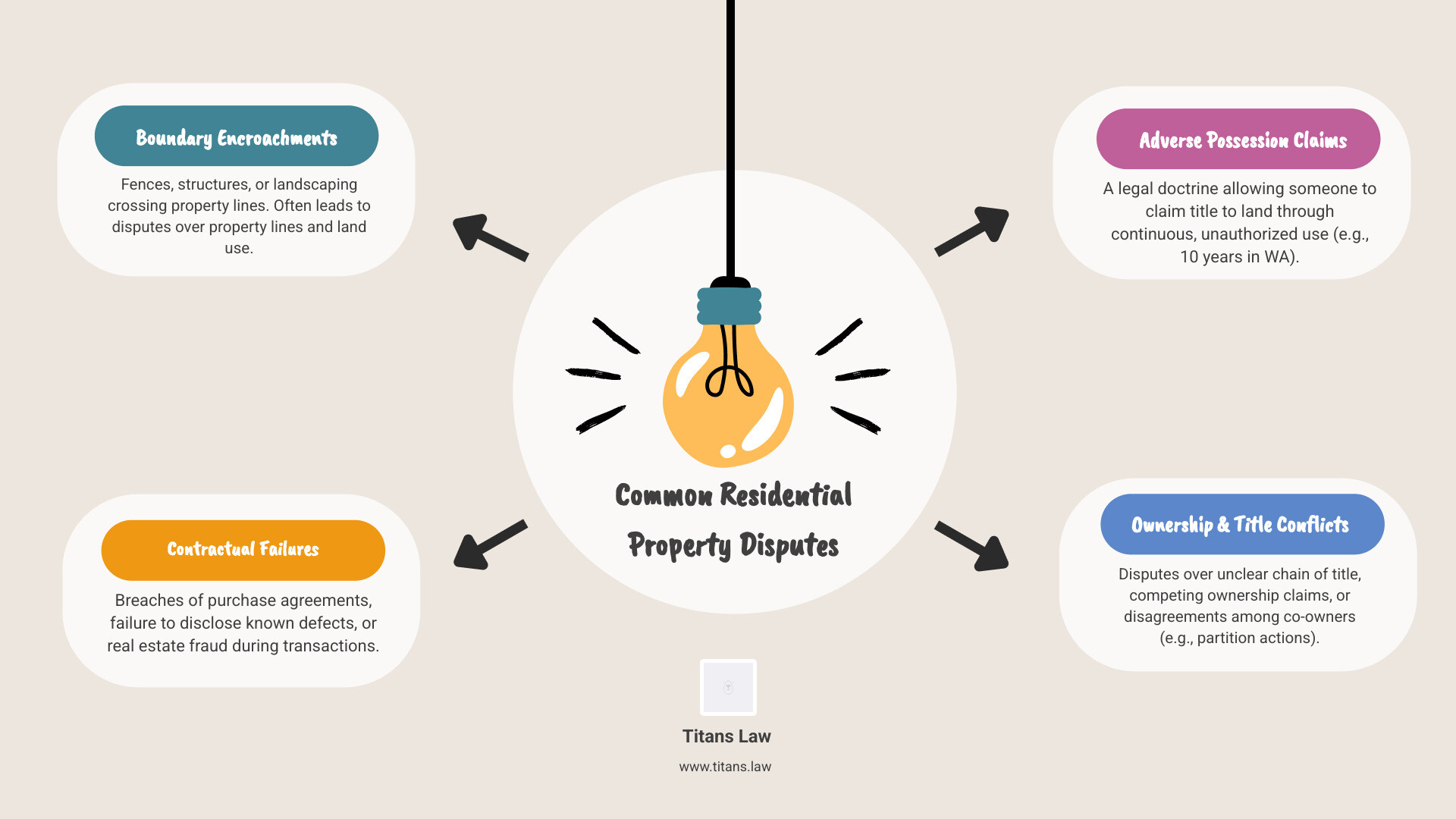
Common Types of Residential Property Disputes and Their Triggers

Residential property disputes can arise from a myriad of situations, often turning otherwise good neighbors into legal adversaries. Understanding the common triggers is the first step in protecting your property rights.
Boundary Line Encroachments and Fences
One of the most frequent sources of friction between property owners involves boundary lines. An encroachment occurs when a structure, fence, or other improvement from one property extends onto an adjacent property. This can happen innocently, perhaps due to an outdated survey or a misunderstanding, but the legal implications are significant.
We often see disputes over:
- Fences and structures: A neighbor builds a new fence, shed, or even a pool that inadvertently crosses the property line. As attorney Mary C. Anderson notes, “It’s always the same issue: that your fence has encroached on my property.”
- Landscaping and trees: Overhanging tree branches, invasive roots, or landscaping that extends onto a neighbor’s yard can also lead to heated arguments.
- Legal implications of encroachments: Beyond the initial annoyance, encroachments can diminish property value, complicate future sales, and, if left unaddressed, even lead to claims of adverse possession.
While our firm is based in Florida and handles cases across the United States, it’s illustrative to examine specific state laws regarding fences. For instance, in Washington State, laws address the construction and maintenance of boundary fences. According to RCW 16.60.020 and 16.60.030, a landowner building a boundary fence can generally seek reimbursement for boundary fences from the neighboring landowner for one-half the cost, provided proper notice is given. Furthermore, Washington law prohibits “spite fences.” Washington RCW 7.40.30 specifically states that courts can issue injunctions to stop the construction or compel the removal of fences built maliciously to annoy an adjoining landowner. These examples underscore the fact that fence disputes are rarely simple and often require precise legal interpretation.
Contractual Failures and Real Estate Fraud
Many residential property disputes stem from issues related to contracts. Real estate transactions inherently involve contracts, from purchase agreements to lease agreements. When these agreements are breached, or when one party acts fraudulently, litigation often follows.
Common contractual issues include:
- Breach of purchase agreements: This occurs when one party fails to uphold their end of a real estate contract. For example, a buyer not paying the agreed price, or a seller refusing to complete a transaction. Such breaches can lead to specific performance disputes, where a court compels the party to fulfill the contract, rather than just paying damages.
- Failure to disclose known defects: In the vast majority of states, sellers are legally obligated to disclose known defects before a sale. Failing to disclose issues like leaks, mold, or structural problems can lead to significant disputes and claims of fraud.
- Intentional misrepresentation: Beyond mere non-disclosure, actively misleading a buyer about a property’s condition or characteristics constitutes fraud.
- Fraudulent buyer schemes: Real estate fraud encompasses various deceptive practices. These can include straw buyer schemes, where individuals purchase property on behalf of others who might not qualify for a loan.
- Unlawful property flipping: This involves purchasing and quickly reselling properties at inflated prices, often through deceptive appraisals or false statements, to generate illicit profits.
- Predatory lending practices: These involve lenders imposing unfair or abusive loan terms on borrowers, often targeting vulnerable populations.
These issues highlight the critical importance of due diligence and clear, enforceable contracts in all real estate dealings.
Ownership, Title, and Co-Owner Conflicts
Disputes over who legally owns a property, or how co-owners manage it, are high-stakes affairs.
- Quiet title actions: These lawsuits are designed to clarify legal ownership of real estate, particularly when the chain of title is incomplete, inaccurate, or when there are competing claims. A quiet title action asks the court to consider evidence and definitively determine legal ownership.
- Incomplete chain of title: This can arise from errors in historical records, unrecorded transfers, or unresolved inheritance issues, creating uncertainty about a property’s true owner.
- Co-owner disagreements: When multiple individuals own a property together, disagreements can arise over management decisions, expenses, or whether to sell the property. If these cannot be resolved, a partition action may be necessary, allowing one co-owner to force the sale of the property and divide the proceeds.
- Inheritance disputes: The passing of property through inheritance can be fraught with conflict, especially if there is no clear will or if succession laws are complex. Verifying beneficiary names on government records and ensuring proper distribution according to succession laws are crucial to avoiding disputes.
- Role of title insurance: While title insurance does not always cover every property dispute, purchasing it can significantly reduce the risk of title disputes and can sometimes provide defense against boundary disputes. It helps protect against financial loss from defects in title.
Zoning, Land Use, and Nuisance Claims
Our firm also handles residential property disputes arising from zoning regulations, land use restrictions, and neighborly nuisances.
- Zoning and compliance issues: Every property is subject to local zoning ordinances that dictate how land can be used (e.g., residential, commercial, industrial). Disputes arise when a property owner attempts to use their land in a way that violates these rules, such as operating a business in a residential zone without proper permits.
- Unreasonable interference: This covers a broad range of issues where one property owner’s actions negatively impact another’s enjoyment of their property.
- Blocked views: While often not a legal right, significant changes that intentionally or negligently block a long-standing view can sometimes form the basis of a dispute.
- Excessive noise: Persistent, unreasonable noise from a neighbor can be a significant nuisance, impacting quality of life and potentially leading to legal action.
- Harassment and trespassing: These are direct affronts to property rights. Harassment, under the law, can include threatening physical harm or property damage. Trespassing occurs when someone enters property without permission and refuses to leave, or when a neighbor builds or develops in a way that encroaches on another’s land. Swift, decisive action is critical in these cases to protect your property and personal security.
The Doctrine of Adverse Possession in Washington State
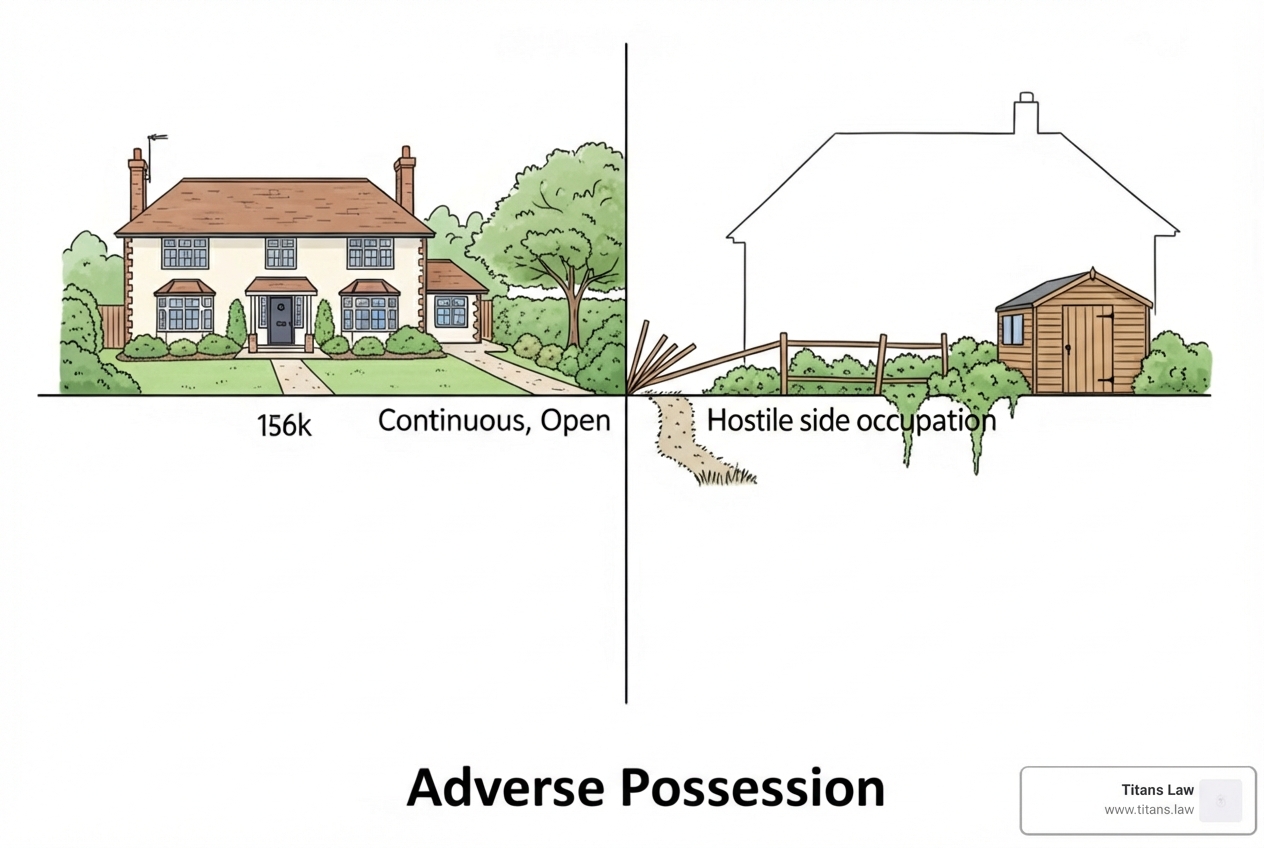
The doctrine of adverse possession is a powerful legal mechanism that allows an individual to acquire legal title to land owned by another, without purchasing it, by fulfilling specific statutory requirements. While our practice primarily focuses on Florida and federal law, understanding the nuances of adverse possession, as exemplified by Washington State law, is crucial for any property owner.
In Washington State, the doctrine of Adverse Possession clarifies who owns a piece of disputed property based on continuous use over time. This is a high-stakes claim, as it can result in the permanent loss of a portion of your land.
The Five Key Elements of an Adverse Possession Claim
To establish a claim for adverse possession in Washington State, a claimant must demonstrate five specific elements, which must be present concurrently for a statutory period of 10 years:
- Open and Notorious use: The claimant’s use of the property must be obvious and visible to the true owner. It cannot be hidden or secretive. This means the owner should reasonably be aware of the encroachment.
- Hostile use (without permission): The use must be without the true owner’s permission. It doesn’t imply ill will, but rather that the claimant is acting as if they own the property, adverse to the true owner’s rights. If the owner grants permission, the “hostile” element is defeated.
- Actual possession: The claimant must physically occupy or use the land in a manner consistent with ownership. This could involve building structures, cultivating crops, or maintaining the land.
- Exclusive possession: The claimant must use the property as their own, to the exclusion of the true owner and the general public. Shared use generally defeats this element.
- Continuous use for 10 years: The claimant’s possession must be uninterrupted for the entire statutory period of 10 years. Even a brief abandonment can reset the clock. However, the use does not have to be constant; it must be consistent with how a true owner would use the property.
Additionally, Washington State law includes a “Color of Title” 7-year rule. If a claimant has a defective deed or other instrument that appears to grant them title (color of title) and they pay property taxes on the land, the statutory period for adverse possession can be reduced to 7 years.
Strategic Implications for Property Owners
The implications of adverse possession are profound for property owners in Washington and elsewhere. The “10-year statute of limitations to object” means that if an original property owner fails to object to a neighbor’s adverse use of their property within this timeframe, they could permanently lose that land. After 10 years, according to Washington law, the original owners no longer own that land.
The high-stakes nature of claims is further amplified by the fact that in Washington State, the prevailing party on an adverse possession property dispute claim would be awarded attorneys’ fees. This provision incentivizes strong legal representation and makes early, decisive action paramount. Ignoring an encroachment or adverse use for too long can have catastrophic consequences, resulting in both the loss of valuable property and significant legal expenses. When facing such a threat, the importance of swift legal action cannot be overstated.
A Strategic Framework for Resolving Residential Property Disputes
When faced with a residential property dispute, a clear, strategic framework is essential. Our firm believes in aggressive, results-driven representation, and that often begins with proactive measures and a clear understanding of the escalation path.
Proactive Measures and Due Diligence
Many disputes can be avoided, or at least mitigated, through diligent upfront work. When you’re in the process of buying or developing property, these actions can save considerable headaches and expense:
- Professional land surveys: Obtaining a current, professional land survey is paramount. It provides a precise, legally recognized definition of your property boundaries, which can prevent or quickly resolve many boundary disputes.
- Comprehensive title search: Before purchasing any property, a thorough title search is always a good idea. This process uncovers all documents related to your property, revealing any existing claims, liens, or easements that could lead to future disputes.
- Reviewing deeds and plat maps: Carefully examining your property deed and any associated plat maps helps ensure the legal description matches your understanding of the property. Discrepancies here are a common source of conflict.
- Understanding municipal codes: Familiarize yourself with local zoning ordinances and building codes. Operating a business in a residential zone or building without proper permits can quickly lead to compliance issues and disputes with neighbors or the municipality.
- Steps to avoid future disputes: Beyond these, we always recommend double-checking the sale deed for errors, ensuring all required municipal approvals and licenses are obtained, verifying that the sanctioned building plan matches the actual built area, and being extra careful with inherited properties by securing proper documentation. For co-owned properties, creating a detailed written contract or agreement outlining rights and obligations is crucial.
The Escalation Path: From Negotiation to Litigation
When a dispute arises, our approach is to pursue the most effective resolution. We advocate for a structured escalation path:
- Firm but civil communication: Initially, attempt to understand the problem and engage in calm, direct communication with the other party. Sometimes, a misunderstanding can be resolved through a simple conversation.
- Formal demand letters: If direct communication fails, a formal demand letter from our firm can often clarify the severity of the situation and compel the other party to take the dispute seriously. This letter outlines your position, the legal basis for your claim, and the desired resolution.
- When to engage legal counsel: It’s time to engage legal counsel when communication breaks down, when the other party is uncooperative, or when the legal complexities require expert navigation. As attorney Mary C. Anderson advises, “It’s time to see a lawyer if the communication between you and a neighbor has broken down and there’s no other option but to enlist an attorney to be a mediator to see if we can resolve this without court intervention.”
- Filing a lawsuit in superior court: If all other avenues are exhausted, filing a lawsuit in superior court becomes necessary. Property line disputes, for instance, are handled in superior court, not small-claims court, indicating their inherent complexity and the need for robust legal representation.
- When to see a lawyer: Beyond communication breakdown, you should consult an attorney if you are served with legal papers, before signing any settlement agreement, when facing complex claims like adverse possession, or whenever the financial stakes of the dispute are high.
Alternative Dispute Resolution (ADR): Mediation vs. Arbitration
Before resorting to full-scale litigation, Alternative Dispute Resolution (ADR) methods can offer quicker and more cost-effective solutions for residential property disputes.
| Feature | Mediation | Arbitration |
|---|---|---|
| Process | Neutral third-party mediator facilitates discussion. | Neutral third-party arbitrator hears evidence and arguments. |
| Outcome | Parties decide whether to agree to a proposed settlement. | Arbitrator issues a decision. |
| Binding Nature | Non-binding, unless parties agree to make it so. | Can be binding if parties agree beforehand. |
| Cost | Generally less expensive than litigation. | Generally less expensive than litigation, but more than mediation. |
| Timeline | Can be concluded in a few hours or meetings. | Can take longer than mediation, as more evidence may be heard. |
Mediation involves an impartial professional helping both sides work out an agreement. It’s confidential and often quicker and cheaper than court proceedings. Arbitration, on the other hand, involves an arbitrator making a decision after hearing evidence, which can be binding if both parties agree. Both typically take about a month to conclude, with mediation potentially wrapping up in a few hours, while arbitration might require more time for evidence review and witness hearings. We help our clients strategically assess which ADR method best suits their objectives and the specific nature of their dispute.
Formal Legal Remedies for Complex Residential Property Disputes
When ADR is insufficient or inappropriate, we pursue formal legal remedies with aggressive litigation:
- Lawsuit to quiet title: This action asks a court to definitively establish legal ownership of a property, resolving any ambiguities or competing claims.
- Injunctions to stop or remove encroachments: An injunction is a court order that can compel a neighbor to stop an offending action (e.g., excessive noise) or remove an encroaching structure.
- Lawsuit to determine a boundary line: If property owners cannot agree on the boundary, any one of them may bring a lawsuit to make this determination, as provided in RCW 58.04.020 in Washington State.
- Pursuing a Boundary Line Adjustment: This is a formal, administrative process (often through the county planning department) to legally shift property lines between adjacent parcels. In Washington State, if all affected landowners agree, they must document the agreement in a written instrument, including a survey map, and file it in accordance with RCW 58.09.
- Legal remedies for trespassing: These can include seeking monetary damages for any harm caused by the trespass, and obtaining an injunction to prevent future trespassing.
Frequently Asked Questions about Washington Property Law
While our practice is rooted in Florida, the intricacies of property law are often best understood through concrete examples. Here, we address common questions using Washington State law as an illustration, demonstrating the types of legal challenges our firm handles across jurisdictions.
What is the process for resolving a property dispute with a neighbor?
Resolving a residential property dispute with a neighbor typically involves several strategic steps:
- Initial discussion: Start by attempting a calm, direct conversation with your neighbor to understand their perspective and explain your concerns. Sometimes, a simple misunderstanding can be resolved amicably.
- Documenting the issue: Keep detailed records of the dispute, including dates, times, specific incidents, photos, videos, and copies of any communication. This documentation is critical if the dispute escalates.
- Obtaining a survey: For boundary disputes, a professional land survey is essential to definitively establish property lines.
- Sending a demand letter: If direct communication fails, our firm can send a formal demand letter outlining your legal position and desired resolution.
- Mediation: A neutral third-party mediator can help facilitate a mutually agreeable solution, often saving time and money compared to court.
- Filing a lawsuit as a final recourse: If all other attempts fail, initiating a lawsuit in superior court becomes necessary to protect your property rights.
How can a boundary line adjustment be pursued in Washington State?
In Washington State, a boundary line adjustment is a formal process to legally modify the shared boundary between adjacent properties:
- Mutual agreement between landowners: The statute reads that if all affected landowners agree to a description and marking of a point or line determining a boundary, they shall document the agreement in a written instrument.
- Documenting in a written instrument: This agreement must be in writing, using appropriate legal descriptions.
- Including a survey map: A new survey map, reflecting the adjusted boundary, must be included.
- Filing with the county: The written instrument and survey map must be filed in accordance with chapter 58.09 RCW.
- Lawsuit under RCW 58.04.020 if no agreement is reached: If landowners cannot resolve their issues and agree to a boundary, the law allows any one of them to bring a lawsuit to make this determination as provided in RCW 58.04.020.
When should I consult a real estate attorney for a property dispute?
You should consult a real estate attorney for a residential property dispute when:
- Communication fails: As attorney Mary C. Anderson states, “if the communication between you and a neighbor has broken down and there’s no other option but to enlist an attorney to be a mediator to see if we can resolve this without court intervention.”
- When served with legal papers: If you receive any legal documents related to a property dispute, you must seek immediate legal counsel.
- Before signing any settlement: Never agree to or sign any settlement without first having an experienced attorney review it.
- When facing complex claims like adverse possession: These claims involve intricate legal requirements and high stakes, necessitating expert legal guidance.
- When the financial stakes are high: Given that property disputes can involve substantial assets and potential attorneys’ fees, professional legal representation is a critical investment.
Consulting an experienced real estate attorney early can help you understand your rights, evaluate your options, and develop a strategic approach to achieve a decisive outcome.
Conclusion: Securing Your Property Rights with Decisive Action
Residential property disputes are more than just disagreements; they are high-stakes conflicts that can severely impact your financial well-being and peace of mind. From encroaching fences and fraudulent transactions to complex adverse possession claims and co-owner conflicts, these issues demand immediate, strategic, and aggressive legal action. Passive or delayed responses can lead to irreversible losses and protracted legal battles.
At Titans Law, we understand that every property dispute carries significant personal and financial consequences. We combine strategic, hard-hitting advocacy with a deep understanding of real estate law, developing custom legal strategies designed to protect your interests and achieve decisive outcomes. Whether your case calls for astute negotiation, a robust defense, or aggressive litigation in the courtroom, we are prepared to fight to win. When the stakes are high, you need a formidable legal team. Contact us to discuss your civil litigation needs.