
When Business Relationships Break Down: Understanding Commercial Lease Disputes
A commercial lease dispute arises when landlords and tenants clash over the terms of their lease agreement. These conflicts can escalate quickly, threatening business operations, draining resources, and damaging critical relationships.
Common Commercial Lease Disputes:
- Non-payment of rent – The most frequent cause of litigation, often leading to eviction proceedings.
- CAM charges and operating expenses – Disputes over calculation methods and amounts owed.
- Maintenance and repair obligations – Conflicts over who pays for what, from roof leaks to HVAC failures.
- Early termination attempts – Unilateral efforts to end the lease before its natural expiration.
- Lease renewal refusals – Disagreements over whether conditions for renewal have been met.
- Assignment and subletting – Conflicts when landlords refuse to approve seemingly qualified transferees.
- Breach of use clauses – Violations of permitted use or exclusive use provisions.
The stakes are significant. Court proceedings can drag on for months or years, racking up substantial attorney fees, findy costs, and lost productivity. Meanwhile, your business sits in limbo. The relationship between landlord and tenant becomes adversarial, and because court filings are public record, your dispute becomes visible to competitors, partners, and customers.
Leasing commercial space is standard practice, but when disagreements emerge, the financial and operational fallout can be severe. Whether you’re a landlord protecting your investment or a tenant defending your business, understanding the landscape of commercial lease disputes is critical.
While alternative dispute resolution methods like mediation can resolve conflicts efficiently, they require good-faith participation. When the other side refuses to negotiate, commits fraud, or breaches fundamental terms, aggressive litigation becomes your only viable path forward.
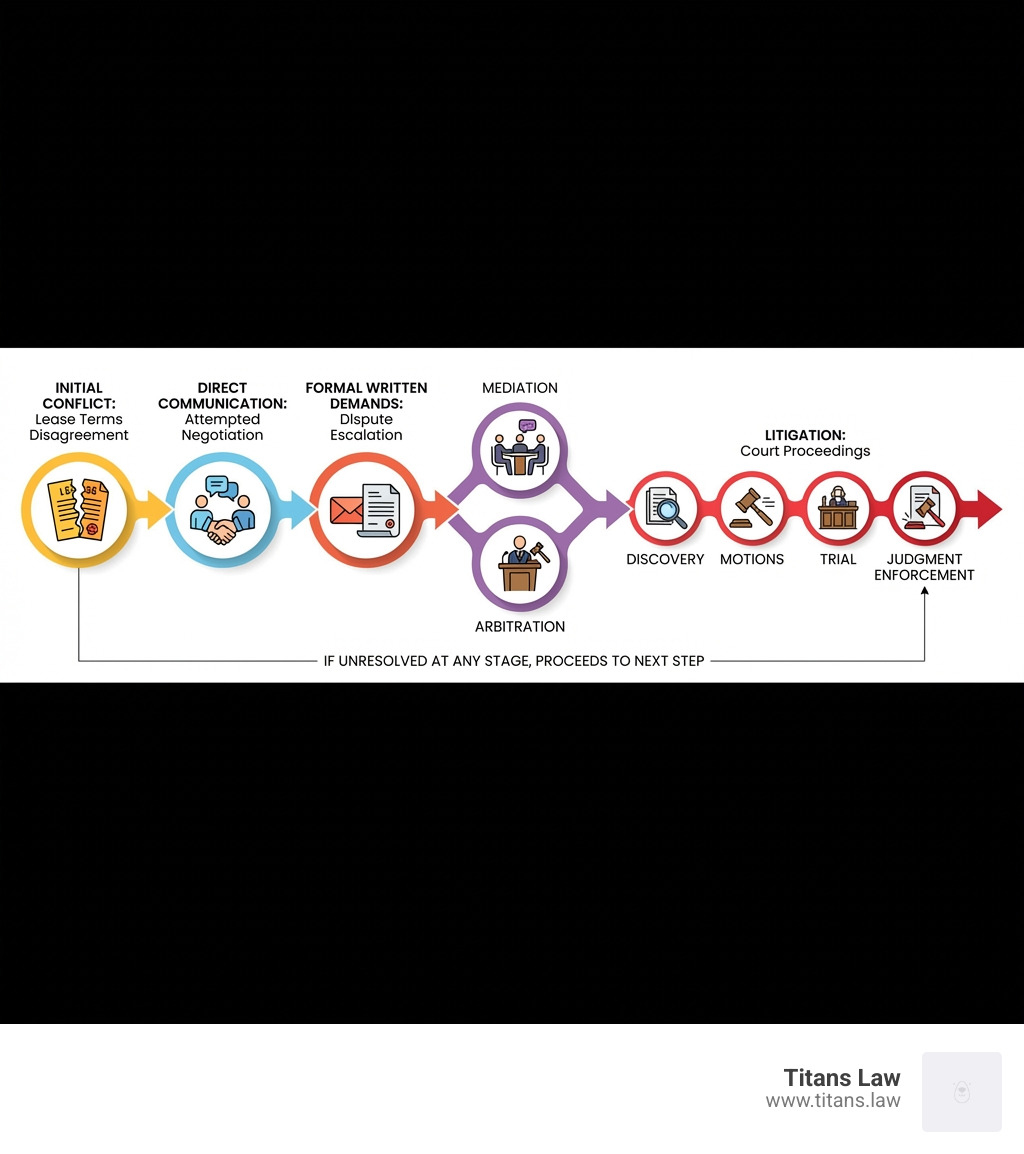
Anatomy of a Conflict: Common Commercial Lease Disputes and Their Consequences
A commercial lease is the foundation of a business relationship, but disagreements can quickly spiral into a full-blown commercial lease dispute. Understanding the common flashpoints and their potential fallout is crucial for both landlords and tenants operating in Florida.
High-Stakes Flashpoints: The Most Common Triggers for Litigation
Certain disagreements are far more likely to land parties in court. These high-stakes flashpoints often revolve around financial obligations, property condition, or the fundamental terms of occupancy.
- Unpaid Rent and Arrears: This is the most common cause of commercial lease litigation. A tenant’s failure to pay severely impacts a landlord’s cash flow, and Florida law empowers landlords to move swiftly to protect their investments.
- CAM Charges and Other Expenses: Disputes frequently arise from ambiguities in how Common Area Maintenance (CAM) charges are calculated, what expenses are included, or a tenant’s request for financial documentation to verify the charges.
- Maintenance and Property Upkeep: Conflicts over liability for maintenance and repair costs are common, often stemming from vague lease terms. Who is responsible for a leaky roof or HVAC failure—the landlord for structural integrity or the tenant for general upkeep?
- Breach of Use Clauses: Leases often dictate the permitted use of the premises or grant exclusive use rights. Breaches, such as a tenant operating outside their defined scope or a landlord violating an exclusivity clause, can lead to significant financial harm.
- Early Termination and Renewal: Unilateral efforts to terminate a lease prematurely or disagreements over renewal options present a high risk for litigation. These disputes often involve whether a tenant has met all conditions or if a landlord is exercising discretion reasonably.
- Assignment and Subletting Conflicts: Landlords may refuse to consent to a lease assignment or sublease, leading to disputes over the reasonableness of their refusal.
The Fallout: Consequences for Landlords and Tenants
When a commercial lease dispute escalates, the consequences for both parties can be severe and far-reaching.
- Significant Financial Loss: Litigation is expensive. Court proceedings can take months or years, with substantial expenses including attorney fees, findy costs, and lost business productivity. Landlords face lost rental income, while tenants may incur relocation costs.
- Lost Business Productivity: The time and attention required to manage a legal dispute diverts focus from core business operations, impacting efficiency and profitability.
- Damaged Business Relationships: An adversarial dispute can irrevocably damage the landlord-tenant relationship and harm reputations within the business community.
- Public Record of Disputes: Unlike private ADR processes, court filings are public records, exposing your dispute to competitors, customers, and partners.
- Eviction and Forfeiture of Lease: For tenants, the ultimate consequence can be eviction. For landlords, a tenant’s breach may give them the right to forfeit the lease and terminate possession, but this can involve prolonged legal battles to regain the property and recover damages.
The choice to pursue or defend against a commercial lease dispute demands careful consideration of these potential consequences and a strategic approach to protect your interests.
Building Your Defenses: Proactive Strategies to Prevent Disputes
The best offense is a good defense. Proactive steps, meticulous planning, and clear communication can significantly reduce the likelihood of costly and time-consuming commercial lease disputes.

The Lease Agreement: Your First Line of Defense
The commercial lease agreement is the bedrock of the landlord-tenant relationship. A properly drafted and negotiated lease can prevent countless future disputes.
- Key Clauses to Negotiate: Before signing, every term must be carefully reviewed. Key areas include:
- Rent and CAM Charge Terms: Ensure clarity on rent increases, what constitutes CAM, and how charges are billed and reconciled.
- Maintenance and Repair Responsibilities: Clearly define who is responsible for structural repairs, interior upkeep, and major systems like HVAC, plumbing, and electrical.
- Default and Remedy Clauses: Understand what constitutes a default, the specific steps for remedy, cure periods, and the landlord’s rights.
- Dispute Resolution Clauses: Consider mandatory mediation or arbitration clauses to streamline resolution and avoid the costs of litigation.
- Exit Strategies: Define renewal options, conditions for early termination, and any applicable penalties.
- Fee-Shifting Provisions: These clauses determine who pays legal fees if a dispute arises and can provide significant leverage.
Careful review and negotiation by experienced legal counsel is critical. For more in-depth insights into complex legal battles, explore our civil litigation services.
The Power of Proactive Management
Even a well-drafted lease requires diligent management to prevent disagreements from escalating.
- Document All Communications: Maintain comprehensive records of all lease-related interactions, agreements, and incidents. Written records are your best defense.
- Memorialize Oral Agreements in Writing: Verbal agreements regarding lease modifications are often unenforceable. Always follow up with an email or letter to create an undeniable record.
- Create an Inspection Log: Conduct routine inspections and keep a written log with photos and videos. Document any issues found and promptly notify the other party in writing to preempt disputes over property conditions.
- Stay Informed on Local Laws: Understanding Florida statutes governing commercial landlord-tenant relationships is paramount to ensuring compliance and protecting your rights.
- Understanding Tenant Agreements: To further improve your proactive approach, consider resources that dig into the intricacies of tenant agreements. This knowledge empowers you to avoid common pitfalls and assert your rights effectively. You can learn more about understanding tenant agreements.
Implementing these strategies helps build a robust defense against potential commercial lease disputes, allowing you to focus on growth rather than legal battles.
The Resolution Playbook: Navigating a Commercial Lease Dispute
Despite preventative measures, a commercial lease dispute may still arise. Your initial response and resolution strategy will largely determine the outcome.
First Moves: What to Do When a Dispute Ignites
When a dispute flares up, a swift, strategic response is essential.
- Review the Lease Agreement: Immediately review the lease to understand the specific clauses related to the dispute, including rights, obligations, and default provisions.
- Gather All Documentation: Collect all relevant records: the lease, amendments, correspondence, invoices, payment records, and inspection reports with photos or videos.
- Formal Written Communication: Communicate with the other party formally and in writing. Clearly state your concerns, refer to specific lease clauses, and propose a resolution to establish a clear record.
- Cease and Desist Letters: For issues like unauthorized use of the premises, a formal cease and desist letter from legal counsel can be a powerful first step.
- Seek Immediate Legal Counsel: Do not delay. As soon as a significant dispute arises, seek guidance from experienced attorneys. Early intervention helps you understand your legal position and avoid missteps.
Choosing Your Battlefield: ADR vs. Litigation
You face a critical decision: pursue Alternative Dispute Resolution (ADR) or prepare for litigation. Each path has distinct advantages.
Alternative Dispute Resolution (ADR): Methods like mediation and arbitration are often faster, more cost-effective, and confidential.
- Mediation: A neutral mediator facilitates negotiation to help parties reach a mutually acceptable settlement. The process is confidential and aims to preserve business relationships.
- Arbitration: An arbitrator acts like a private judge, hearing evidence and issuing a decision that is often binding. It is more structured than mediation but typically faster and more private than court.
Benefits of ADR:
- Confidentiality: Keeps sensitive business details out of the public record.
- Speed & Cost: Can resolve disputes much faster and at a lower cost than litigation.
- Control & Relationships: Parties have more control over the outcome, and the process is less adversarial, which can help preserve the landlord-tenant relationship.
When Litigation is Unavoidable:
While ADR is preferable, litigation is sometimes necessary.
- Bad Faith or Major Breaches: If one party refuses to negotiate in good faith, commits fraud, or engages in a major breach of the contract, litigation may be the only way to compel a resolution.
- Need for Court Orders: Situations requiring injunctive relief or a public ruling can only be addressed through the court system.
Here’s a comparison of these resolution pathways:
| Feature | Mediation | Arbitration | Litigation |
|---|---|---|---|
| Process | Facilitated negotiation; non-binding | Formal hearing; binding or non-binding decision | Formal court trial; binding judicial decision |
| Control | High (parties control outcome) | Medium (arbitrator controls decision) | Low (judge/jury controls outcome) |
| Confidentiality | High (private) | High (private) | Low (public record) |
| Speed | Fast (weeks) | Moderate (months) | Slow (months to years) |
| Cost | Low to Moderate | Moderate to High | High |
| Relationship | Often preserved | May be strained | Often adversarial |
| Enforceability | Settlement agreement (contractual) | Arbitrator’s award (enforceable like judgment) | Court judgment |
Escalating to the Courtroom: When Litigation is the Only Option
While we advocate for efficient, out-of-court resolutions, there are times when a commercial lease dispute demands the full force of litigation. When the stakes are high, the opposing party is unreasonable, or the law provides no other recourse, we are prepared to fight aggressively in the courtroom.
The Role of a High-Stakes Litigator in a Commercial Lease Dispute
When a dispute cannot be resolved through negotiation, litigation becomes the battlefield. This is where the tenacity of a high-stakes litigator is indispensable. Our role is about strategic, hard-hitting advocacy designed to secure decisive outcomes.
- Strategic Case Assessment: We analyze every facet of your case, from the lease agreement to the applicable Florida statutes, to develop a comprehensive strategy that identifies strengths, weaknesses, and leverage points.
- Hard-Hitting Advocacy: Whether representing landlords pursuing remedies for non-payment or tenants defending against wrongful eviction, we bring aggressive, results-driven representation to challenge opposing arguments and present your position with conviction.
- Negotiation from a Position of Strength: Even during litigation, we negotiate from a position of strength, leveraging our litigation prowess to secure favorable settlement terms.
- Navigating Complex Procedures: Commercial lease litigation involves intricate legal procedures, findy processes, and motion practice. We expertly steer these complexities to strategically advance your case.
- Enforcing Judgments: A favorable judgment is only as good as its enforcement. We pursue all available legal avenues to ensure court orders are upheld and you receive the relief you are entitled to.
The Legal Arsenal: Remedies and Recourse in Court
When a commercial lease dispute reaches the courtroom, various legal remedies are available to enforce rights and recover damages.
- Damages for Unpaid Rent: For landlords, a primary recourse is to sue for all outstanding rent. In Florida, a landlord can affirm the lease and periodically sue for rent as it comes due or terminate the lease and sue for damages.
- Specific Performance: When monetary damages are insufficient, a court may order a party to fulfill a contractual obligation, such as completing a promised repair or honoring a renewal option.
- Injunctions: Courts can issue injunctions to prevent a party from taking a prohibited action (like unauthorized use of the premises) or to compel a required action (like providing essential services).
- Lease Termination and Eviction: For significant breaches, landlords can seek a court order to terminate the lease and evict the tenant. This process must strictly adhere to Florida’s legal requirements.
- Forfeiture: A landlord may exercise their right to forfeit a lease and regain possession of the property upon a tenant’s breach, a powerful remedy that requires strict adherence to lease terms and statutory notice requirements.
- Defending Against Wrongful Eviction: Tenants can pursue claims for wrongful eviction if a landlord improperly terminates a lease, which can result in significant damages for the tenant.
Successfully navigating these remedies requires deep expertise in commercial real estate law and aggressive litigation strategies.
Frequently Asked Questions about Commercial Lease Disputes
What are the most common reasons for commercial lease disputes?
The most common reasons for commercial lease disputes often revolve around money and property condition. These include non-payment of rent, disagreements over Common Area Maintenance (CAM) charges, conflicts regarding who is responsible for maintenance and repairs, and breaches of specific lease terms. Additionally, disputes can arise from attempts to terminate a lease early, refusal to renew a lease, or conflicts over assigning or subletting the premises. Ambiguity in the lease agreement is a frequent underlying cause for many of these issues.
What are the first steps I should take if a dispute arises?
When a commercial lease dispute arises, your first steps are crucial. Immediately review your entire lease agreement to understand your rights and obligations. Gather all relevant documentation, including correspondence, invoices, payment records, and any evidence related to the dispute (photos, videos). Attempt to communicate formally and in writing with the other party to clarify the issue and propose a resolution. Most importantly, seek legal counsel promptly. Early legal intervention can help you assess your position, understand your options, and avoid mistakes that could jeopardize your case.
Is it better to use mediation or go to court to resolve a dispute?
Generally, pursuing mediation or other forms of Alternative Dispute Resolution (ADR) is often better than immediately resorting to court for a commercial lease dispute. ADR methods like mediation and arbitration are typically faster, less expensive, and confidential, helping to preserve business relationships. Court proceedings, on the other hand, are public, can drag on for months or years, and incur significant costs. However, litigation may be unavoidable if there are allegations of fraud, if one party refuses to participate in ADR, or if the dispute involves a major breach of contract requiring a definitive judicial ruling. The decision depends on the specifics of the dispute, the willingness of parties to cooperate, and the desired outcome.
Conclusion
Navigating a commercial lease dispute can be a daunting challenge for any business. From the initial spark of disagreement to the potential for high-stakes litigation, each step demands careful consideration, strategic planning, and resolute action. Preventing disputes through carefully drafted lease agreements and proactive management is always the ideal scenario. However, when conflicts inevitably arise, understanding the pathways to resolution—whether through the collaborative environment of ADR or the decisive arena of the courtroom—is paramount.
At Titans Law, we understand that your commercial lease is more than just a contract; it’s fundamental to your business’s stability and success. When the integrity of that agreement is challenged, you need more than just legal advice—you need aggressive, results-driven representation. We combine strategic, hard-hitting advocacy with a deep understanding of complex commercial disputes to protect your interests and achieve decisive outcomes. When the stakes are high, Titans Law fights to win.