
Why Religious Freedom in the Workplace Requires Strong Legal Protection
A religious discrimination attorney represents employees and job applicants who face unlawful treatment based on their religious beliefs, practices, or observances in the workplace. These attorneys steer federal and state anti-discrimination laws to secure reasonable accommodations, challenge hostile work environments, and pursue remedies including back pay, compensatory damages, and injunctive relief through EEOC charges and federal litigation.
Key facts for those searching for legal representation:
- Legal Protection: Title VII of the Civil Rights Act of 1964 prohibits religious discrimination by employers with 15+ employees; many state and local laws (including New York) extend protection to employers with 4+ employees
- What an Attorney Does: Files EEOC charges, challenges undue hardship defenses, negotiates settlements, and litigates federal claims through trial
- Recent Legal Development: The Supreme Court’s Groff v. DeJoy (2023) decision requires employers to prove “substantial increased costs” to deny accommodations—not just minimal inconvenience
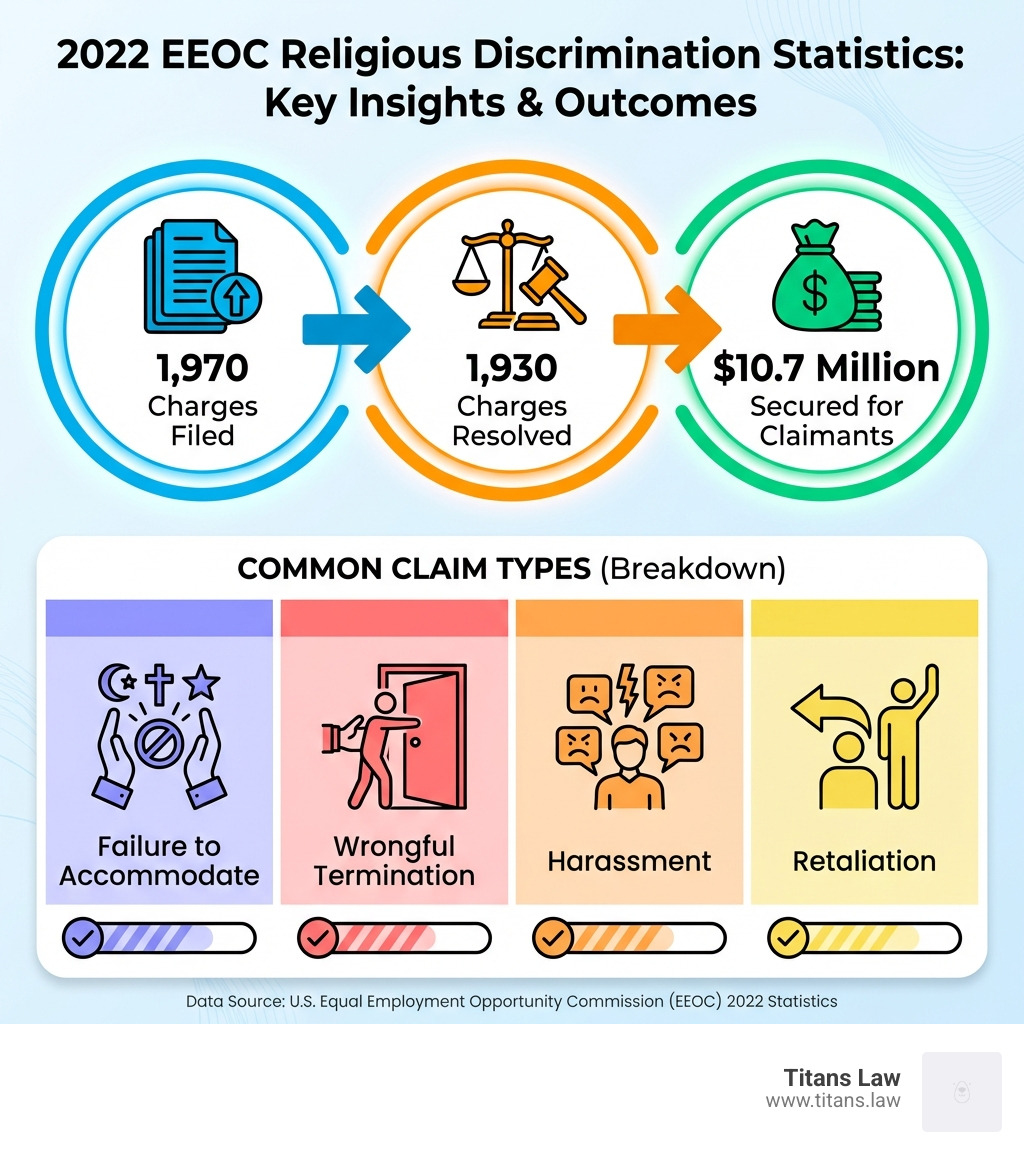
- Common Claims: Denial of religious accommodations, wrongful termination, harassment, retaliation, and disparate treatment based on faith
- Available Remedies: Back pay, emotional distress damages, attorney’s fees, and injunctive relief
In 2022, the EEOC received 1,970 charges of religious discrimination and secured $10.7 million in monetary benefits for claimants. These cases span every industry and involve conflicts over scheduling for Sabbath observance, religious attire like hijabs and yarmulkes, prayer breaks, and grooming standards.
The law protects not only traditional organized religions but also sincerely held moral or ethical beliefs—and even protects atheists and employees associated with individuals of a particular faith. When employers refuse reasonable accommodations, create hostile environments through harassment, or retaliate against employees who assert their rights, the consequences extend beyond individual harm to fundamental constitutional principles.
Religious discrimination cases require hard-hitting advocacy. Employers frequently invoke the “undue hardship” defense to avoid accommodation obligations. Titans Law attorneys bring aggressive litigation strategies, extensive federal court experience, and a reputation for controlling the narrative in high-stakes civil disputes. Our approach combines strategic precision with decisive action to protect client interests and secure favorable outcomes.
The workplace should never force you to choose between your livelihood and your faith. Understanding your legal rights—and having experienced counsel who knows how to enforce them—is the first step toward workplace justice.
Defining Religious Discrimination in the Modern Workplace
Religious discrimination occurs when an employer treats an employee or job applicant unfavorably due to their religious beliefs, practices, or observances. This includes not only overt acts of prejudice but also policies or practices that, while neutral on their face, disproportionately impact individuals of a certain faith. Our firm stands ready to confront employers who disregard these fundamental protections, ensuring that our clients’ rights are vigorously defended.

The scope of “religion” under federal law is broad, encompassing not only traditional, organized faiths but also sincerely held moral or ethical beliefs. This means that protection extends to non-theistic beliefs, such as atheism, and individuals who do not subscribe to any particular religion. Furthermore, discrimination based on an employee’s association with someone of a particular religion (e.g., being married to a person of a different faith) is also prohibited. A hostile work environment, characterized by repeated harassment, disparaging remarks, or exclusion based on religion, is a clear form of unlawful discrimination.
Federal law, specifically Title VII of the Civil Rights Act of 1964, applies to employers with 15 or more employees. However, it is crucial to understand that many state and local laws, such as those in New York City, offer even broader protections, sometimes applying to employers with as few as four employees. While the specifics of these local laws may vary from state to state, they underscore a pervasive commitment to religious freedom in the workplace. For instance, you can learn more about how local laws can offer robust protections in places like New York City through resources like the New York City Religious Discrimination Law Overview.
| Legal Authority | Minimum Employees Covered |
|---|---|
| Federal Law (Title VII) | 15+ employees |
| State/Local Laws (e.g., New York City) | May be 4+ employees |
Identifying Unlawful Adverse Employment Actions
Religious discrimination manifests in various forms, often leading to adverse employment actions that severely impact an individual’s career and livelihood. These actions are not merely unfortunate incidents; they are violations of federal and state law that demand a decisive legal response. Our firm specializes in practice-areas that include challenging such unlawful conduct.
Examples of adverse employment actions stemming from religious discrimination include:
- Wrongful Termination: Being fired or laid off because of your religious beliefs or practices, even if performance is strong.
- Failure to Hire: An applicant being denied a job offer after an interviewer finds their religious affiliation or makes discriminatory comments.
- Promotion Denial: Being passed over for a promotion in favor of a less qualified candidate who shares the employer’s religious beliefs.
- Segregation: Being isolated from customers or coworkers, or assigned to less desirable roles, due to religious attire or practices.
- Retaliation: Suffering negative consequences (e.g., demotion, reduced hours, increased scrutiny) after requesting a religious accommodation or reporting discrimination.
When these high-stakes situations arise, our firm provides the aggressive representation necessary to protect our clients’ interests.
The Role of a Religious Discrimination Attorney in High-Stakes Disputes
In the complex arena of religious discrimination, a religious discrimination attorney is not just an advisor; we are strategic advocates committed to securing justice. Our role is multifaceted, encompassing:
- Strategic Advocacy: We develop custom legal strategies designed to expose discriminatory practices and hold employers accountable. This involves a deep understanding of federal and state anti-discrimination laws, as well as the nuances of recent case law.
- Evidence Preservation: We act swiftly to gather and preserve critical evidence, from internal communications and HR records to witness testimonies, which can be crucial in proving discriminatory intent or impact.
- Liability Assessment: Our team conducts thorough investigations to assess the full extent of employer liability, identifying all potential claims and avenues for relief.
- Litigation Strategy: We prepare every case as if it is going to trial, ensuring we are ready to aggressively litigate on your behalf. This involves meticulous preparation, from initial filings to findy and courtroom arguments. Our attorneys are seasoned litigators who thrive in challenging environments.
Our approach is hard-hitting and results-driven. When you face religious discrimination, you need more than just legal advice; you need a powerful legal partner ready to fight for your rights.
The Duty to Accommodate and the “Undue Hardship” Standard
Employers have a legal obligation to reasonably accommodate an employee’s sincerely held religious beliefs or practices, unless doing so would impose an “undue hardship” on the business. This duty is a cornerstone of religious freedom in the workplace. A reasonable accommodation is any adjustment to the work environment that will allow an employee to practice their religion.
The process of finding an accommodation should be an interactive one, where the employer and employee engage in good-faith dialogue to identify workable solutions. Examples of common religious accommodations include:
- Schedule Swaps: Adjusting work schedules to allow for religious observances, such as Sabbath, holy days, or prayer times. This might involve shift changes, flexible work hours, or allowing unpaid time off.
- Dress Code Modifications: Permitting religious attire (e.g., a Jewish yarmulke, a Muslim hijab, a Sikh turban) or grooming practices (e.g., beards for religious reasons), as long as it does not pose an undue safety or health risk.
- Prayer Breaks: Allowing employees designated times and private spaces for prayer during the workday.
It is important to remember that employers cannot simply deny an accommodation request without a legitimate, legally recognized reason. If you believe your employer has failed in this duty, a religious discrimination attorney can help you understand your options. You can find resources and legal directories to locate qualified attorneys through platforms like LawInfo Attorney Directory.
Impact of Groff v. DeJoy on Religious Accommodation Claims
The legal landscape surrounding religious accommodation saw a significant shift with the Supreme Court’s 2023 decision in Groff v. DeJoy. This landmark ruling clarified and strengthened the standard for “undue hardship,” making it more challenging for employers to deny religious accommodations.
Previously, many courts applied a relatively low bar for employers, considering even “more than a de minimis cost” (a very minimal burden) as sufficient to claim undue hardship. However, Groff v. DeJoy rejected this interpretation, asserting that employers must now demonstrate that granting a religious accommodation would impose “substantial increased costs in relation to the conduct of its particular business” to prove undue hardship.
This means that a mere inconvenience or minor administrative burden is no longer enough for an employer to refuse a religious accommodation. The employer must present concrete evidence of significant difficulty or expense. This ruling makes it potentially easier for employees to win accommodation cases, as the burden of proof for employers has been substantially liftd. Our firm closely monitors such developments to ensure our strategies are always at the cutting edge of employment law. Stay informed about significant legal updates by visiting our blog.
How a Religious Discrimination Attorney Challenges Undue Hardship Defenses
The “undue hardship” defense is often an employer’s primary shield against religious accommodation claims. Our role as a religious discrimination attorney is to dismantle this defense with aggressive, fact-based arguments. We approach this challenge with meticulous preparation and strategic insight, leveraging our experience in high-stakes civil litigation.
Our methods for challenging undue hardship defenses include:
- Financial Analysis: We scrutinize an employer’s claims of financial burden, often demonstrating that the alleged “substantial increased costs” are either exaggerated or can be mitigated through reasonable adjustments. We analyze budget documents, operational expenses, and industry standards to expose inconsistencies.
- Operational Impact Assessment: We challenge claims that an accommodation would disrupt business operations, decrease efficiency, or create safety hazards. Our team investigates whether alternative solutions exist or if the employer’s assertions are speculative rather than evidence-based.
- Business Necessity Scrutiny: We evaluate whether the employer’s policy or practice that conflicts with the religious belief is truly a business necessity, or if it can be modified without fundamentally altering the business model.
- Rebutting Employer Claims: We systematically rebut employer arguments by presenting compelling evidence of how similar accommodations have been successfully implemented elsewhere, or by highlighting the employer’s failure to engage in a good-faith interactive process.
Our meet-our-team page showcases the caliber of legal professionals who are prepared to handle these complex challenges. We understand that employers will aggressively defend their positions, and we are equally aggressive in representing our clients’ interests, ensuring that the Groff v. DeJoy standard is rigorously applied.
Navigating the Legal Process: From EEOC Charges to Federal Court
For employees experiencing religious discrimination, the legal journey often begins with administrative action. Federal law typically requires individuals to first file a charge with the Equal Employment Opportunity Commission (EEOC) before they can pursue a lawsuit in federal court. This process, known as administrative exhaustion, is a critical first step.
Here’s a general overview of the administrative and litigation process:
- EEOC Charge Filing: An individual must file a formal charge of discrimination with the EEOC within a specific timeframe (usually 180 or 300 days from the date of discrimination, depending on state law). This charge outlines the alleged discriminatory acts.
- EEOC Investigation/Mediation: The EEOC may investigate the charge, gather evidence, and may offer mediation to resolve the dispute.
- Right-to-Sue Letter: If the EEOC does not find a violation or is unable to resolve the charge, it will issue a “right-to-sue” letter. This letter is the employee’s green light to file a lawsuit in federal court.
- Federal Court Litigation: Once a right-to-sue letter is issued, the employee has 90 days to file a lawsuit. This initiates the formal litigation process, involving:
- Findy Phase: Both sides exchange information, documents, and witness lists. This can be extensive and includes written questions (interrogatories), requests for documents, and sworn testimony (depositions).
- Deposition Strategy: Our attorneys carefully prepare for and conduct depositions, which are crucial opportunities to gather evidence, assess witness credibility, and build a strong case.
- Motions: Parties may file various motions, such as motions to dismiss or motions for summary judgment, which can significantly impact the trajectory of a case.
- Settlement Negotiations: Throughout the process, opportunities for settlement negotiations may arise, which we approach strategically to achieve the best possible outcome for our clients.
- Trial: If a settlement is not reached, the case proceeds to trial, where we present our client’s case to a judge or jury.
Our firm is adept at navigating every stage of this complex legal journey, from the initial EEOC filing to the final verdict in federal court. Our expertise in civil-litigation ensures that our clients receive robust representation throughout the entire process.
Why You Need a Religious Discrimination Attorney for Complex Litigation
Religious discrimination claims, particularly those involving workplace disputes, are inherently complex and often become high-stakes matters. Employers, especially large corporations, typically have vast legal resources at their disposal, making it challenging for an individual to pursue justice alone. This is precisely why a seasoned religious discrimination attorney is indispensable.
Our firm specializes in high-stakes disputes, bringing a unique blend of aggressive advocacy and strategic precision to every case. Here’s why our expertise is critical:
- Federal Court Experience: Religious discrimination claims often proceed to federal court, an environment demanding specialized knowledge of federal rules of procedure, evidence, and specific case law. Our attorneys possess experience in federal litigation, ensuring that your case is handled with the highest level of competence.
- Settlement Negotiations: While we prepare every case for trial, we also understand the value of strategic settlement negotiations. Our hard-hitting approach in negotiations ensures that employers take our clients’ claims seriously, often leading to favorable resolutions without the need for a lengthy trial.
- Trial Readiness: When negotiation fails, our firm is always trial-ready. We are known for our meticulous preparation, compelling courtroom presentations, and unwavering commitment to achieving decisive outcomes for our clients. We thrive in the courtroom, where our aggressive advocacy can make all the difference.
Facing religious discrimination is a battle for your rights and your livelihood. Do not steer this challenging terrain without the powerful legal representation that Titans Law provides. We fight to win.
Addressing Transparency: Titans Law Reviews and Professional Integrity
At Titans Law, we understand that when you are seeking legal representation for a sensitive and high-stakes issue like religious discrimination, transparency and trust are paramount. Our commitment to professional integrity is reflected in every aspect of our practice, from our aggressive advocacy to our client communication. We believe in being upfront and accessible, and we encourage potential clients to explore our track record and reputation.
We stand by the positive sentiment often found in Titans Law reviews, which highlight our dedication, strategic approach, and the decisive outcomes we achieve for our clients. Our clients’ testimonials often speak to their positive Titans Law experience, emphasizing our firm’s professionalism, the quality of our legal services, and the trust they place in our Titans Law attorneys. We pride ourselves on clear communication, ensuring clients are informed and empowered throughout their legal journey. You can read more about what our clients say on our reviews page.
We also recognize that in the digital age, individuals may encounter questions or concerns, including searches for “Titans Law complaints,” “Titans Law scam,” or “Titans Law BBB.” We address these queries directly and transparently:
- Commitment to Excellence: Any concerns raised are taken seriously and viewed as opportunities for continuous improvement. Our firm operates with the highest ethical standards, and our focus is always on delivering aggressive, results-driven representation.
- Professional Affiliations: We maintain strong professional standing and adhere to the guidelines set forth by legal and professional organizations.
- Direct Engagement: We encourage anyone with questions or concerns to contact us directly. We believe in open dialogue and resolving matters efficiently and respectfully.
Our reputation is built on a foundation of successful litigation and unwavering client advocacy. We are proud of the work we do and the justice we secure for those whose rights have been violated.
Verifying Firm Authority and Reputation
Choosing the right religious discrimination attorney means selecting a firm with proven authority and an impeccable reputation for delivering results. At Titans Law, we don’t just talk about fighting for our clients; we demonstrate it through hard-hitting advocacy and a strong record of success in complex civil disputes.
Our authority stems from:
- Professionalism: Every interaction, every legal document, and every courtroom appearance reflects our unwavering commitment to the highest standards of the legal profession.
- Results-Driven Representation: We measure our success by the decisive outcomes we achieve for our clients. Our strategies are crafted with the end goal in mind: protecting your interests and securing justice.
- Hard-Hitting Advocacy: When the stakes are high, you need a firm that isn’t afraid to take on formidable opponents. Our attorneys are known for their aggressive and strategic approach, ensuring that our clients’ voices are heard and their rights are vigorously defended.
We invite you to dig deeper into our firm’s standing. [Read Titans Law reviews] and see the impactful Titans Law experience our clients have shared. If you have been impacted by religious discrimination in the workplace, we encourage you to [Share your Titans Law experience] with us and find how our dedicated Titans Law attorneys can fight for you.
Frequently Asked Questions about Religious Discrimination
Understanding your rights and the legal process is crucial when facing religious discrimination. Here, we address some common questions we encounter:
What constitutes “undue hardship” after the Groff v. DeJoy ruling?
Following the Supreme Court’s decision in Groff v. DeJoy (2023), the standard for “undue hardship” has been significantly raised. An employer must now demonstrate that granting a religious accommodation would result in “substantial increased costs in relation to the conduct of its particular business.” This means that minor inconveniences, administrative burdens, or de minimis (minimal) costs are generally no longer sufficient to justify denying an accommodation. Instead, employers must present concrete evidence of significant difficulty or expense that would fundamentally alter the nature or operation of their business. A religious discrimination attorney from our firm can rigorously challenge an employer’s undue hardship claims by scrutinizing their financial and operational assertions.
What remedies are available for victims of workplace religious discrimination?
Victims of workplace religious discrimination may be entitled to various remedies and compensation, depending on the specifics of their case and the laws violated. These can include:
- Back Pay: Compensation for lost wages and benefits that the employee would have earned had the discrimination not occurred.
- Front Pay: Compensation for future lost earnings if reinstatement is not feasible.
- Compensatory Damages: To cover non-economic losses such as emotional distress, pain, and suffering.
- Punitive Damages: Awarded in cases where the employer’s conduct was malicious or reckless, intended to punish the wrongdoer and deter similar conduct.
- Injunctive Relief: Court orders requiring the employer to cease discriminatory practices, implement anti-discrimination policies, or reinstate the employee.
- Attorney’s Fees and Costs: The employer may be ordered to pay the employee’s legal fees and court costs.
Our firm is committed to pursuing the maximum available remedies to ensure our clients receive full compensation for the harm they have endured.
How long do I have to file a claim with a religious discrimination attorney?
The deadlines for filing religious discrimination claims are strict and vary depending on the jurisdiction and the specific law under which the claim is brought. Generally, for federal claims under Title VII, an employee must file a charge with the EEOC within 180 or 300 days of the discriminatory act. The 300-day deadline applies if the discriminatory act also violates a state or local anti-discrimination law that has its own enforcement agency.
After receiving a “right-to-sue” letter from the EEOC, an employee typically has 90 days to file a lawsuit in federal court. Missing these deadlines can permanently bar your claim, regardless of its merits. Therefore, it is imperative to contact a religious discrimination attorney as soon as you suspect you have experienced discrimination. We can assess your situation, advise you on the applicable deadlines, and ensure all necessary filings are made promptly and correctly.
Conclusion
Religious freedom is a foundational principle, and it extends robustly into the workplace. When employers violate this right through discrimination, harassment, or a refusal to reasonably accommodate sincerely held beliefs, the consequences for employees can be devastating. At Titans Law, we stand as a formidable force against such injustices.
We are a high-stakes civil litigation firm delivering aggressive, results-driven representation in complex disputes and high-exposure matters. Our approach combines strategic, hard-hitting advocacy with a deep understanding that every case carries significant personal and financial consequences. Backed by extensive experience and a strong record of success, our Titans Law attorneys develop custom legal strategies designed to protect our clients’ interests and achieve decisive outcomes—whether at the negotiating table or in the courtroom.
When the stakes are high, Titans Law fights to win. If your religious freedom in the workplace has been compromised, do not face this challenge alone. Contact Titans Law today for powerful legal representation.