
Why Corporate Fraud Investigations Matter for Your Business
A corporate fraud investigation is a systematic process organizations use to uncover, document, and address fraudulent activities that threaten their financial stability and reputation. These investigations involve collecting evidence, interviewing witnesses, analyzing financial records, and determining whether fraud occurred—and who’s responsible.
Key elements of a corporate fraud investigation include:
- Evidence preservation – Securing documents, digital records, and communications immediately
- Forensic analysis – Examining financial statements, transactions, and electronic data
- Witness interviews – Gathering testimony from employees, executives, and third parties
- Legal compliance – Navigating privilege, privacy laws, and potential criminal implications
- Final reporting – Documenting findings and recommending corrective actions
The stakes couldn’t be higher. According to the Association of Certified Fraud Examiners (ACFE), organizations lose five percent of their revenues to fraud each year. That’s not just money disappearing from balance sheets—it’s reputational damage, regulatory scrutiny, and in some cases, criminal prosecution.
Consider the case of a former NYU finance director who allegedly diverted $3.4 million meant for minority- and women-owned businesses into shell companies for personal use. This wasn’t finded through routine accounting. It required a methodical investigation that traced funds, analyzed patterns, and built an evidence trail that could withstand legal scrutiny.
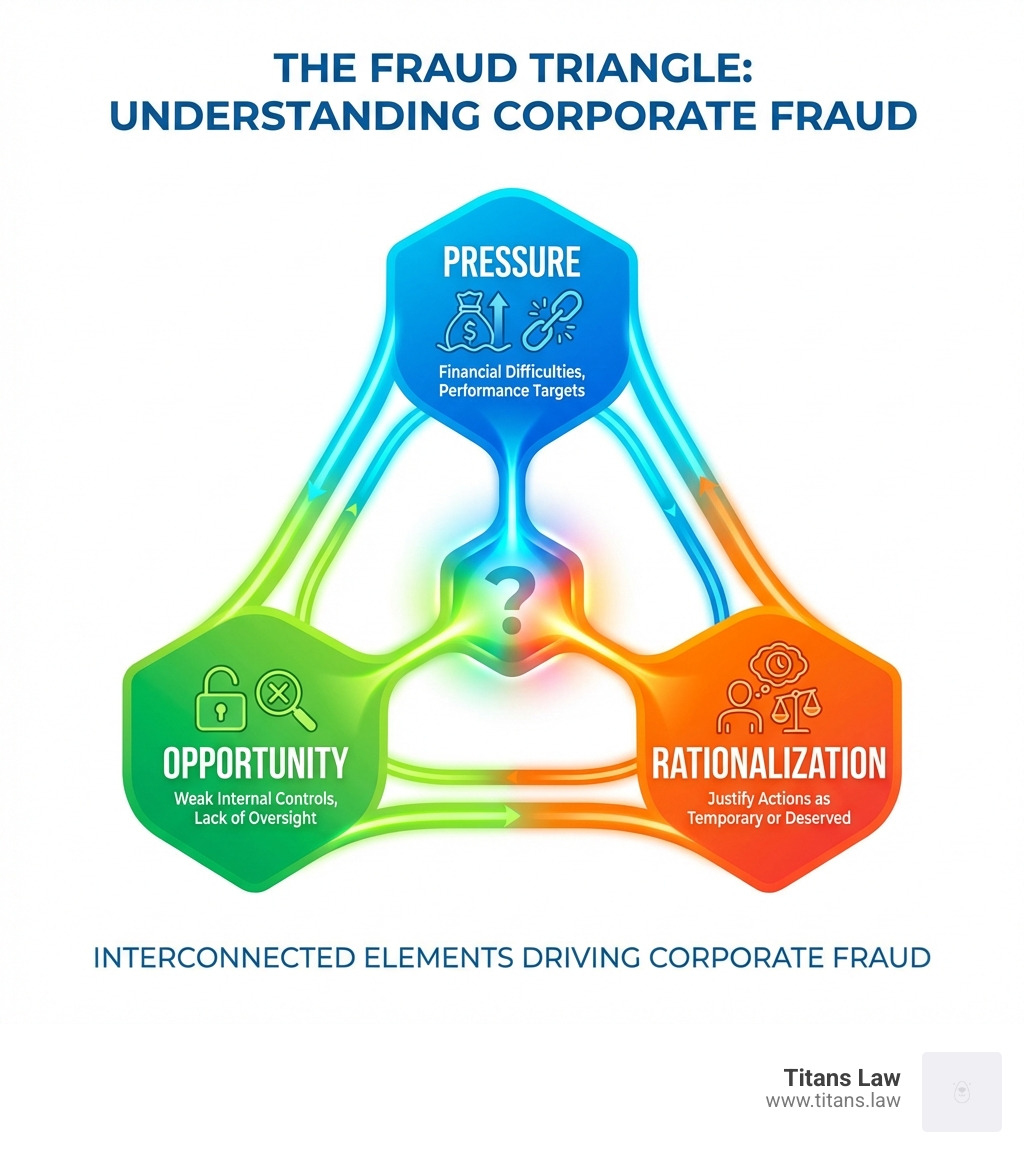
Corporate fraud doesn’t announce itself. It hides in falsified invoices, manipulated financial statements, and carefully constructed shell companies. It thrives where opportunity meets pressure and rationalization—what fraud examiners call the Fraud Triangle.
When fraud allegations surface, whether from a whistleblower hotline or an internal audit, your response in the first 48 hours determines everything. Evidence must be preserved. Key personnel must be interviewed before stories align. Digital footprints must be captured before they’re erased.
This guide walks you through the complete corporate fraud investigation process—from the moment an allegation hits your desk to the final investigative report. You’ll understand when to bring in external investigators, how to steer attorney-client privilege, and what makes evidence hold up under legal scrutiny.
Anatomy of Deceit: Common Types and Motivations for Corporate Fraud
Corporate fraud is a cunning adversary, often driven by a mix of personal gain, organizational pressure, and perceived opportunity. Understanding these motivations and the forms they take is the first step in combating them.
The primary motivations behind corporate fraud often align with the “Fraud Triangle” — Pressure, Opportunity, and Rationalization. Pressure can come from personal financial difficulties, addiction, or even intense corporate performance targets. Opportunity arises from weak internal controls, lack of oversight, or a position of trust. Rationalization allows the perpetrator to justify their actions, viewing it as temporary, deserved, or harmless.
Common types of corporate fraud encountered include:
- Asset Misappropriation: This is the most common type of fraud, involving the theft or misuse of an organization’s assets. Examples include skimming cash, false expense reports, inventory theft, or billing schemes where employees create fictitious vendors or invoices. The NYU case, where a finance director was accused of diverting $3.4 million in funds using shell companies, is a stark example of asset misappropriation.
- Financial Statement Fraud: This involves intentionally misrepresenting financial information to deceive investors, creditors, or other stakeholders. It can manifest as overstating revenues, understating expenses, or manipulating asset valuations. This type of fraud often involves high-level executives and can have devastating consequences for market confidence.
- Corruption Schemes: This broad category includes bribery, kickbacks, and conflicts of interest.
- Bribery: Offering, giving, receiving, or soliciting anything of value to influence an action or decision.
- Kickbacks: A portion of a payment returned to an individual in exchange for a favorable decision or service.
- Shell Companies: Often used in bribery or kickback schemes, these are fictitious entities created to facilitate fraudulent transactions, making it appear as though legitimate services were rendered.
- Cybercrime: While often external, insider cyber threats can also lead to corporate fraud. This includes data theft for financial gain, unauthorized access to systems to manipulate financial records, or using company resources for personal fraudulent activities.
- Money Laundering: This is the process of making illegally gained proceeds appear legitimate. It typically involves three steps:
- Placement: Introducing illicit funds into the financial system.
- Layering: Moving money through complex transactions to obscure its origin.
- Integration: Returning the laundered money to the criminal as legitimate funds. The FBI focuses on combating money laundering because it allows criminals to hide wealth, avoid prosecution and taxes, and fund further criminal activity.
Organizations must be vigilant for red flags that can indicate potential fraud. These include:
- Unexplained wealth or lavish lifestyles of employees
- Unusual or excessive transactions with new or unknown vendors
- Missing or altered documents
- Lack of segregation of duties in financial processes
- Consistent override of internal controls
- Employee reluctance to take vacation
- Frequent changes in accounting estimates or methods
The Investigation Playbook: A Step-by-Step Corporate Fraud Investigation
When fraud is suspected, a structured and decisive approach is paramount. A corporate fraud investigation is a complex undertaking, often involving various stakeholders and a defined lifecycle to steer the intricacies of uncovering misconduct.

The lifecycle of an investigation typically moves through several phases: initiation, information collection, detailed review and interviews, damage quantification, potential litigation, settlement negotiation, and finally, remediation and post-settlement monitoring. Throughout this process, various stakeholders play crucial roles. Legal counsel provides strategic guidance, ensuring all actions comply with the law and protect the organization’s legal standing. HR manages personnel-related aspects, including employee rights and potential disciplinary actions. IT is vital for digital evidence collection, preservation, and analysis. In complex or sensitive cases, external investigators or forensic accountants bring specialized expertise and an objective perspective.
Initiating a Corporate Fraud Investigation: The First 48 Hours
The moment an allegation of fraud surfaces is critical. Whether it’s an anonymous tip from a whistleblower, an anomaly flagged by an internal audit, or a direct report, the initial response sets the tone for the entire corporate fraud investigation.
The first step is to assess the situation thoroughly. We determine if the report was made in good faith and if there’s sufficient data to back the allegation. It is essential to establish a reasonable factual basis for the investigation before proceeding. If there’s a whistleblower, we interview them first to gather context.
Next, we immediately focus on the preservation of evidence. This means securing documents, digital records, and communications to prevent alteration or destruction. This could involve restricting access to certain systems, taking forensic images of hard drives, or securing physical documents.
Simultaneously, we form the investigation team, carefully selecting individuals with the necessary expertise and discretion. This team defines the investigation’s scope, outlining what will be investigated, who will be involved, and the objectives. Interim corrective actions may also be necessary, such as temporarily suspending employees involved (with pay, clearly communicated as non-disciplinary), changing passwords, or suspending access to sensitive systems to prevent further damage.
Evidence Collection and Forensic Analysis
The heart of any corporate fraud investigation lies in the meticulous collection and analysis of evidence. This phase demands precision, adherence to legal standards, and often, advanced technological capabilities.
Maintaining a strict chain of custody for all collected evidence is non-negotiable. This ensures the integrity of the evidence and its admissibility in any subsequent legal proceedings. We review a wide array of documents, from traditional paper records to complex digital files. This includes:
- Financial Records: Ledgers, invoices, bank statements, expense reports, purchase orders, and payroll data are scrutinized for discrepancies, unauthorized transactions, or patterns indicative of fraud.
- Digital Evidence: This is increasingly critical. Computer forensics experts extract data from servers, laptops, mobile devices, and cloud storage. They uncover deleted files, metadata, and communication trails. Data analytics tools are employed to process vast amounts of data, identifying anomalies, trends, and connections that might signal fraudulent activity.
- Email Analysis: Email communications often contain direct or indirect evidence of fraud, including discussions about schemes, instructions, or attempts to cover up misconduct.
Technology plays an increasingly vital role in both detecting and investigating fraud. Sophisticated software can analyze transaction data to spot unusual patterns, identify fictitious entities, or flag high-risk activities. This allows investigators to prioritize efforts and focus on areas with the highest likelihood of fraud.
For complex financial and digital evidence, our firm often leverages forensic experts to solve intricate schemes. More info about our litigation support services can be found on our website.
The Art of the Interview: Gathering Critical Testimony
While documents and data provide the “what,” interviews often reveal the “who” and “why.” As investigation expert Meric Bloch notes, “interviewing is usually the most important part of any investigation.” This stage requires a delicate balance of strategy, empathy, and adherence to legal protocols.
Effective interview planning is crucial. This includes developing a clear strategy, preparing an interview list (starting with reporters and witnesses, interviewing suspects last), and setting a realistic timeline. We use structured interview techniques, beginning with a clear explanation of purpose and assuring interviewees of confidentiality and protection from retaliation.
Building rapport with interviewees is key to eliciting candid and accurate information. We ask precise, open-ended questions to encourage detailed responses, carefully distinguishing between facts, inferences, and opinions. The interviewee’s answers, not the investigator’s questions, constitute the evidence.
There’s a distinct difference between interviewing witnesses and subjects. Witness interviews aim to gather facts and context without accusation. Subject interviews, on the other hand, are often more challenging and require specific strategies to address allegations.
Documenting statements accurately is paramount. This can involve detailed notes or, in some cases, audio or video recordings. However, legal considerations for recording interviews vary by state. In Florida, for example, it is generally legal to record a conversation if all parties consent. Always check state laws to ensure compliance.
Concluding the Investigation and Reporting
After collecting and analyzing all available evidence, the corporate fraud investigation moves toward its conclusion. This phase involves synthesizing findings, making objective determinations, and presenting them in a clear, actionable report.
Analyzing evidence requires distinguishing objective facts from inferences and opinions. Investigators must avoid making judgments or assumptions, focusing solely on verifiable evidence. We assess the quality of evidence, ensuring it is concrete, specific, relevant, competent, and authentic. All evidence must be securely stored, both physically and digitally, to prevent tampering.
The comprehensive fraud investigation report is a critical deliverable. It should be structured clearly and objectively, typically including:
- Executive Summary: A concise overview of the allegations, investigation process, key findings, and recommendations.
- Background: Details of the allegations, how they were received, and the scope of the investigation.
- Investigation Methodology: A description of the steps taken, including documents reviewed, interviews conducted, and forensic analysis performed.
- Findings of Fact: A detailed, evidence-backed narrative of what occurred, presenting only objective facts and direct quotes from interviews, avoiding inflammatory language or jargon.
- Conclusion: A clear determination of whether fraud occurred and who was involved.
- Recommendations: Actionable steps for remediation, disciplinary action, internal control improvements, and potential legal recourse.
- Supporting Documentation: An appendix of key evidence referenced in the report.
A well-written report, grounded in facts and free from speculation, demonstrates due diligence and provides a solid basis for organizational decision-makers to take corrective action.
Navigating the Legal Minefield: Critical Legal and Ethical Considerations
A corporate fraud investigation is not merely a fact-finding mission; it is a journey fraught with legal and ethical complexities that demand careful navigation. Failing to adhere to these considerations can undermine the investigation’s integrity and expose the organization to significant legal risks.

Key legal and ethical considerations include:
- Attorney-Client Privilege and Work Product Doctrine: When we are engaged as legal counsel, communications between us and our client, and materials prepared in anticipation of litigation, are generally protected from disclosure. This privilege is crucial for conducting candid internal investigations.
- Data Privacy Laws: We must adhere to state and federal data privacy laws (e.g., Florida Information Protection Act, federal HIPAA, GLBA) when collecting, storing, and analyzing personal and sensitive information during an investigation.
- Employee Rights: Employees have rights, including due process and protection against wrongful termination. Investigations must be conducted fairly, without bias, and in accordance with company policies and employment laws.
- Potential for Criminal Charges: Corporate fraud can lead to criminal charges for individuals and, in some cases, the organization itself. We always consider the potential for parallel criminal proceedings and advise on strategies for cooperation or defense.
- Interacting with Government Agencies: Investigations may involve interaction with various government agencies, such as the U.S. Securities and Exchange Commission (SEC) for securities fraud, the FBI for white-collar crime, or the U.S. Department of Justice (DOJ). The DOJ has a comprehensive Corporate Enforcement Policy that outlines incentives for self-disclosure, cooperation, and remediation.
- Differences between Internal and External Investigations:
Feature Internal Investigation External Investigation Conducted By Internal staff (e.g., HR, internal audit, legal department) Independent third parties (e.g., law firms, forensic accountants) Primary Goal Remediation, compliance, internal discipline Fact-finding for litigation, regulatory response, criminal defense Perceived Objectivity Potentially lower Generally higher Privilege May be harder to maintain Easier to establish under legal counsel Cost Potentially lower direct costs Generally higher direct costs Expertise Varies; may lack specialized forensic skills Specialized forensic, legal, and investigative expertise
The consequences of corporate fraud are severe for both individuals and organizations. Individuals can face imprisonment, significant fines, and loss of professional licenses. Organizations can suffer massive financial losses, reputational damage, stock price declines, regulatory sanctions, and even dissolution. Our role is to aggressively protect our client’s interests in the face of these high-stakes consequences.
Fortifying the Gates: Proactive Fraud Prevention and Internal Controls
The best defense against corporate fraud is a strong offense. Organizations can significantly reduce their vulnerability by cultivating an anti-fraud culture and implementing robust internal controls.
The role of internal controls and policies in fraud prevention and detection cannot be overstated. These are the safeguards designed to protect assets, ensure data accuracy, promote operational efficiency, and encourage adherence to management policies. Key elements include:
- Segregation of Duties: Ensuring that no single individual has control over all aspects of a financial transaction, reducing the opportunity for fraud.
- Regular Audits: Both internal and external audits provide independent verification of financial records and operational processes, deterring fraudulent activities and detecting anomalies.
- Whistleblower Hotlines: Establishing secure, efficient, and impartial reporting channels encourages employees to report suspected misconduct without fear of retaliation. This is a critical detection mechanism.
- Employee Training: Educating employees about fraud risks, ethical conduct, and the importance of internal controls creates a more vigilant workforce.
- Risk Assessments: Regularly identifying and evaluating potential fraud risks allows organizations to prioritize prevention efforts in areas with high likelihood and impact.
- Policy Development and Enforcement: Clear, well-communicated anti-fraud policies, along with consistent enforcement, demonstrate an organization’s commitment to integrity and deter potential fraudsters.
By integrating forensic, financial crime, and cybersecurity measures, organizations can create a multi-layered defense against emerging threats like deepfake fraud allegations and ESG fraud. A strong reputation for integrity is crucial to safeguarding market confidence and public trust, making proactive prevention an investment, not an expense.
Conclusion: When the Stakes Demand Decisive Action
The landscape of corporate fraud investigation is complex, challenging, and fraught with high stakes. From understanding the motivations and varied types of fraud to carefully collecting evidence, conducting interviews, and navigating a labyrinth of legal and ethical considerations, each step demands precision, expertise, and an unwavering commitment to justice.
When allegations surface, the integrity of your business, your financial stability, and your public trust are on the line. A poorly handled investigation can exacerbate losses, invite regulatory scrutiny, and inflict irreparable reputational damage. This is why the necessity of expert legal command cannot be overstated.
At Titans Law, we understand that every case carries significant personal and financial consequences. We deliver aggressive, results-driven representation in complex disputes and high-exposure matters, applying strategic, hard-hitting advocacy to protect our clients’ interests. When you face the formidable challenge of corporate fraud, you need more than just an investigator; you need a legal team that combines extensive experience with a strong record of success, ready to achieve decisive outcomes whether at the negotiating table or in the courtroom.
When the stakes are high, Titans Law fights to win. Secure outcome-driven litigation counsel for your high-stakes matter. Contact us today.