
When Business Partnerships and Corporate Entities Fracture
An asset division lawyer represents business owners, shareholders, and partners in high-stakes disputes involving the separation of corporate assets, partnership dissolution, and shareholder conflicts. These attorneys combine litigation expertise with financial acumen to protect your interests when business relationships break down and millions are at stake.
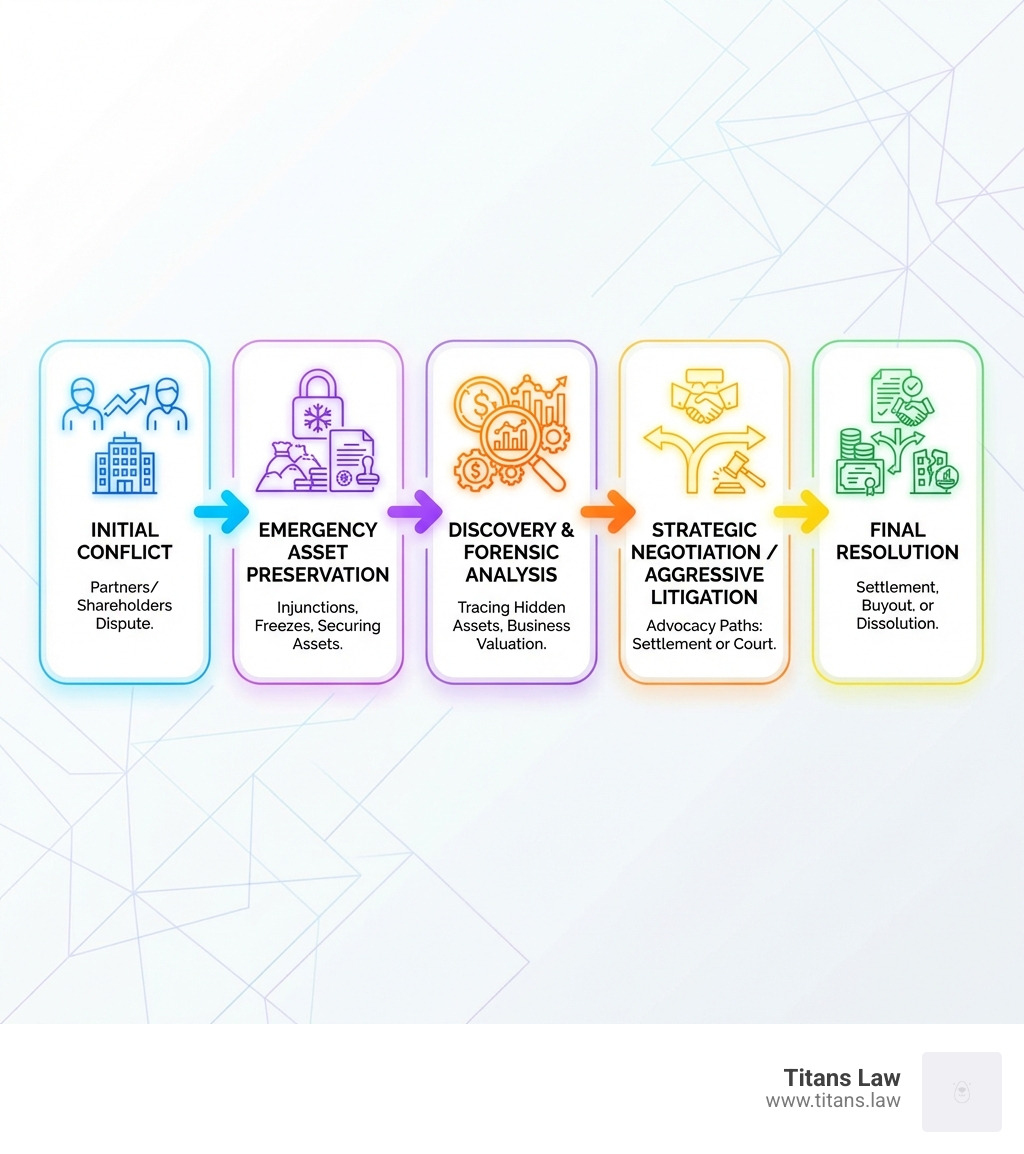
What an Asset Division Lawyer Does:
- Valuation & Tracing – Identifies and values complex business assets including intellectual property, goodwill, and operational assets
- Forensic Investigation – Uncovers hidden assets, fraudulent transfers, and commingled funds through expert accounting analysis
- Strategic Litigation – Pursues injunctions, freezes assets, and aggressively advocates in court when negotiations fail
- Contract Enforcement – Enforces shareholder agreements, buy-sell provisions, and partnership terms
- Creditor Protection – Ensures debts and liabilities are properly allocated during dissolution
Business asset division differs fundamentally from personal property disputes. When a partnership dissolves, a corporation winds down, or shareholders clash over company ownership, the financial complexity multiplies exponentially. Unlike straightforward asset splits, business disputes involve intangible assets like intellectual property and brand value, operational cash flows, client relationships, and interconnected liabilities that can destroy value if mishandled.
In the commercial context, the stakes are exponentially higher—entire businesses hang in the balance, and opposing parties often use aggressive tactics to gain leverage. The difference between adequate representation and strategic advocacy can determine whether you walk away with your fair share or watch years of investment evaporate. Business asset disputes require attorneys who understand corporate structures, can coordinate forensic accountants and valuation experts, and won’t hesitate to pursue aggressive legal remedies when opponents play hardball.
When business relationships fracture, time works against you. Assets can be transferred, concealed, or devalued before you act. Documentation disappears. Opposing parties consolidate their positions. The window for securing injunctions and freezing assets closes rapidly.
The Complexities of Valuing and Tracing Business Assets
Dividing business assets is far more intricate than splitting tangible personal property. We are not merely counting items; we are dissecting an entire economic ecosystem. This process demands a rigorous approach to valuation, meticulous tracing of financial flows, and an unwavering commitment to uncovering every detail. The financial health and future viability of your enterprise—or your stake in it—depend on this precision. Without a comprehensive understanding of the business’s true worth, and without a clear picture of all its assets and liabilities, you risk significant financial loss.

Business asset valuation in a high-stakes dispute is rarely straightforward. It goes beyond balance sheets and income statements. We must consider the full spectrum of assets, from physical inventory and real estate to the often-overlooked intangible assets that can constitute the lion’s share of a company’s value. Furthermore, differentiating between what truly belongs to the business versus what might be personal assets of a partner or shareholder, especially when funds have been commingled, requires a sharp legal and financial eye. This is where the expertise of a seasoned asset division lawyer, working in tandem with forensic accounting specialists, becomes indispensable. Their combined efforts are crucial for unearthing hidden assets and ensuring a fair, equitable, and legally sound division.
Identifying and Valuing Intangible Assets
In today’s economy, the true value of a business often resides not in its brick-and-mortar structures or physical inventory, but in its intellectual capital. Patents, trademarks, copyrights, and trade secrets can be the bedrock of a company’s competitive advantage and market position. Valuation methodologies for these assets are complex and specialized, often requiring the expertise of intellectual property valuation professionals.
Beyond formal intellectual property, we must also consider the less tangible, yet immensely valuable, components like brand reputation and customer lists. A well-established brand, built over years of investment and strategic marketing, carries significant goodwill that translates directly into market value. Similarly, a carefully cultivated customer base represents future revenue streams. Our approach involves a thorough assessment of these elements, ensuring that their contribution to the overall business valuation is accurately quantified. We leave no stone unturned, because overlooking these critical assets can dramatically skew the division, leaving you shortchanged.
The Challenge of Commingled and Hidden Assets
One of the most insidious challenges in business asset division is the presence of commingled or hidden assets. In the heat of a dispute, unscrupulous partners or shareholders may attempt to obscure the true financial picture of the business. This can involve deliberately mixing personal funds with business accounts, a practice known as commingling, which blurs the lines of ownership and makes equitable division difficult.
More aggressively, parties might engage in sophisticated tactics to hide assets altogether. This could involve funneling funds into offshore accounts, creating shell corporations to obscure ownership, or engaging in fraudulent transfers to third parties. When such actions are suspected, our asset division lawyer team employs aggressive “findy tactics.” We work closely with forensic accountants who specialize in tracing funds across complex financial networks, scrutinizing every transaction, and following every lead. In cases where the corporate structure has been used to perpetrate fraud or injustice, we are prepared to pursue piercing the corporate veil, holding individuals personally accountable for corporate debts and obligations. Our objective is clear: to ensure full transparency and accountability, leaving no asset concealed and no stone unturned.
The Role of an Asset Division Lawyer in High-Stakes Disputes
When business relationships devolve into disputes over assets, the legal landscape becomes treacherous. This is not a moment for hesitation or compromise; it is a time for decisive, strategic action. An asset division lawyer acts as your frontline defender, bringing a combination of strategic foresight, legal expertise, and aggressive advocacy to the table. Our role begins long before any court filing, with a meticulous case assessment that maps out every potential avenue and vulnerability. We develop a robust pre-litigation strategy designed to establish leverage, protect your position, and set the stage for a favorable outcome.

In high-stakes scenarios, time is often of the essence. We are prepared to move swiftly to secure injunctions to freeze assets, preventing their dissipation or fraudulent transfer while the legal process unfolds. This crucial step can be the difference between preserving your rightful share and facing an empty ledger. Our firm excels at coordinating expert teams—from forensic accountants to business valuators—to build an unassailable case. While we are always prepared for aggressive negotiation to achieve a swift and favorable resolution, our strength lies in our readiness for trial advocacy. When opponents refuse to negotiate in good faith, we possess the courtroom prowess to fight fiercely for your interests and secure a decisive victory. Our litigation services are designed for these exact challenges. More info about our litigation services
How an Asset Division Lawyer Protects Shareholder Interests
Shareholder disputes can quickly escalate, threatening the very existence of a company and the financial future of its investors. Whether you are a majority shareholder seeking to protect corporate stability or a minority shareholder fighting for fair treatment, an asset division lawyer is critical. We carefully review shareholder agreements and any existing buy-sell provisions, which often dictate the terms of asset distribution or share transfers upon certain triggering events. Our expertise ensures that these agreements are enforced to your advantage, or challenged if they are inequitable or improperly executed.
For minority shareholders, the battle can be particularly challenging. We champion minority shareholder rights, addressing claims of business oppression where majority owners might be acting in a manner that unfairly prejudices the minority. In extreme cases, where irreconcilable differences or egregious conduct threaten the business, we can initiate corporate dissolution proceedings. This aggressive legal action forces a structured wind-down of the company and an equitable distribution of its assets, ensuring that your investment is not lost due to internal strife.
Navigating Partnership Dissolution with an Asset Division Lawyer
The dissolution of a business partnership is often fraught with financial and legal complexities, especially when relationships turn adversarial. What began as a collaborative venture can quickly turn adversarial when the time comes to divide assets and settle accounts. Our asset division lawyer team specializes in navigating these intricate dissolutions, ensuring that your interests are paramount. We begin by dissecting the partnership agreement, which is the foundational document governing rights, responsibilities, and, crucially, the terms of dissolution. We carefully analyze capital accounts, ensuring that each partner’s contributions and withdrawals are accurately tallied and accounted for.
Issues such as fiduciary duties, where partners owe each other a high standard of care and loyalty, often come to the forefront. Breaches of these duties can have significant financial repercussions, and we aggressively pursue claims where a partner’s actions have harmed your interests. In situations where one partner wishes to exit or force another out, we can strategize and execute forced buyouts, ensuring that the valuation and terms are fair and legally enforceable. Our goal is to achieve a decisive and advantageous resolution, whether through negotiation or, if necessary, litigation. For a broader understanding of the legal principles governing partnerships, you may consult General information on Partnership Law.
Key Legal Frameworks in Business Asset Division
The division of business assets is not merely a financial exercise; it is deeply embedded in a complex web of legal frameworks. Our firm operates with a comprehensive understanding of these statutes and principles, ensuring that every strategic move we make is legally sound and enforceable. This mastery of the law is what allows us to aggressively protect your interests and pursue decisive outcomes.
At the heart of business asset division are state corporate statutes, which dictate the formation, operation, and dissolution of corporations. Similarly, the Uniform Partnership Act (UPA) and various Limited Liability Company (LLC) acts provide the legal scaffolding for partnerships and LLCs, respectively. These statutes outline default rules for asset distribution, liability, and governance when internal agreements are silent or incomplete. Beyond these foundational laws, the specific operating agreements and shareholder agreements negotiated by the parties themselves often provide the most critical guidance. We also operate under the strictures of fiduciary duty law, ensuring that partners and corporate officers adhere to their obligations of loyalty and care. Finally, creditor rights play a significant role, as business debts must be addressed and allocated before any equity can be distributed to owners.
Enforcing Rights Through Contractual Agreements
In the commercial world, well-drafted contractual agreements are the bedrock of stability and predictability. When disputes arise over asset division, these documents—operating agreements, shareholder agreements, and partnership contracts—become our primary weapons. We carefully scrutinize every clause, leveraging provisions such as buy-sell clauses, which pre-determine how ownership interests are valued and transferred, to your strategic advantage.
Crucially, many sophisticated business agreements include dispute resolution clauses. These may mandate mediation or arbitration before litigation, or specify the jurisdiction and governing law for any conflicts. Our expertise lies not only in interpreting these clauses but in strategically employing them to achieve the most favorable outcome for you. We understand that enforcing your contractual rights is paramount to securing your investment and ensuring that the original intent of the business relationship is upheld, even when that relationship has fractured.
Statutory Rights and Default Rules
While contractual agreements provide custom rules for business relationships, there are instances where such agreements are absent, incomplete, or ambiguous. In these situations, we turn to statutory rights and default rules embedded within state-specific business codes. These laws provide a legal safety net, outlining how assets should be divided, liabilities allocated, and businesses dissolved when the parties themselves have not explicitly provided for such contingencies. For example, state laws often dictate the procedures for judicial dissolution, where a court orders the termination of a business entity due to irreconcilable differences or mismanagement.
In such cases, a court may appoint a receiver—an impartial third party—to oversee the winding down of the business, liquidate its assets, and distribute the proceeds according to legal priority. Our role as your asset division lawyer is to steer these statutory frameworks, ensuring that even in the absence of clear contractual guidance, your rights are robustly protected. We use these default rules to our advantage, advocating for interpretations and applications that maximize your recovery and minimize your exposure.
Frequently Asked Questions about Business Asset Division
How are business debts and liabilities divided during a dissolution?
Debt allocation is a critical part of asset division. Liabilities are typically settled before any distribution to partners or shareholders. An asset division lawyer ensures debts are properly authenticated, valued, and equitably assigned based on partnership agreements, personal guarantees, and state law, protecting you from unfair liability.
What happens if a business partner fraudulently transfers assets before a dispute?
This is known as a fraudulent conveyance. An asset division lawyer can take immediate legal action to trace and claw back these assets. This may involve filing for injunctions, initiating litigation to void the transfer, and pursuing damages against the malfeasant partner.
Can a court force the sale of a business to divide its assets?
Yes. In contentious disputes where partners or shareholders cannot agree on a buyout or in-kind distribution, a court can order a judicial dissolution. This often involves appointing a receiver to wind down operations, liquidate all assets at fair market value, and distribute the net proceeds.
Secure Your Stake with Strategic Legal Representation
In the volatile arena of business disputes, inaction is a luxury you cannot afford. Your investment, your legacy, and your financial future are on the line. Protecting your stake demands more than just legal advice; it requires strategic advocacy, relentless pursuit of facts, and the unwavering resolve to achieve decisive outcomes. The cost of inaction in these high-stakes scenarios can be catastrophic, leading to the erosion of assets, the loss of control, and a diminished financial position.
We are Titans Law. We deliver aggressive, results-driven representation in complex disputes and high-exposure matters. Our approach combines strategic, hard-hitting advocacy with a profound understanding of the financial consequences and personal liability at stake. When the stakes are high, we don’t just fight; we fight to win. We develop custom legal strategies designed to protect your interests and secure the decisive outcomes you deserve, whether at the negotiating table or in the courtroom. Don’t let a business dispute dismantle what you’ve built. Contact us for a strategic consultation and let us help you secure your stake.