
Why Child Custody Solutions Matter for Your Family’s Future
Child custody solutions are the legal and practical strategies that help separated or divorced parents establish clear, enforceable arrangements for their children’s care, living situations, and upbringing. These solutions range from negotiated parenting plans and mediated agreements to court-ordered custody arrangements that protect your child’s well-being while preserving your parental rights.
Quick Answer: The Most Effective Child Custody Solutions Include:
- Negotiated Parenting Plans – Parents create detailed agreements covering schedules, decision-making, and responsibilities
- Court-Ordered Custody – Judges determine custody based on the child’s best interests when parents can’t agree
- Mediation and Alternative Dispute Resolution – Neutral third parties help parents reach agreements outside court
- Co-Parenting Tools and Apps – Technology platforms like OurFamilyWizard document communication and manage schedules
- Professional Support Services – Parenting coordinators, family counselors, and experienced attorneys guide high-conflict situations
When the stakes are high and your child’s future hangs in the balance, passive approaches simply don’t work. Child custody disputes are among the most emotionally charged and consequential legal matters you’ll face. The quality of your custody arrangement directly impacts your child’s mental health, emotional stability, and long-term development.
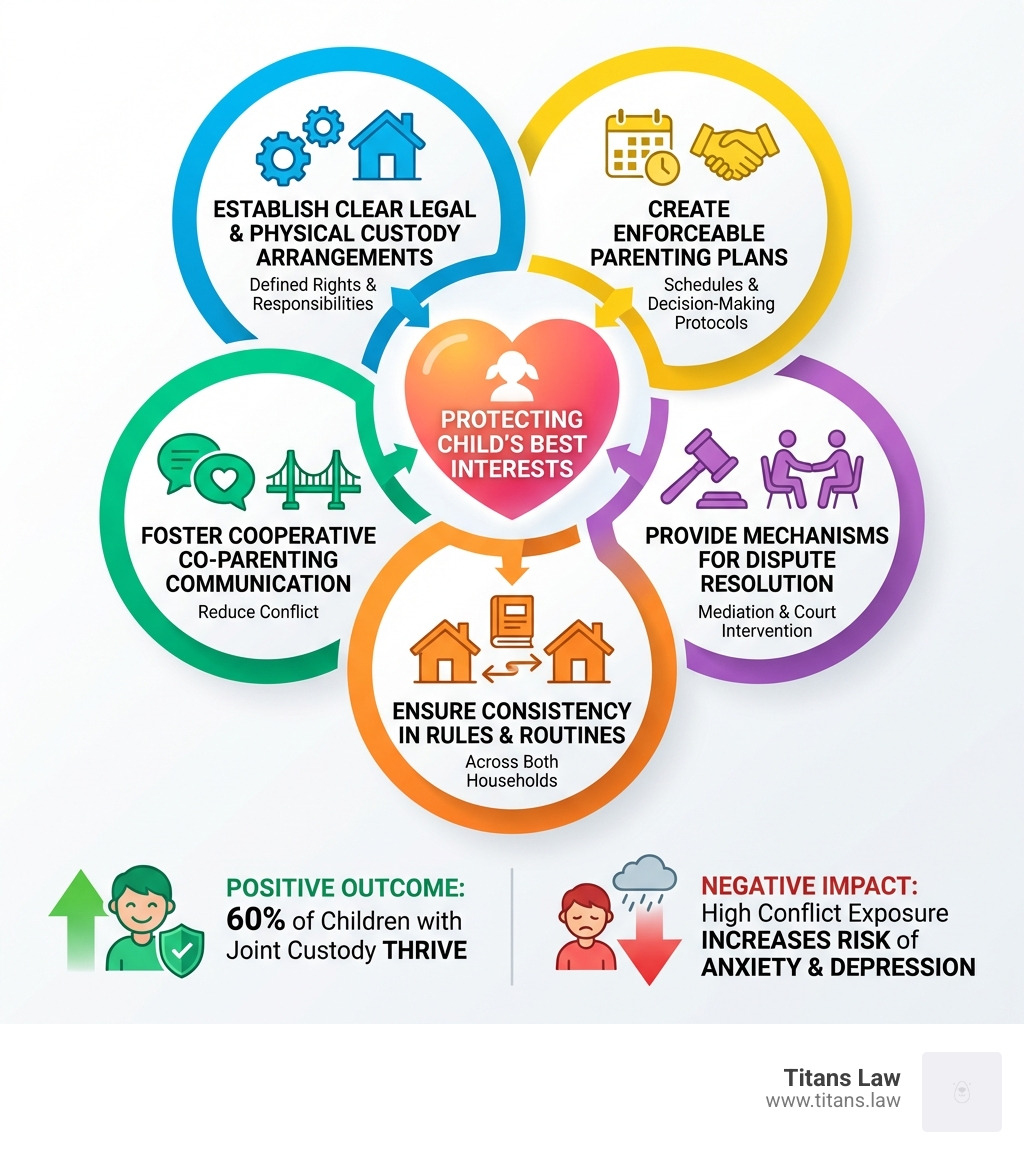
Research shows that approximately 60% of parents with joint custody report that their children are thriving. Conversely, children exposed to ongoing parental conflict face significantly higher risks of depression, anxiety, and behavioral issues. The difference between these outcomes often comes down to one critical factor: having the right strategy and aggressive advocacy when it matters most.
Whether you’re establishing custody for the first time, modifying an existing order, or fighting to protect your parental rights against an uncooperative co-parent, you need solutions that work in the real world—not just in theory. This guide provides the strategic roadmap you need to steer custody challenges, protect your rights, and secure your child’s future.
Understanding the Legal Framework of Child Custody
When parents separate or divorce, one of the most critical aspects we address is establishing clear child custody arrangements. These arrangements define the legal rights and responsibilities each parent has concerning their children. The primary goals of child custody resolutions are always to ensure the child’s well-being, provide stability, and maintain meaningful relationships with both parents, unless circumstances dictate otherwise. Understanding the different types of custody and how they function is the first step in creating effective child custody solutions. For more detailed information on family law, please visit our family law page.
Defining the Types of Custody
Child custody in Florida, and across the United States, generally involves two main components: legal custody and physical custody. These can then be further divided into joint or sole arrangements.
- Legal Custody: This refers to a parent’s right and responsibility to make important decisions about a child’s upbringing. These decisions typically include:
- Health: Medical treatments, choice of doctors, mental health care.
- Education: School enrollment, extracurricular activities, tutoring.
- Religion: Religious upbringing and practices.
- In Florida, courts generally prefer to award shared parental responsibility (joint legal custody), meaning both parents have the right to make these decisions, and they are expected to communicate and agree.
- Physical Custody (Time-Sharing): This determines where the child lives primarily and which parent is responsible for their day-to-day care. In Florida, the term “physical custody” has largely been replaced by “time-sharing” to emphasize that both parents ideally share time with their children.
- Joint Physical Custody (Shared Time-Sharing): This means the child spends significant time living with both parents. It doesn’t necessarily mean a 50/50 split, but rather a schedule that allows both parents to be actively involved in the child’s daily life. Approximately 52% of parents in the U.S. have joint physical custody.
- Sole Physical Custody: In this arrangement, the child lives primarily with one parent, and the other parent typically has a visitation schedule. This is usually ordered when one parent is deemed unable to provide a stable environment or if there are concerns about the child’s safety with that parent.
To illustrate the differences, here’s a table comparing these custody types:
| Feature | Legal Custody (Decision-Making) | Physical Custody (Time-Sharing) |
|---|---|---|
| Joint | Both parents share the right to make major decisions. | Child lives significant time with both parents, often on a schedule. |
| Sole | One parent has the exclusive right to make major decisions. | Child lives primarily with one parent; the other has visitation. |
| Key Focus | Long-term welfare, education, healthcare, religious upbringing. | Day-to-day care, residence, daily routine. |
For general legal definitions of child custody, you can refer to resources like Cornell Law School’s Wex.
The Role of a Parenting Plan
In Florida, every child custody case requires a comprehensive parenting plan. This document is the cornerstone of effective child custody solutions, outlining how parents will share parental responsibilities and time-sharing. It’s more than just a schedule; it’s a detailed roadmap for co-parenting. A parenting plan typically addresses:
- Visitation Schedules (Time-Sharing Schedule): Specific dates and times when the child will be with each parent, including regular weekdays, weekends, holidays, and school breaks.
- Holiday and Vacation Planning: How special days and extended breaks will be divided, often alternating years or splitting time.
- Communication Protocols: How parents will communicate with each other regarding the child (e.g., email, phone calls, co-parenting apps) and how each parent will communicate with the child when they are with the other parent.
- Decision-Making Processes: How major decisions regarding the child’s education, health care, and religious upbringing will be made, especially in cases of shared parental responsibility where agreement is expected.
- Transportation: Who is responsible for picking up and dropping off the child for time-sharing exchanges.
- Other Matters: Can include provisions for extracurricular activities, travel, and access to school and medical records.
A well-crafted parenting plan minimizes future disputes by anticipating common co-parenting challenges. It provides clarity and stability for the children, which is paramount. For more specific information on developing these plans, visit our child custody page.
Navigating the Legal System for Child Custody Solutions
When parents cannot agree on a parenting plan, or if there are significant disputes, the court system becomes involved to establish or modify child custody solutions. This process can be complex, and understand how courts in Florida approach these sensitive matters.

How Courts Determine the “Best Interest of the Child”
The guiding principle for all child custody decisions in Florida is the “best interest of the child.” This isn’t just a legal phrase; it’s a comprehensive standard that courts use to evaluate every aspect of a proposed custody arrangement. When making decisions, judges consider a multitude of factors to determine what environment and care will best promote the child’s welfare.
Here’s a list of factors Florida courts commonly consider, which are similar to those in other states:
- The capacity and disposition of each parent to facilitate and encourage a close and continuing parent-child relationship, to honor the time-sharing schedule, and to be reasonable when changes are required.
- The anticipated division of parental responsibilities after the litigation, including the extent to which parental responsibilities will be delegated to third parties.
- The capacity and disposition of each parent to provide a consistent routine for the child, such as daily schedules for homework, meals, and bedtime.
- The capacity and disposition of each parent to be informed of the circumstances of the minor child, including, but not limited to, the child’s friends, teachers, medical care providers, daily activities, and favorite things.
- The geographic viability of the parenting plan, with special attention paid to the needs of school-age children and the amount of time to be spent traveling to effectuate the parenting plan.
- The moral fitness of the parents.
- The mental and physical health of the parents.
- The home, school, and community record of the child.
- The reasonable preference of the child, if the court deems the child to be of sufficient intelligence, understanding, and experience to express a preference.
- The capacity and disposition of each parent to protect the child from the effects of ongoing parental conflict and to act in the best interest of the child rather than acting in their own self-interest.
- The developmental needs of the child and the capacity and disposition of each parent to meet those needs.
- Any evidence of domestic violence, child abuse, abandonment, or neglect.
- Any history of substance abuse by either parent.
- Any other factor that the court deems relevant to the determination of a specific parenting plan.
The Legal Process for Custody Orders
Establishing or modifying child custody orders involves a series of legal steps. While the specifics can vary, the general process in Florida typically includes:
- Filing a Petition: The process begins when one parent files a petition with the court, requesting the establishment or modification of a parenting plan and time-sharing schedule.
- Serving Papers: The other parent must be formally served with the legal documents, informing them of the court action.
- Mediation Requirements: In Florida, courts often mandate that parents attend mediation to attempt to reach an agreement on a parenting plan before a judge makes a decision. This is a crucial step in many child custody solutions, allowing parents to collaboratively create terms.
- Findy: Both parents exchange information and documents relevant to the case, such as financial records, medical records, and school reports.
- Temporary Orders: In some cases, the court may issue temporary orders for time-sharing and parental responsibilities while the case is ongoing, providing immediate stability for the child.
- Court Hearings: If mediation is unsuccessful, the case proceeds to court hearings, where a judge will hear evidence and arguments from both sides.
- Final Judgments: The judge issues a final order, detailing the parenting plan, time-sharing schedule, and parental responsibilities.
Navigating this legal landscape requires a clear understanding of the process and aggressive advocacy. When circumstances change, existing orders may need to be modified. For more information on modifying orders, we invite you to visit our modifications page. You can also review an example of a state’s self-help custody guide to understand the types of resources available for legal processes.
Collaborative Strategies for Co-Parenting Success
Beyond the legal framework, the long-term success of any child custody solution hinges on the parents’ ability to co-parent effectively. Cooperative co-parenting is not just a nice idea; it’s a critical factor in a child’s mental and emotional well-being. Children whose parents maintain a cooperative co-parenting relationship are more likely to thrive, showing better adjustment and fewer emotional issues. We believe that even amidst divorce, focusing on collaborative strategies can transform conflict into constructive action for your children. For more insights on navigating divorce, explore our divorce proceedings page.

Mediation as a Path to Amicable Child Custody Solutions
Mediation plays a vital role in fostering collaboration and reaching amicable child custody solutions, especially in high-conflict cases. In Florida, mediation is often a mandatory step before a custody dispute goes before a judge.
- Role of a Neutral Third-Party: A mediator is a trained, neutral third party who facilitates communication between parents, helping them identify common ground and negotiate a mutually acceptable parenting plan. The mediator does not make decisions but guides the discussion.
- Benefits of Mediation:
- Cost-Effectiveness: Mediation is generally less expensive than litigation, saving parents significant legal fees.
- Control Over Outcomes: Parents have more control over the terms of their parenting plan, rather than a judge imposing a decision. This often leads to greater satisfaction and compliance.
- Confidentiality: Discussions in mediation are confidential, encouraging open and honest communication.
- Improved Communication: The process itself can teach parents valuable communication skills, which are crucial for future co-parenting.
- High-Conflict Case Strategies: For high-conflict custody cases, mediation can be particularly beneficial. In some situations, courts may also appoint a parenting coordinator or therapist as a third-party to help manage ongoing disputes. A parenting coordinator’s role is often to help parents implement the parenting plan, resolve minor disputes, and make decisions within their scope of authority, which can be enforceable as a court order. This outside intervention can be a lifesaeline for children caught in continuous parental conflict, helping to ensure they are not placed in the middle.
Effective Communication and Conflict Resolution
Children exposed to conflict between co-parents are more likely to develop issues such as depression, anxiety, or ADHD. Therefore, effective communication is not just a courtesy; it’s a necessity for your child’s health. We equip parents with strategies to improve communication and handle disagreements maturely.
- Business-Like Communication: Treat co-parenting interactions like a business partnership focused on your children. Keep emotions out of it, focus on facts, and discuss logistics.
- Active Listening: Truly hear what your co-parent is saying, even if you disagree. This shows respect and can de-escalate tension.
- Using “I” Statements: Instead of “You always…”, try “I feel concerned when…”. This shifts focus from blame to personal feelings and needs.
- Avoiding Blame: Finger-pointing is unproductive. Focus on finding solutions for the children, not on who is at fault for past issues.
- Setting Boundaries: Establish clear rules for communication (e.g., no yelling, no discussing sensitive topics in front of children, specific times for calls). If safety is a concern, especially in situations involving domestic violence, it’s crucial to understand your rights and how to protect yourself and your children. Our protective orders page provides important information on this.
- Compromise: Co-parenting requires flexibility. Be willing to make concessions for the sake of your child’s stability and happiness. Not every issue is worth fighting over.
- Keep Children Out of Conflict: Never use your children as messengers, confidantes, or pawns in your disputes. This puts an immense emotional burden on them and can severely damage their well-being.
Creating Consistency Between Two Homes
Children thrive on predictability and routine. A key aspect of successful child custody solutions is establishing consistency in rules, discipline, and schedules across both households. This creates a stable environment, reduces anxiety, and helps children adapt to having two homes.
- Consistent Rules: While not every rule needs to be identical, agreeing on core expectations (e.g., homework time, screen time limits, respect for elders) helps children understand boundaries and reduces opportunities for them to play one parent against the other.
- Discipline Strategies: Discuss and agree upon general approaches to discipline. This doesn’t mean you have to punish identically, but a shared philosophy helps children understand consequences.
- Shared Schedules: Coordinate school events, medical appointments, extracurricular activities, and bedtimes where possible. A shared digital calendar can be invaluable for this.
- Managing Transitions: Making transitions between homes as smooth as possible is crucial for children.
- Preparation: Help children pack their belongings and prepare mentally for the switch.
- Positive Attitude: Both parents should maintain a positive and calm demeanor during exchanges, avoiding conflict in front of the child.
- Low-Key Returns: When a child returns, allow them space to readjust and avoid immediately prying for details about their time with the other parent.
- Essentials at Both Homes: Have basic necessities (clothes, toiletries, favorite toys) at both residences to minimize packing stress.
- Smoother Visitations: By maintaining consistent routines and communication, visitations become less stressful events and more natural parts of the child’s life. This minimizes disruptions and reinforces the idea that both homes are safe and loving environments.
Practical Tools and Resources for Modern Co-Parenting
Numerous tools and resources are available to help parents steer the complexities of co-parenting, making child custody solutions more manageable. From apps that streamline communication to professional services that offer guidance, these resources can significantly reduce conflict and improve cooperation.
Practical Tools and Resources for Modern Child Custody Solutions
Technology has revolutionized how co-parents can interact, offering platforms designed to foster transparency and accountability.
- Co-Parenting Apps: Applications like OurFamilyWizard are designed specifically for co-parents. They offer a suite of features to manage various aspects of co-parenting:
- Shared Calendars: Organize time-sharing schedules, appointments, and activities in one central location, accessible to both parents.
- Expense Tracking Tools: Easily log shared expenses, attach receipts, and request reimbursements, which can be crucial for managing financial issues in co-parenting. This ties directly into child support obligations, which you can learn more about on our child support page.
- Documented Messaging: All communications are recorded and time-stamped, providing a clear, tamper-proof record. This can be invaluable in high-conflict situations or if court intervention becomes necessary. OurFamilyWizard boasts that it’s accepted by courts in all 50 states and has been used by over 1,000,000 parents and professionals.
- ToneMeter: Some apps even include AI-powered tools like ToneMeter, which can flag emotionally charged language in messages and suggest more neutral wording, helping parents improve communication with their co-parent.
- Virtual Visits: These are video calls or online interactions between a parent and child. They are appropriate and often encouraged when:
- Parents live far apart, making in-person visits difficult or expensive.
- One parent is traveling or deployed (e.g., military service).
- There are safety concerns that necessitate supervised in-person visits, but unsupervised virtual contact is deemed appropriate.
- The court orders them as part of a time-sharing schedule.
Virtual visits help maintain the parent-child bond and ensure children can regularly connect with both parents, making transitions and visitation smoother, especially when physical presence isn’t possible.
Seeking Professional Support
Sometimes, even with the best intentions and tools, parents need external help to steer particularly challenging situations or to improve their co-parenting dynamic.
- Family Counseling: A family therapist can provide a neutral space for parents and children to address emotional issues stemming from separation or divorce. They can help children process their feelings and teach parents strategies for supporting their children through transitions.
- Child Therapists: If a child is struggling with anxiety, depression, or behavioral issues related to parental separation or conflict, a child therapist can provide specialized support custom to their age and developmental stage. You can find licensed therapists through services like BetterHelp.
- Parenting Coordinators: As mentioned earlier, a parenting coordinator (PC) is often appointed by the court in high-conflict cases to help parents implement their parenting plan, resolve minor disputes, and improve communication. Their decisions can be binding, offering a structured approach to conflict resolution.
- Legal Services: When disputes are significant, or if one parent is not adhering to court orders, legal representation is essential. An experienced family law attorney can provide strategic advocacy, steer complex legal procedures, and protect your parental rights. This is especially true in complex financial situations, such as those discussed on our high-asset divorce page, where child custody can become intertwined with significant financial implications.
These resources provide a robust support system for parents committed to finding the best child custody solutions for their families.
Conclusion: Securing Your Child’s Future
Navigating child custody can feel like a daunting journey, but with the right approach and resources, it’s possible to achieve stable and nurturing outcomes for your children. We’ve explored the primary goals of child custody solutions: prioritizing the child’s best interests, establishing clear legal and physical custody arrangements, and fostering cooperative co-parenting. From understanding the nuances of legal and physical custody to leveraging the power of mediation and modern co-parenting tools, a comprehensive strategy is key.
The long-term benefits of a stable, conflict-free parenting plan are immeasurable for your child’s emotional health and development. Children whose parents can effectively co-parent are more secure, consistent, and better equipped for a healthy future. However, we understand that achieving this ideal can be challenging, especially when emotions run high or one parent is uncooperative.
When the stakes are high, and your child’s future is on the line, you need more than just information—you need strategic advocacy. We, at Titans Law, are a civil litigation firm known for delivering aggressive, results-driven representation in complex disputes. We combine hard-hitting advocacy with genuine empathy, understanding that every case carries significant personal and financial consequences. Our experienced attorneys develop custom legal strategies designed to protect your interests and achieve decisive outcomes, whether at the negotiating table or in the courtroom.
If you are facing complex custody disputes, struggling to establish a fair parenting plan, or need to modify an existing order, knowing when to seek legal representation is crucial. We are here to fight for your rights and ensure your child’s well-being. Don’t steer these waters alone.
Contact our family law attorneys for a consultation today to discuss your specific situation and learn how we can help you secure your child’s future.