
Why Protection Orders Can Destroy Your Life—and Why You Need the Right Lawyer Now
Across the country, individuals in high-stakes business and property disputes are served with civil protective orders that carry devastating, criminal-level consequences. In jurisdictions such as Pennsylvania, these are known as Protection from Abuse (PFA) orders. Defending against them requires a civil litigation attorney with trial experience.
How to Find a Qualified Defense Attorney:
- Search for civil litigation firms with extensive trial experience, not practices that handle routine civil matters.
- Verify courtroom credentials – your attorney must know the rules of evidence and how to aggressively cross-examine witnesses.
- Use professional resources – services like the Pennsylvania Bar Association’s Find a Lawyer can refer you to vetted attorneys, but you must still assess their litigation focus.
- Assess their approach – you need a lawyer who treats your case as the high-stakes civil dispute it is.
Being served with a protective order is a serious legal attack. You can be evicted from your property, your firearms can be seized, and the order may appear on background checks, threatening professional licenses and business interests. A final order can last for years and be extended based on mere allegations.
These orders are often issued ex parte—based on one person’s testimony without you being present. The burden of proof is low, and false accusations are common tactical weapons in business and property conflicts. You need a litigation attorney who knows how to dismantle weak testimony, expose ulterior motives, and build an aggressive defense from day one.
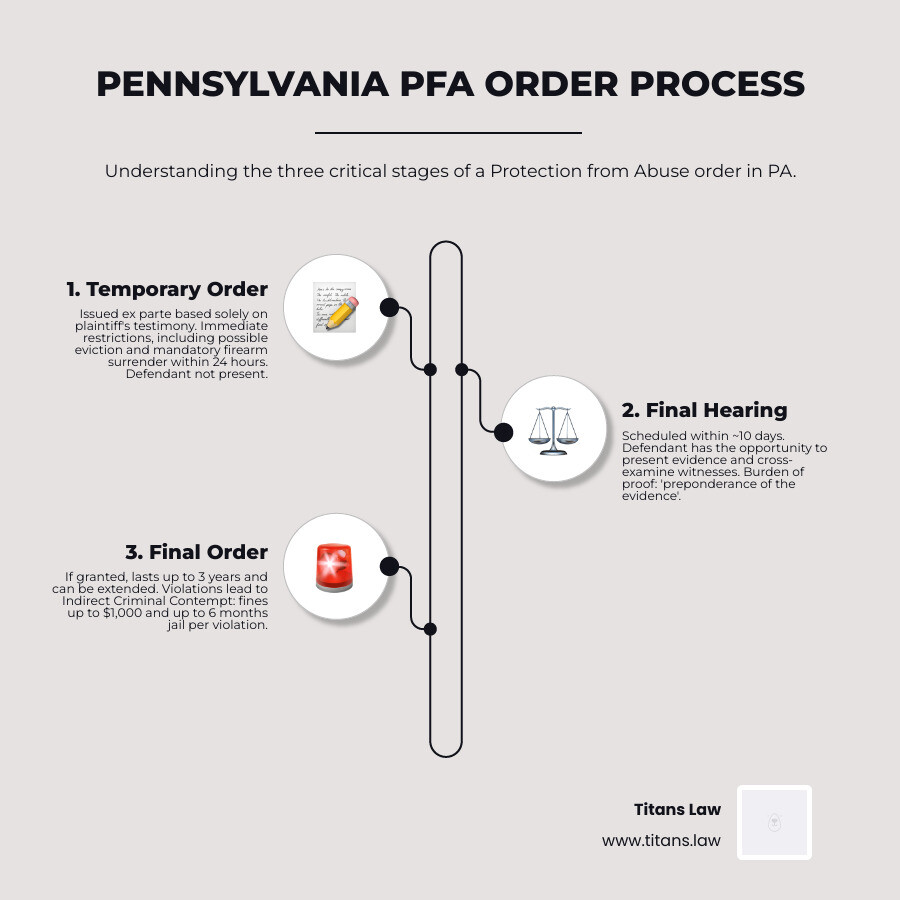
Understanding Protection from Abuse (PFA) and Other Restraining Orders
When facing allegations that could lead to a protective order, it’s crucial to understand the legal instruments involved. For individuals and businesses caught in high-stakes disputes, distinguishing between different types of orders is vital.
What is a PFA (Protection from Abuse) order in Pennsylvania?
Protective orders are civil court orders intended to prevent harm. While laws vary by state, Pennsylvania’s Protection from Abuse (PFA) Act provides a clear example of how these orders function. A PFA is a civil matter, not a criminal charge, and the burden of proof is a lower “preponderance of the evidence” standard. This means a judge only needs to believe it is “more likely than not” that the alleged conduct occurred.
While designed for specific domestic relationships, these orders are frequently weaponized to gain leverage in property disputes or business separations involving co-habitants. The definition of abuse can be broad, including not just physical harm but also a course of conduct that places a person in reasonable fear of it. Understanding this scope is paramount for defending against their tactical misuse in civil litigation.
What is the difference between a PFA order and a general restraining order?
The primary distinction lies in the relationship between the parties. A PFA-type order requires a specific prior relationship (e.g., co-habitants). Conversely, a general civil restraining order has a much broader application and can be issued against anyone—business partners, co-workers, competitors, or strangers—who poses a threat of harassment, violence, or interference with business operations.
For clients in complex commercial litigation, this distinction is critical. A general restraining order can be a tool for asset protection, while defending against a PFA-type order requires navigating laws intended for domestic situations, even when the true motive is financial. Titans Law regularly deals with these issues in high-stakes disputes for clients based in Florida and throughout the United States.
Who can be subject to a protective order?
Understanding who can be subject to each type of order is fundamental to both seeking and defending against them, especially in high-stakes civil and commercial disputes.
| Feature | Pennsylvania PFA Order | General Civil Restraining Order |
|---|---|---|
| Relationship | Required: Parties must have a specific prior relationship, such as having resided together. | Not required: Can be issued against anyone, including business partners, employees, or competitors. |
| Applicable Conduct | “Abuse” (physical injury, threats, or a course of conduct creating fear of injury). | Broader scope, including harassment, stalking, property damage, or interference with business. |
| Enforcement | Violation is typically a criminal offense (Indirect Criminal Contempt) with potential jail time. | Violation is typically civil contempt, leading to fines or other court sanctions. |
The Severe Consequences of a Protective Order
Being served with a protective order carries profound and immediate consequences that extend far beyond the courtroom. For individuals with professional licenses, significant assets, or business interests, these orders can inflict severe reputational and financial damage. We approach these matters as high-stakes civil litigation because that is what they are.
What are the immediate consequences of being served with a PFA order?
The moment you are served, drastic consequences can take effect without you having a chance to present a defense. These are not minor inconveniences; they are substantial restrictions on your rights.

An order can immediately prohibit all contact with the plaintiff, even through third parties. It can also result in your eviction from a property you own or lease, disrupting your life and potentially your business operations. Furthermore, a judge can order the immediate surrender of all firearms and ammunition, typically within 24 hours. Any violation of these terms can lead to immediate criminal charges.
How does a PFA affect firearm ownership and concealed carry permits?
The impact on firearm ownership is severe. A temporary order can mandate the immediate surrender of all firearms. If a final order is granted, it is considered a “qualifying protective order” under federal law. This triggers a nationwide federal prohibition on possessing, purchasing, or transporting firearms or ammunition for the duration of the order.
This federal disqualification will result in the revocation of any concealed carry permit and can end a career for any professional who requires a firearm for their job. Given the serious U.S. Constitution’s Second Amendment implications, a vigorous defense is essential.
How long does a PFA order last and can it be extended?
The timeline for these orders creates long-term legal exposure.
- Temporary Order: Issued ex parte (with only the plaintiff present), this order lasts until the final hearing, usually within 10 business days.
- Final Order: If granted after a full hearing, a final order can last for up to three years.
- Extensions: A plaintiff can petition the court to extend the order, alleging new conduct or a continued threat. Each extension can add up to another three years, creating the potential for a semi-permanent restriction on your rights and reputation.
This threat of repeated extensions underscores the need for a robust defense at the initial hearing to prevent a final order from ever being entered.
How to Find PFA Lawyers Near Me and Build a Strong Defense
When facing a protective order, you need a seasoned civil litigator who understands how to aggressively defend against allegations that could decimate your reputation and financial interests. Finding the right PFA lawyers near me means seeking a firm with a proven track record in high-stakes civil litigation.
Titans Law represents clients in complex commercial and protective-order disputes arising in Florida and in significant matters nationwide. Even when an order is issued in another state, the fallout often hits assets, business relationships, and licensing in the jurisdictions where you live and operate.
What is the role of a lawyer in defending against false accusations?
In a PFA case, especially one rooted in false accusations or tactical maneuvering, a skilled litigation attorney’s role is aggressive and multifaceted. We treat these as strategic attacks with significant commercial or reputational implications.

Our primary role is to dismantle the plaintiff’s case. This involves:
- Challenging Testimony: Rigorous cross-examination to expose inconsistencies, contradictions, and fabrications.
- Exposing Ulterior Motives: Investigating the context of the filing to reveal tactical motivations, such as gaining leverage in a business or property dispute.
- Filing Counter-Claims: Exploring actions against the plaintiff for malicious prosecution or abuse of process to demonstrate a proactive, aggressive defense.
- Trial Advocacy: Preparing and executing a forceful courtroom strategy to present our client’s case, challenge the plaintiff’s evidence, and secure a decisive outcome.
What should I do if I am falsely accused in a PFA case?
Being falsely accused demands a strategic and immediate response. Your actions in the first few days are critical.
- Comply with the Temporary Order: Do not violate any provision of the order. Any violation can lead to immediate arrest for Indirect Criminal Contempt.
- Cease All Contact: Do not contact the plaintiff or any protected individuals, directly or indirectly. This is a strict no-contact rule.
- Preserve Evidence: Immediately gather all evidence that supports your defense, including emails, texts, security footage, financial records, and witness information.
- Secure Experienced Legal Counsel: This is the most crucial step. Do not face a PFA hearing alone. You need aggressive representation from a civil litigation firm. For more on how we handle complex legal challenges, see more info about our civil litigation services.
How can I find qualified pfa lawyers near me?
Finding qualified lawyers requires a discerning approach, especially when your professional reputation and assets are at risk.
- Seek Civil Litigation Firms: Prioritize firms specializing in high-stakes civil litigation, not those focused on routine civil matters.
- Verify Trial Experience: Your attorney must be an experienced trial lawyer. PFA hearings are adversarial proceedings where aggressive cross-examination and mastery of evidence are critical.
- Assess Their Mindset: A firm that understands the tactical misuse of PFA orders in business and property disputes will be better equipped to defend you.
- Use Professional Resources: While services like the Pennsylvania Bar Association’s Find a Lawyer service provide referrals, you must still vet attorneys for the specific litigation expertise your case demands.
If you operate or hold assets in Florida or elsewhere in the United States, align your search with firms that regularly handle multi-jurisdictional, business-focused protection-order matters, such as Titans Law.
The Legal Process: Challenging, Appealing, and Expunging a PFA
Navigating a PFA case involves distinct legal stages, each demanding aggressive engagement to protect your rights and reputation.
What is the process for challenging or appealing a PFA order?
The legal process for fighting a protective order is complex and deadline-driven. While procedures vary by jurisdiction, the stages generally include a final hearing and potential appeals.
- The Final Hearing: This is your primary opportunity to challenge the allegations. Through your attorney, you can present evidence and cross-examine the plaintiff to show they have not met their burden of proof. The record created here is the foundation for any appeal.
- Post-Trial Motions & Appeals: If a final order is issued, the legal battle is not necessarily over. For example, in Pennsylvania, a defendant has only 10 days to file a Motion for Reconsideration with the trial judge. Following that, there is a strict 30-day deadline to file a Notice of Appeal to the Superior Court. An appeal asks a higher court to review the trial court’s decision for legal errors. Missing these deadlines can forfeit your right to challenge the order.
Can a PFA order be expunged from one’s record, and how?
Yes, but it is not an automatic process. The presence of a PFA in civil court records can damage employment and professional opportunities. Expungement removes the record from public access.
The process begins by filing a Petition to Expunge. Eligibility typically depends on the case’s outcome:
- You may be eligible if the PFA petition was denied after a final hearing.
- You may be eligible if the plaintiff withdrew the petition.
- In some cases, an expired order may be eligible, though this is more challenging.
A judge will hold a hearing to decide on the petition. Skilled legal representation is required to make a compelling case for expungement.
What are the penalties for filing a false PFA in Pennsylvania?
Filing a false PFA is a serious offense. A plaintiff who knowingly provides false testimony under oath can face severe criminal charges and civil liability.
- Criminal Charges: Potential charges include Perjury (up to 7 years in prison), False Swearing (up to 2 years in jail), and False Reports to Law Enforcement (up to 2 years in jail).
- Civil Liability: A defendant may file a civil lawsuit against the plaintiff for malicious prosecution or abuse of process. This action seeks compensation for damages caused by the false PFA, including legal fees, lost income, and reputational harm. Our expertise in high-stakes civil litigation is critical in pursuing these claims.
Frequently Asked Questions about Pennsylvania Protection Orders
Understanding the intricacies of protective orders is vital for anyone involved in a high-stakes civil dispute. Here are answers to common questions.
What happens if a PFA includes an eviction order?
An eviction provision requires you to immediately vacate the property. The order is enforced by the local sheriff’s department, and you must comply. The order typically includes a provision for a “civil standby,” where a deputy accompanies you at a scheduled time to retrieve essential personal belongings without contacting the plaintiff. The only way to reverse the eviction is to successfully challenge and defeat the PFA order at the final hearing.
What are the penalties for violating a PFA order?
Violating a PFA is a serious criminal offense, charged as Indirect Criminal Contempt (ICC). The penalties are severe and apply to each individual violation:
- Incarceration: Up to 6 months in jail per violation.
- Fines: Up to $1,000 per violation.
- Criminal Record: A conviction for ICC creates a criminal record, which has devastating long-term consequences for employment and professional licensing.
Intent is often not required to prove a violation. Any prohibited contact, even if unintentional or through a third party, can lead to an arrest.
Can a PFA be filed for verbal or emotional abuse?
Generally, no. While laws like Pennsylvania’s PFA Act are designed to prevent abuse, they set a high legal bar that typical arguments or heated language do not meet. The conduct must usually constitute a “course of conduct” that places the plaintiff in reasonable fear of bodily injury.
Courts often apply a “legitimate purpose test.” Communications that are part of a legitimate business or property dispute, even if contentious, are less likely to be considered abuse. This distinction is critical in defending against the misuse of PFA laws in commercial conflicts. The analysis of whether conduct meets the legal definition of abuse, such as stalking under state or Federal law definitions, requires sophisticated legal argument.
Secure Aggressive Representation for Your High-Stakes Case
A protective order is not a minor legal issue; it is a high-stakes civil matter with the power to inflict lasting damage on your reputation, profession, and financial well-being. When facing such allegations, you need a trial attorney with the strategic acumen and courtroom prowess to protect your rights.
While the laws governing these orders vary by state, the aggressive litigation tactics required to defend against their misuse are universal. Titans Law, based in Florida and handling complex matters across the United States, brings that expertise to high-stakes disputes nationwide. We develop custom legal strategies designed to protect our clients’ interests and achieve decisive outcomes—whether at the negotiating table or in the courtroom.
We are prepared to dismantle weak testimony, expose ulterior motives, and aggressively challenge any allegation that threatens your future. When the stakes are high, Titans Law fights to win.
If you require aggressive, results-driven representation in a complex protective order dispute, contact our firm to discuss your case.