The Growing Threat of Solar Installation Fraud
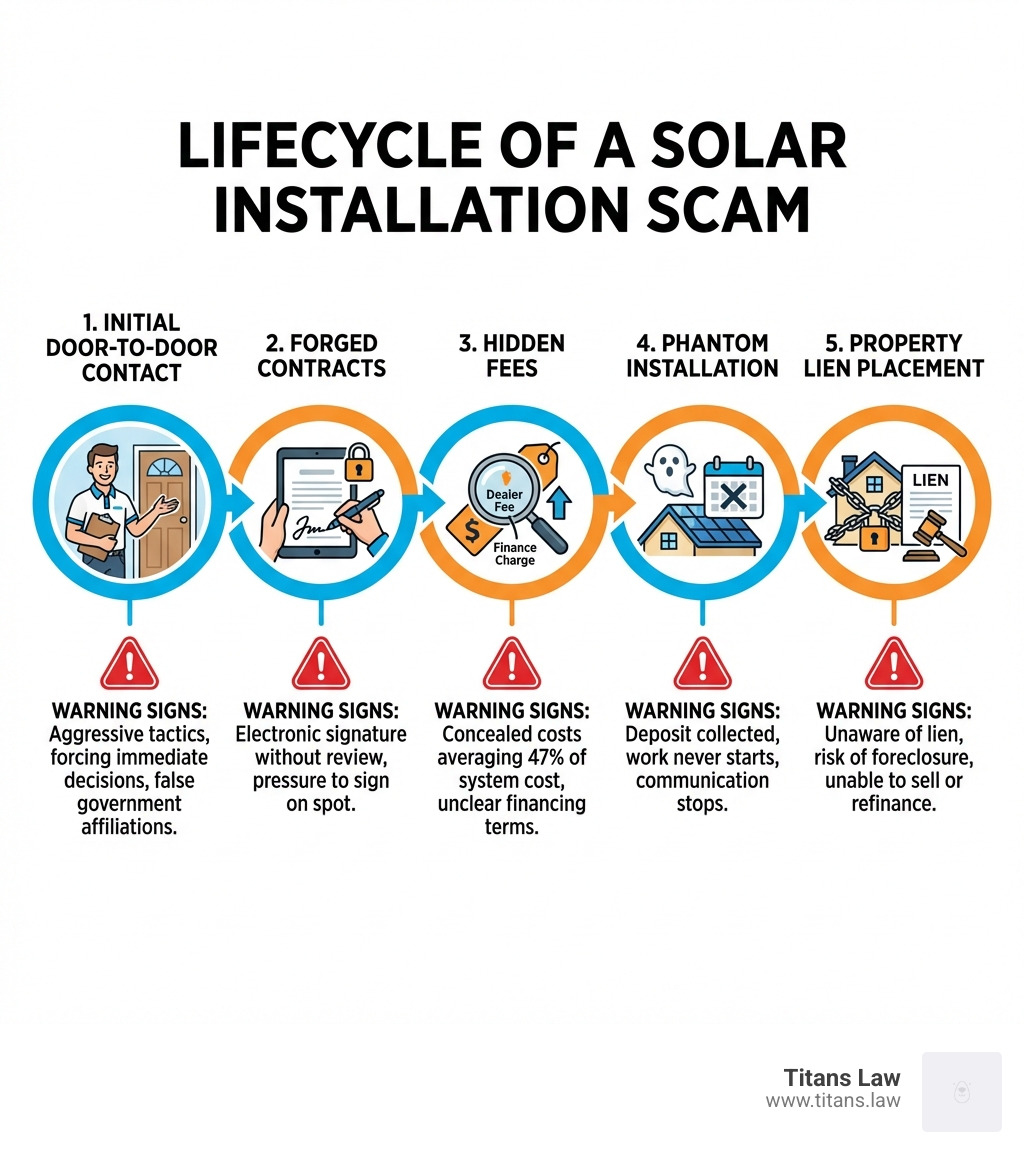
Solar installation fraud is a rapidly expanding criminal enterprise targeting homeowners who want to reduce energy costs and help the environment. These scams involve deceptive sales tactics, forged contracts, misrepresented government incentives, hidden financing fees, and phantom installations that never get completed.
Key Types of Solar Installation Fraud:
- Phantom Installations – Companies collect deposits and disappear without installing panels
- PACE Loan Traps – Hidden property liens that can lead to foreclosure
- Forged Contracts – Signatures faked on financing agreements
- False Incentive Claims – Misrepresentation of tax credits and rebates
- Dealer Fee Schemes – Hidden financing fees averaging 47% of system cost
- High-Pressure Door-to-Door Sales – Aggressive tactics forcing immediate decisions
The solar boom has created opportunity for bad actors. Complaints to the Federal Trade Commission containing the word “solar” increased four-fold over four years. One-star ratings on Solar Reviews surged more than 1,000% since 2018—far outpacing the industry’s actual growth rate.
Emanuel Minto, a 91-year-old homeowner, was told by a door-to-door salesman that he qualified for a government solar program costing just $100 per month. Instead, his payments were four times higher, his signature was allegedly forged on an electronic contract, and a nearly $50,000 lien was placed on his paid-off home.
In Colorado, a statewide grand jury indicted two defendants on 11 counts for allegedly taking hundreds of thousands of dollars in customer payments for solar installations and failing to complete the work. The funds were deposited into company accounts and spent on purposes unrelated to customer projects.
These aren’t isolated incidents. State Attorneys General across multiple jurisdictions are now investigating organized criminal enterprises operating under the guise of legitimate solar businesses.
Understanding how these schemes work is the first step in protecting yourself—or taking legal action if you’ve already been victimized.
Common Tactics and Red Flags of Solar Installation Fraud
The allure of reduced energy bills and environmental stewardship makes solar power an attractive option for many homeowners. Unfortunately, this booming industry has also attracted a darker element: those who seek to exploit enthusiasm through deception and fraud. Solar installation fraud often begins with seemingly innocent contact, escalating rapidly through high-pressure sales and misleading promises.
One of the most common entry points for fraud is through door-to-door sales. These interactions can quickly turn aggressive, pushing homeowners into decisions without adequate time for research or consideration. We’ve seen instances where salespersons claim affiliation with government agencies or utility companies, using these false pretenses to gain trust and access. The FTC’s Impersonation Rule now explicitly targets those who misrepresent affiliations with legitimate businesses or government entities, highlighting the severity of this tactic.

Scammers frequently promise “free” solar panels or drastically exaggerated savings. These offers, which sound too good to be true, invariably come with hidden costs, complex financing structures, or simply never materialize into actual installations. These “phantom installations” are a particularly egregious form of fraud where companies collect substantial deposits, then disappear, leaving homeowners out of pocket and without a single panel installed.
Beyond the initial deceptive pitch, fraudulent schemes can lead to more severe consequences, including identity theft. By collecting personal and financial information under false pretenses, scammers can open accounts, forge signatures, or engage in other illicit activities that compromise a homeowner’s financial security. The Consumer Financial Protection Bureau (CFPB) has warned against misleading statements about the financial benefits of solar and hidden fees, emphasizing the need for vigilance.
The solar industry has seen a significant increase in complaints related to such practices. One-star ratings on Solar Reviews have increased more than 1,000% since 2018. This dramatic rise in dissatisfaction underscores the pervasive nature of these fraudulent tactics.
For further guidance on protecting yourself from deceptive practices, we recommend reviewing FTC guidance on clean energy scams and the BBB warning on phony solar offers.
Identifying Red Flags of Solar Installation Fraud
Recognizing the warning signs is crucial for homeowners considering solar energy. Here are key red flags that should immediately raise suspicion:
- Urgency Tactics: Be wary of salespersons who pressure you to sign a contract “today” or claim a “limited-time offer” that expires instantly. Reputable companies provide ample time for decision-making.
- Unsolicited Visits: While not all door-to-door sales are fraudulent, an uninvited salesperson pushing for immediate decisions is a significant red flag. They often lack the transparency of a company you’ve sought out yourself.
- Vague Contracts: If a contract is difficult to understand, lacks detailed specifications about equipment, installation, or warranties, or contains clauses that are unclear, proceed with extreme caution. Scammers thrive on confusion. Our Contract Drafting Services emphasize clarity and protecting your interests.
- Large Upfront Payments: While a reasonable deposit is standard, be suspicious of requests for unusually large upfront payments, especially if they demand the full amount before any work begins. This can be a tactic used by “fly-by-night” contractors who disappear with your money.
- Forged Signatures: In some alarming cases, scammers have resorted to forging signatures on electronic contracts or impersonating homeowners over the phone to secure agreements. Always verify every document and communication. Attorney General Tong of Connecticut described such complaints as “beyond shocking,” including forged signatures and impersonations.
Trust your instincts. If a deal seems too good to be true, or if you feel uncomfortable or pressured at any point, it’s wise to step back and conduct further research.
The Financial Trap: Misrepresented Incentives and PACE Liens
One of the most insidious aspects of solar installation fraud involves the manipulation of financial information, particularly government incentives and financing options. Homeowners are often eager to capitalize on legitimate programs designed to make solar more affordable, and scammers are quick to exploit this enthusiasm.
Scammers frequently misrepresent federal tax credits, state rebates, and local incentives. They might promise exaggerated savings, claim you qualify for programs you don’t, or even invent non-existent government initiatives. For example, they might assure you of a 30% federal tax credit even if your tax liability doesn’t allow for such a benefit, or promise rebate checks that never materialize. The Consumer Financial Protection Bureau (CFPB) has specifically warned consumers about hidden fees and misleading statements regarding the financial benefits of solar.
Consider the reality versus the scammer’s promise:
| Feature | Legitimate Federal Tax Credit (Investment Tax Credit – ITC) /image.png)
This table illustrates typical discrepancies between legitimate offers and common scam claims.
Beyond initial promises, some financing structures themselves can be a trap. Property Assessed Clean Energy (PACE) loans, while offering low upfront costs, attach a tax lien to your home. This lien takes priority over your mortgage, meaning if you fall behind on payments, your home could be at risk of default or even foreclosure. The CFPB has proposed new consumer protections for clean energy financing, recognizing the complex risks involved. For more on these critical protections, refer to the CFPB proposed protections for clean energy financing.
Another significant financial pitfall is hidden fees, often referred to as “dealer fees” or “loan origination fees.” Statistics from EnergySage show that for the last half of 2023, fees for the most popular solar loan averaged 47% of the cost of a rooftop solar panel installation. This can add thousands of dollars to the overall cost, significantly eroding any promised savings. These fees are often buried in complex loan documents or not clearly disclosed during the sales process.
For reliable information on solar incentives and general guidance, consult the Department of Energy guide for homeowners.
Risks of Solar Leases and Power Purchase Agreements (PPAs)
Solar leases and Power Purchase Agreements (PPAs) present another set of financial complexities that scammers frequently exploit. While often marketed as “no money down” or “free solar,” these agreements involve third-party ownership of the solar system on your roof.
Under a lease or PPA, a company installs and maintains the solar panels, and you either pay a fixed monthly “rent” for the system (lease) or purchase the electricity it generates at a set rate (PPA). The primary pitfall is that you, the homeowner, do not own the system. This means:
- No Tax Credits for You: The federal investment tax credit (ITC) and other incentives typically go to the system owner (the leasing company), not to you. Scammers often fail to clarify this, leading homeowners to believe they will receive these benefits.
- Long-Term Contracts: Leases and PPAs are typically long-term commitments, often 20 to 25 years. These contracts can include escalation clauses, meaning your monthly payments or per-kilowatt-hour rate can increase over time, potentially eroding your savings.
- Home Sale Complications: Selling a home with a leased solar system can be incredibly difficult. Many buyers are hesitant to take on a long-term contract for a system they don’t own, and some lenders may view it as an encumbrance. This can significantly complicate or even derail a home sale.
- Maintenance Neglect: While the leasing company is responsible for maintenance, some disreputable firms may neglect their duties once the contract is signed, leaving you with a underperforming system.
The Treasury Department offers valuable insights into consumer solar awareness, including the nuances of different financing models. We encourage you to review their guidance on Treasury Department consumer solar awareness to make informed decisions.
How to Verify Legitimacy and Protect Your Property
In the face of rising solar installation fraud, proactive verification is your best defense. Before committing to any solar project, thoroughly vet the company and understand the entire scope of the agreement. Just as we conduct rigorous due diligence in high-stakes civil litigation, homeowners must apply a similar level of scrutiny to protect their property and financial well-being.
Start by ensuring that any solar installer you consider holds appropriate licensing and certifications. The North American Board of Certified Energy Practitioners (NABCEP) offers industry-recognized certifications for solar professionals. A reputable company will proudly display these credentials and readily provide proof. You can verify certifications directly through the NABCEP directory of certified professionals.
Never settle for the first quote you receive. Always obtain multiple quotes (we recommend at least three) from different installers. This allows you to compare pricing, system designs, equipment, and proposed savings. Be wary if one quote is significantly lower or higher than the others without clear justification. Each quote should provide an itemized bid, detailing every component, labor cost, permit fee, and warranty. If a company is evasive about providing a detailed breakdown, consider it a red flag.
When reviewing contracts, the devil is in the details. A clear, comprehensive contract is paramount. It should explicitly state the total cost, payment schedule, system specifications, estimated energy production, warranty terms (for panels, inverters, and workmanship), and what happens if the system underperforms. If you find yourself in a situation where contract terms are vague or disputed, our Contract Drafting Services can help ensure your interests are protected from the outset.
Verifying the Legitimacy of a Solar Installation Fraud Prevention Strategy
Protecting yourself from solar installation fraud requires a multi-faceted approach to verifying legitimacy:
- Check State Licensing Boards: In Florida, ensure the company and its contractors are properly licensed. You can typically search these databases online through your state’s Department of Business and Professional Regulation. Unlicensed contractors are a massive risk.
- Review Their Reputation: Use reliable platforms like the Better Business Bureau (BBB). A reputable company will have a history of positive reviews and a transparent record of addressing any complaints. Be cautious of companies with little to no online presence or a pattern of negative feedback.
- Verify Government Incentives Independently: Scammers often promise exaggerated or non-existent government programs. Always research legitimate rebates and tax credits through official sources like the Department of Energy or Energy Star. Never rely solely on a salesperson’s word.
- Ask for References: A legitimate installer should be able to provide references from previous clients. Contact these references to inquire about their experience with the company’s sales process, installation quality, and post-installation support.
- Understand Your Rights: In Florida, understand the Cooling-off Period for door-to-door sales, which typically allows you a few days to cancel a contract without penalty. Do not be pressured into signing on the spot.
By taking these steps, you significantly reduce your vulnerability to solar installation fraud and increase the likelihood of a successful and beneficial solar investment.
Legal Implications and Taking Action Against Solar Installation Fraud
When homeowners fall victim to solar installation fraud, the financial and emotional toll can be devastating. However, it’s crucial to understand that these fraudulent acts often carry severe legal implications for the perpetrators. Our firm, Titans Law, specializes in high-stakes civil litigation, and we are well-versed in navigating the complex legal landscape surrounding such deceptive practices.
The acts committed by fraudulent solar companies can range from civil breaches of contract to serious criminal offenses. As seen in the Colorado indictment, perpetrators can face charges such as racketeering, felony theft, and tax evasion. The Colorado Organized Crime Control Act was invoked in that case, indicating the potential for these schemes to be part of larger, organized criminal enterprises. When hundreds of thousands of dollars in customer payments are diverted for purposes other than the intended projects, the legal consequences are substantial.
In Florida, our attorneys have extensive experience handling contract disputes and civil fraud cases. Whether it’s a matter of a company failing to complete work, installing substandard equipment, or misrepresenting critical terms, these actions can form the basis for powerful legal claims. For victims struggling with such situations, consulting with Civil Litigation Lawyers is a critical first step. Our firm’s Contract Dispute Attorney team is adept at dissecting complex agreements and holding parties accountable for their obligations. The Colorado Attorney General’s report on solar fraud indictments serves as a stark reminder of the criminal penalties that can be pursued in these cases.
Steps to Take if You Are a Victim of Solar Installation Fraud
If you suspect you’ve been a victim of solar installation fraud, swift and decisive action is paramount. Here’s a roadmap of steps to consider:
- Gather Documentation: Collect all contracts, emails, text messages, payment records, sales pitches, and any other relevant communication or documents related to your solar installation. This evidence will be vital for any legal action.
- File a Police Report: If you believe a crime has been committed (e.g., theft, fraud, forgery), file a report with your local law enforcement agency. This creates an official record and can initiate a criminal investigation.
- Report to Federal and State Agencies:
- Federal Trade Commission (FTC): File a complaint with the FTC at Report fraud to the FTC. The FTC tracks these complaints and can take action against fraudulent companies.
- Florida-Specific Resources: In Florida, you can also report scams to Fraud Free Florida and your local Attorney General’s Fraud Hotline at (866) 966-7226.
- Consumer Financial Protection Bureau (CFPB): If the fraud involves financing or loans, report it to the CFPB.
- Notify Financial Institutions: If you provided bank account details or signed up for a loan, immediately contact your bank or credit card company. They may be able to stop payments or offer fraud protection.
- Seek Legal Counsel: This is perhaps the most crucial step. An experienced civil litigation attorney can review your case, assess the viability of a lawsuit, and guide you through the process of seeking compensation for damages, contract rescission, or other remedies. Our firm, Titans Law, offers robust representation for homeowners facing such egregious breaches of trust. For more insights into handling legal disputes in our state, explore When Agreements Go Awry: Handling Contract Disputes in the Sunshine State.
You don’t have to steer these complex legal waters alone. Our firm stands ready to provide the aggressive, results-driven representation needed to combat solar installation fraud.
Frequently Asked Questions about Solar Fraud
What are the real costs of solar installation compared to scam offers?
Legitimate solar installation costs typically encompass the panels, inverter, mounting hardware, wiring, labor, permitting fees, and interconnection costs. A reputable installer will provide a detailed, itemized quote. While the upfront investment can be substantial, the long-term benefits include reduced electricity bills and potential property value increase. The payback period for a quality system is usually 8-15 years, varying by location and energy consumption.
Scam offers, conversely, often promise “free” solar or unrealistic, immediate savings. They may omit crucial costs, bury “dealer fees” (which can average 47% of the loan amount, as noted in recent data), or use misleading financing terms that inflate the total price over time. The “cost” in a scam is often hidden or misrepresented, leading to higher payments, unexpected liens, or a non-existent system.
How do scammers misrepresent the 30% federal tax credit?
The federal solar Investment Tax Credit (ITC) allows homeowners to deduct a percentage (currently 30%) of the cost of installing a solar energy system from their federal taxes. Scammers frequently exploit this by:
- Promising Cash Back: Implying you’ll receive a direct check from the government, regardless of your tax liability. The ITC is a credit, not a refund, and can only reduce what you owe.
- Inflating the Credit: Misrepresenting the percentage or implying it covers more than it does.
- Claiming Universal Eligibility: Suggesting everyone qualifies, even if they don’t own the system (e.g., in a lease or PPA scenario, the company, not the homeowner, receives the credit).
- Burying it in “Free” Offers: Using the credit as justification for a “no-cost” system that actually involves a high-interest loan or a disadvantageous lease.
Always consult a tax professional to understand your eligibility and the true value of any tax credits.
Can a solar company legally place a lien on my home without my knowledge?
No, a solar company cannot legally place a lien on your home without your knowledge or consent, assuming the contract was entered into legitimately. However, fraudulent companies achieve this through deceptive means:
- Forged Signatures: As seen in cases like Emanuel Minto’s, scammers may forge your signature on financing documents, particularly for Property Assessed Clean Energy (PACE) loans. PACE loans automatically attach a tax lien to your property.
- Misleading Contracts: You might unknowingly sign a contract that includes a clause allowing a lien, especially if the document is complex, not fully explained, or presented in a language you don’t understand.
- Non-Payment of Contractors: If the primary solar company hires subcontractors and fails to pay them, those subcontractors might place a mechanic’s lien on your home to secure payment, even if you paid the main company.
If a lien is placed on your home without your consent or through fraudulent means, it is a serious legal matter requiring immediate attention. This is a prime example of a situation where the aggressive and results-driven representation of our Civil Litigation Lawyers can be indispensable.
Conclusion
The promise of solar energy—clean power, reduced utility bills, and a smaller carbon footprint—is a powerful one. Yet, as the industry booms, so too does the dark underbelly of solar installation fraud. From high-pressure sales tactics and misleading financial promises to outright phantom installations and forged contracts, these scams threaten not only homeowners’ finances but also the reputation of a vital industry.
At Titans Law, we understand the significant personal and financial consequences that arise from such deceptive practices. Our firm specializes in high-stakes civil litigation, providing aggressive and results-driven representation to those who have been wronged. We combine strategic, hard-hitting advocacy with a deep understanding of complex disputes to protect our clients’ interests.
If you suspect you have been a victim of solar installation fraud in Florida or elsewhere in the United States, do not hesitate to seek legal counsel. Our Titans Law attorneys are prepared to dissect intricate contracts, pursue damages, and hold fraudulent parties accountable. While some may search for “Titans Law complaints,” our unwavering commitment to ethical practice and achieving decisive outcomes is reflected in our extensive record and positive client testimonials. If you’re wondering “Is Titans Law a scam?”, we invite you to review our transparent approach to high-stakes civil litigation and the success stories that define our firm. Our dedication ensures that your “Titans Law experience” will be one of professional, communicative, and effective legal support.
When the stakes are high, Titans Law fights to win. We encourage you to explore our Practice Areas to learn more about how we can assist you. For insights into what our clients say, we invite you to Read Titans Law reviews. If you have been impacted by solar installation fraud or any other complex business dispute, Contact Titans Law today—we are ready to deliver the decisive outcomes you deserve.